
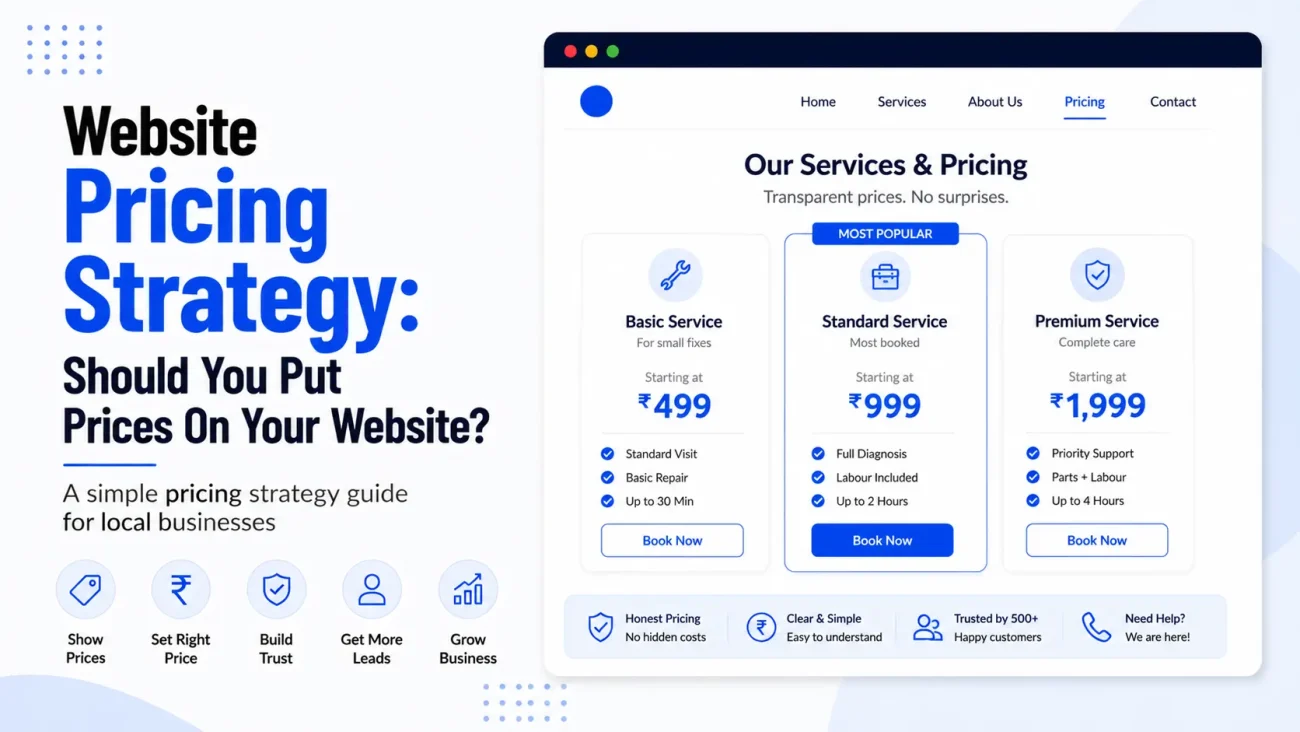
For most local service businesses, the short answer is yes, and the honest answer is that it depends on how predictable your pricing actually is. A website pricing strategy is not a single choice between showing everything and showing nothing, it is a decision about how much certainty you can honestly offer a visitor before they have described their exact job, and getting that decision right matters more in India than almost anywhere else, because here, price is usually the first question, not the last one.
This article walks through why business owners hesitate to show prices, why that hesitation usually costs more than it protects, and how to pick the right amount of pricing detail for a business where the work genuinely does vary from job to job.
Why most businesses hesitate to show prices
The reasons are understandable, and almost every business owner who avoids pricing has a version of one of these in mind. Some worry that a number on the page, seen without any context, will scare a visitor away before they understand what is included in it. Some worry that showing a price hands it straight to competitors, who can then quietly undercut it. Some genuinely believe their work is too variable for a single figure to mean anything, since a blocked drain and a full repiping job are not the same call. And some have simply inherited the habit from an older way of doing business, where “call for a quote” was standard practice long before websites existed at all.
None of these reasons are foolish, and the right approach takes each of them seriously rather than dismissing them. But taken together, they usually lead a business to hide pricing completely, and that is where the real cost shows up.
Why “should I put prices on my website” usually has one answer in India
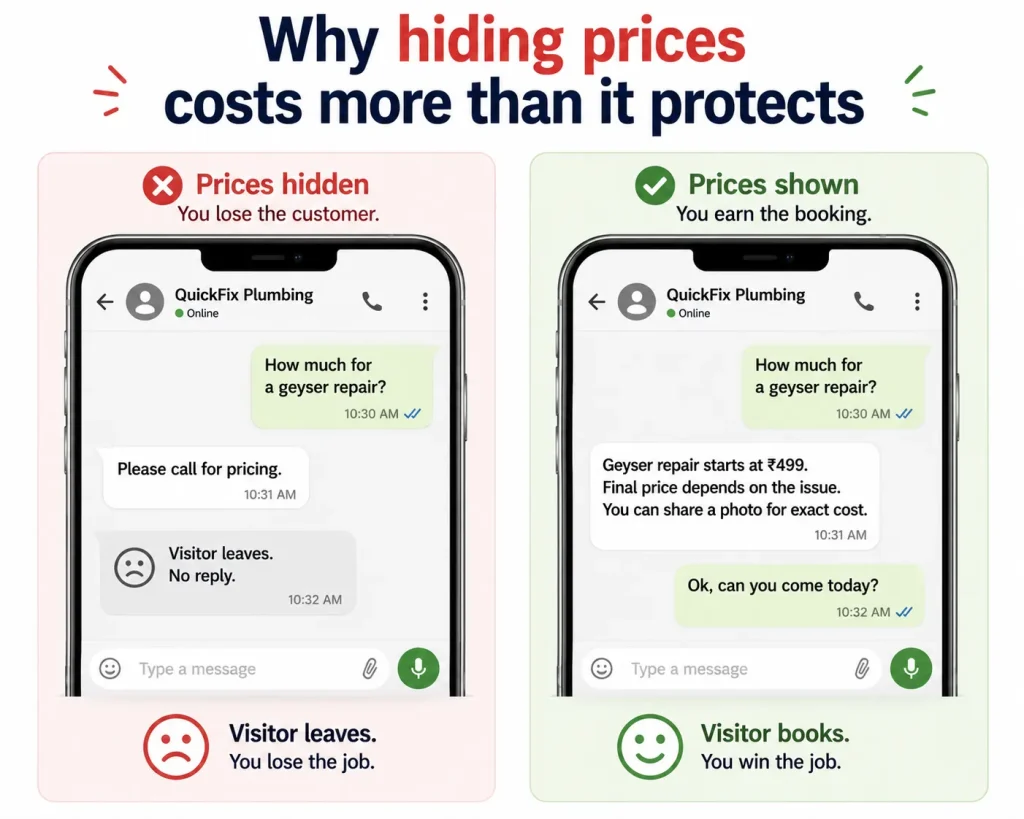
If you have ever asked yourself should I put prices on my website, the fastest way to test it is to imagine the conversation a real visitor has with your site. In India, that conversation almost always starts with the price, and it starts there before the visitor cares who you are, how long you have been in business, or what your process looks like. A composite version of this, based on patterns seen across many WhatsApp enquiries, looks something like this:
Visitor: Hi, do you do AC servicing? Business: Yes, we do. Please call us for pricing. Visitor: [no reply, chat closes]
The visitor did not leave because the price was too high. They left because no price was given at all, and in a market where three other businesses are one search away, a visitor rarely waits around to find out. This is the core reason a website pricing strategy built entirely around hiding numbers tends to underperform in India specifically, even when the exact same strategy is common practice in other countries.
The three real approaches to a website pricing strategy
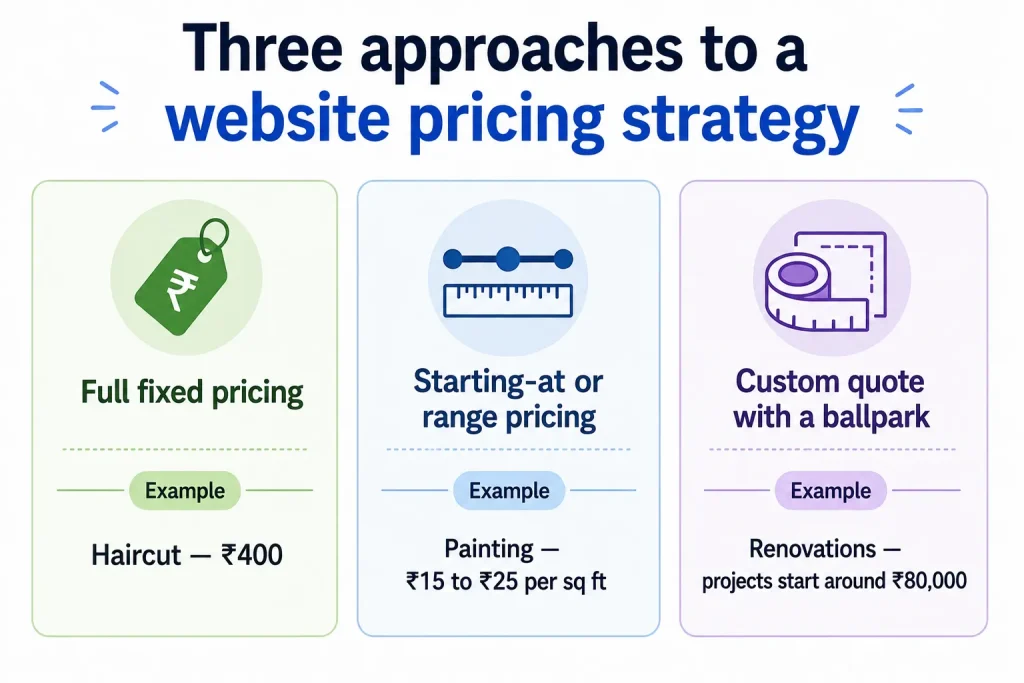
Showing prices is not all-or-nothing, and most of the fear business owners have about pricing comes from imagining only the two extreme ends of it. There are actually three reasonable approaches, and almost every local business fits into one of them.
- Full, fixed pricing. Works well for standardised services where the job barely changes from customer to customer — a haircut, a tuition fee, a standard cleaning package, a fixed inspection charge. If your price genuinely does not move, hiding it protects nothing.
- Starting-at or range pricing. Works well for services where the job varies but falls into a few predictable bands — electrical repairs, painting by room size, pest control by property size. A range gives the visitor a real number to plan around, while leaving room for the final figure to depend on the details.
- Custom quote, with a ballpark shown anyway. Reserved for genuinely bespoke work — a full home renovation, a wedding, a custom furniture order. Even here, showing nothing at all is rarely the right call. A line such as “most of our projects start around ₹80,000” still gives a visitor something to plan against, without pretending a fixed price is possible.
How to decide which website pricing strategy fits your business
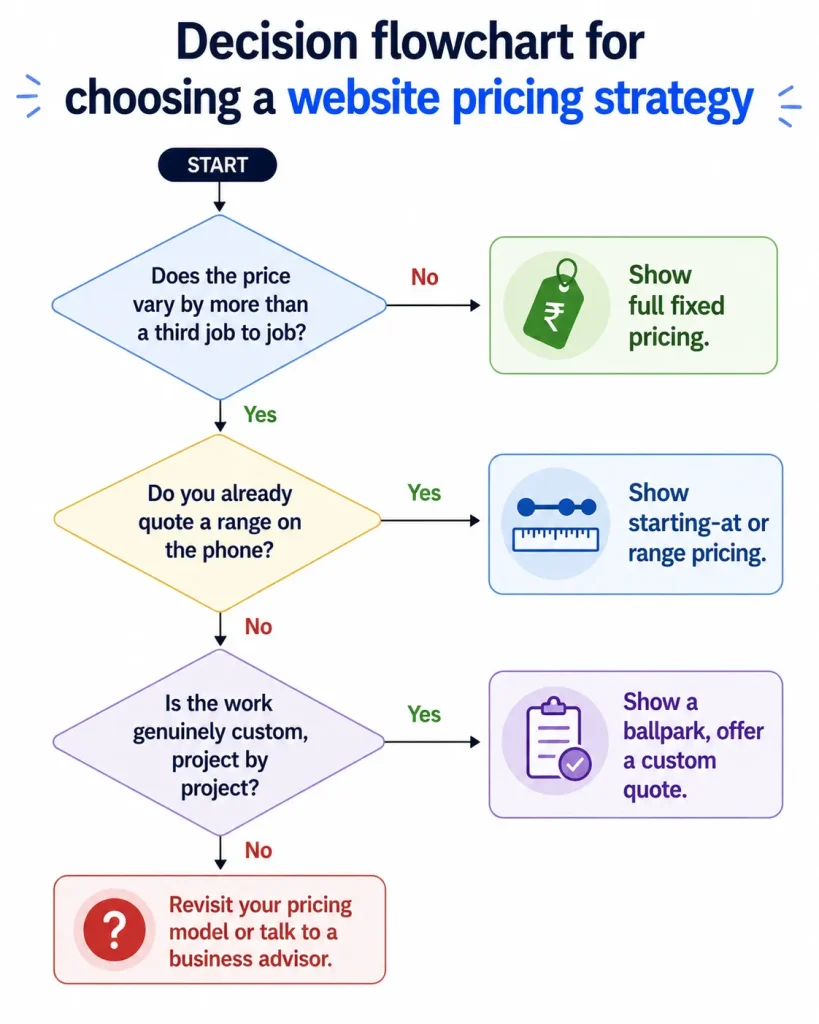
Working out the right approach for your own business is usually a matter of answering three honest questions, rather than guessing at what feels safest. This is really the practical version of the bigger question — should small businesses show prices at all — and it becomes much easier to answer once you stop treating it as one decision and start treating it as three smaller ones.
Ask first whether the price for the same service can swing by more than about a third from one customer to the next. If it rarely does, you are closer to full fixed pricing than you think, even if it feels risky to commit a number to writing. Ask second whether you already give a range verbally on the phone before you have seen the job, since if you are comfortable saying “usually between X and Y” out loud, there is no real reason that same range cannot sit on the page. Ask third whether a visible price would attract the wrong kind of customer, such as one expecting corners to be cut to hit a low number, and if that is a genuine risk, a starting-at figure paired with a short line on what is included usually solves it better than hiding the number entirely.
What to write when you cannot give an exact price
Even businesses doing genuinely custom work can practise website price transparency without promising a number they cannot honestly give. The goal is to replace silence with a range, not to replace a range with a false certainty.
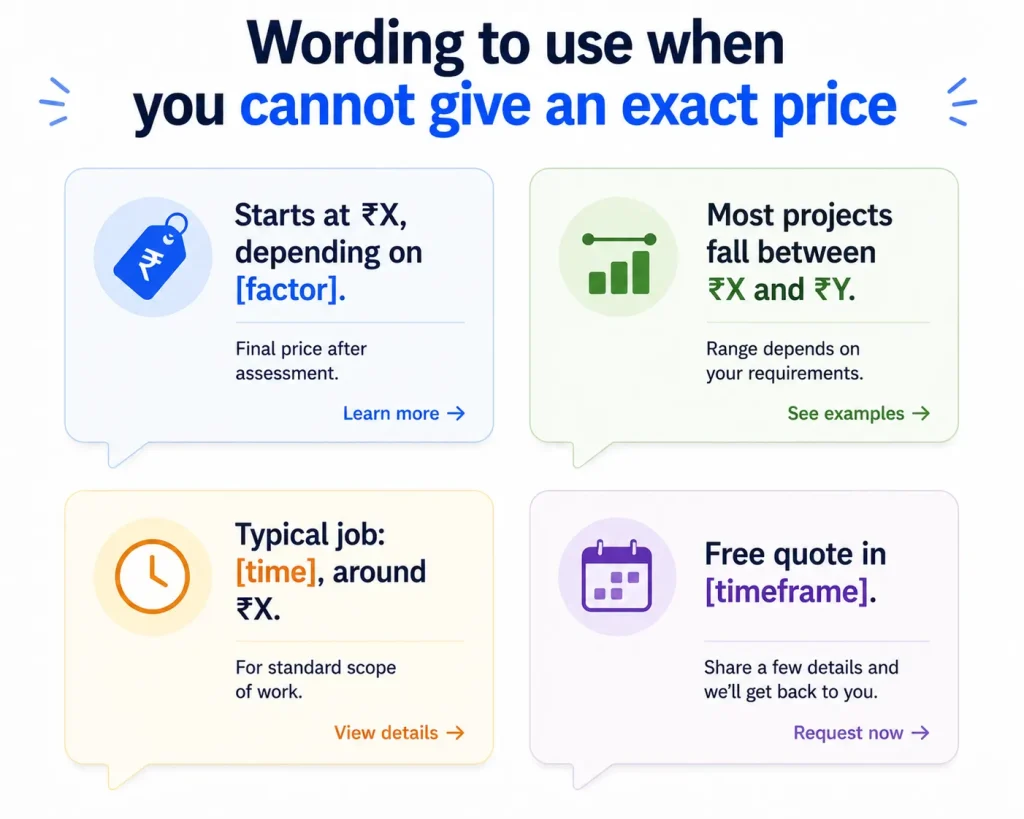
Here is wording you can copy and adjust for your own service pricing on website pages:
- “Most [service] projects fall between ₹[X] and ₹[Y], depending on [the one or two factors that actually drive the cost].”
- “[Service] starts at ₹[X], and the final figure depends on [factor]. We’ll confirm the exact cost before any work begins.”
- “A typical [job] takes us [time] and costs around ₹[X]. Larger or more complex jobs are quoted individually, always in writing before we start.”
- “Free, no-obligation quote in [timeframe] — we’ll give you a number before you decide anything.”
Every one of these gives the visitor something concrete to hold onto, which is the entire point of showing prices in the first place, even when a truly fixed number is not honestly possible.
An example: displaying prices on website pages, before and after
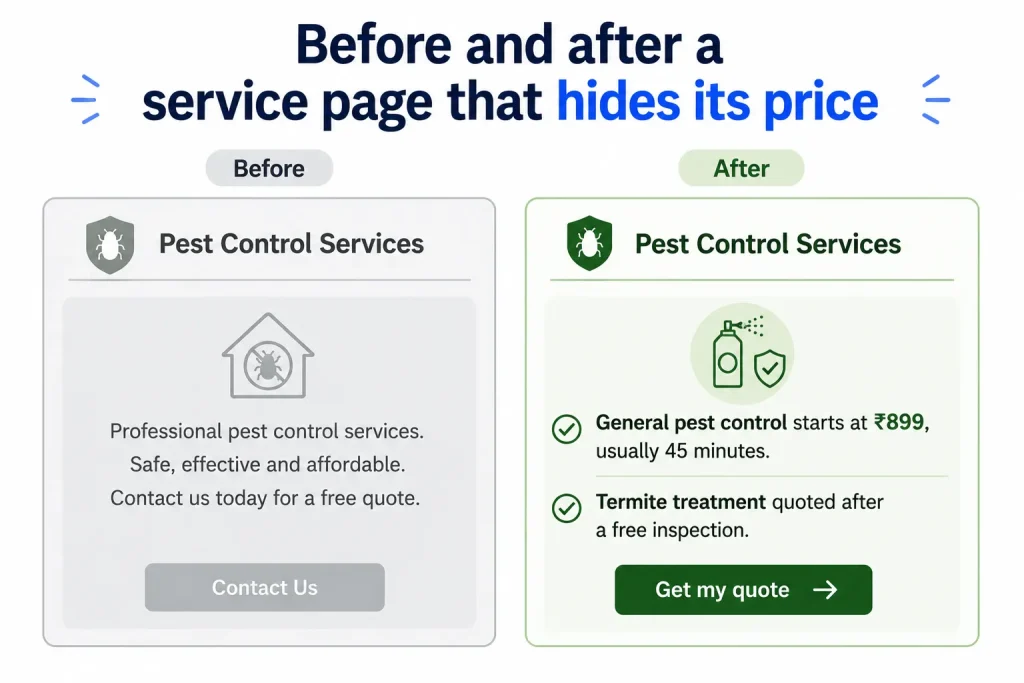
Here is what the difference looks like on an actual service page. Both versions below are composites, not the wording of any one business.
Before, a pest control service page that hides its price entirely:
Professional pest control services for homes and offices. Safe, effective and affordable. Contact us today for a free quote.
After, using a starting-at approach:
General pest control (cockroaches, ants) starts at ₹899 for a standard 2BHK, and usually takes about 45 minutes. Termite treatment is quoted separately after a free inspection, since it depends on the extent of the problem. Either way, you’ll have a number in writing before we start.
The second version has not given up anything the first version was protecting. It has simply replaced a vague promise with a real starting figure, and it has kept the genuinely variable part of the job, termite treatment, honestly marked as something that still needs a look before a final number can be given. This is what displaying prices on website pages properly looks like in practice — not a lower price, just a clearer one.
If you’re serving customers outside India
The core logic of a website pricing strategy holds everywhere, but the pressure to show a number is not always as immediate outside India. In the US, UK and Australia, some service categories, particularly higher-end or luxury ones, use the absence of a price as a deliberate signal of exclusivity, and that convention does have a real audience. Even so, the same underlying research shows that most visitors, in any country, would rather see a range than see nothing at all, so the safer default for a local service business is still to show something, even if the exact wording leans more formal than it would in India.
Common mistakes with website price transparency
Showing a number is only half the job, and a few habits undo the trust it is meant to build.
- Showing a price with too many hidden exclusions. A ₹500 figure that turns into ₹2,000 once “extras” appear does more damage than showing no price at all, since it feels like a trick rather than an oversight.
- Quoting an unrealistically low number to win the click. This wins the first message and loses the customer once the real figure appears, and it usually costs more in reputation than it gains in enquiries.
- Giving a price with no explanation of what it includes. A number alone still leaves a visitor guessing, so pair every price with a short line on what is and is not covered by it.
- Updating the price everywhere except one forgotten page. Once a business has a service page, a home page mention and a Google Business Profile listing, it is easy for one of the three to go out of date, and a visitor who spots the mismatch tends to trust none of the numbers rather than assume the newest one is correct.
Checklist for your website pricing strategy
Use this list to check your current service pricing on website pages before you consider it finished.
- Does your most standardised service have a real, fixed price shown?
- Does anything genuinely variable at least show a starting figure or a range?
- Have you written what each price includes, not just the number itself?
- Is there a clear next step for the truly custom work, such as a free quote with a stated turnaround time? Read: 15 call-to-action button examples for local business websites.
- Would you be comfortable if a customer read this price out loud back to you after the job was done?
Frequently asked questions
Should small businesses show prices even if competitors don’t? Yes, and this is often where the real advantage sits. If most businesses in your trade hide pricing, being the one that shows it, even as a range, immediately sets your site apart, since it is answering the question every visitor was already asking and nobody else was answering.
Does showing prices attract lower-quality, price-only customers? It can, if the price shown is unrealistically low. A fair, honest starting price tends to do the opposite, since it filters out visitors who were never going to be a good fit anyway, and leaves you talking mainly to people who already know roughly what the job costs.
Should I show exact prices like ₹499, or round numbers like ₹500? Either works, and this is more about your brand than your website pricing strategy itself. Precise numbers such as ₹499 tend to read as carefully calculated, while round numbers such as ₹500 tend to read as simpler and more approachable. Pick whichever matches how you already talk about price on the phone.
What if my price genuinely changes every single time? Even then, a range is almost always possible if you are honest with yourself about your last twenty jobs. Look back at what you actually charged recently, and you will usually find a band, even if it feels wider than you would like to admit.
What to do next
Look at your busiest, most standardised service, and add a real price or a real range to that one page today. That single change, done for just one service, will tell you more about how your visitors respond to pricing than any amount of debating the question in your head, and it is the fastest way to test whether your current website pricing strategy is actually working for you. Read: Before and After Plumber Website Copywriting: A Plumber’s Home Page Rewritten.

4 thoughts on “Website Pricing Strategy: Should You Put Prices On Your Website?”