
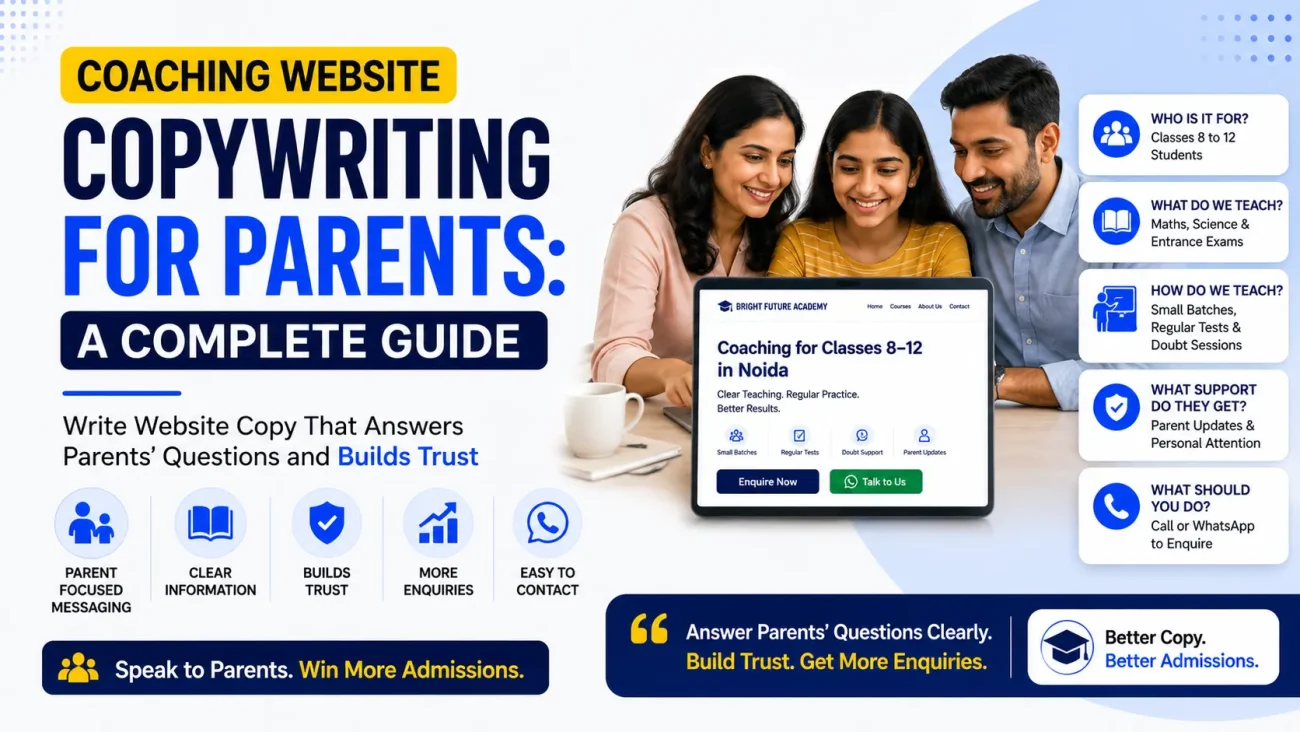
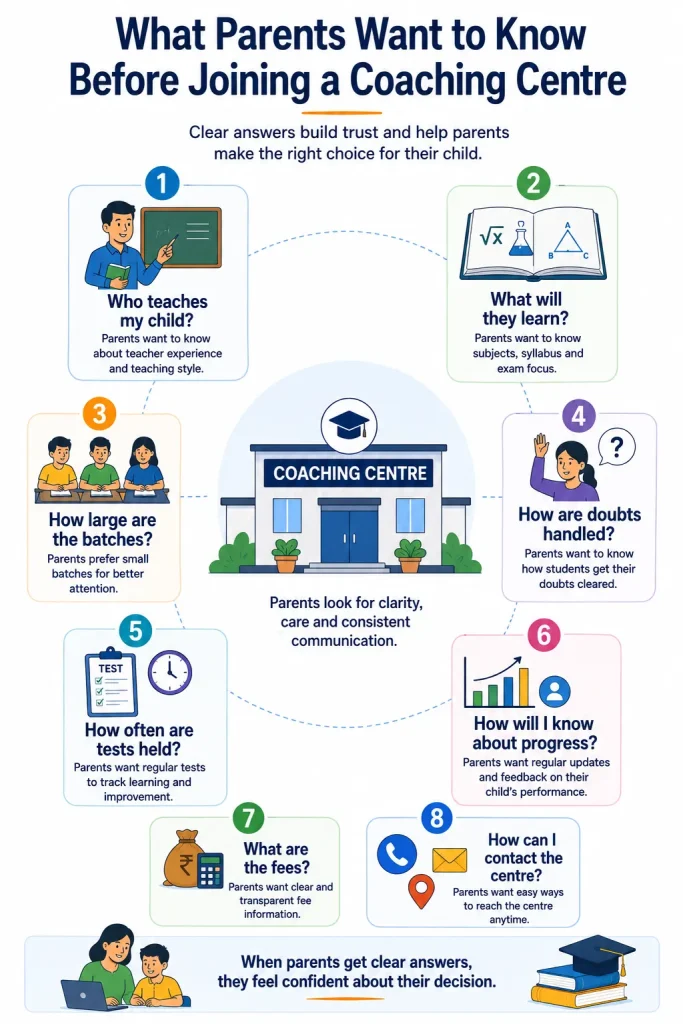
When a parent visits a coaching or tuition centre website, they are usually looking for different information than a student. A student may want to know whether the classes are interesting, whether the teacher explains topics well or whether the centre has a good study environment. A parent is more likely to think about the teaching quality, fees, class size, teacher experience, location, safety, progress and whether the centre is suitable for their child.
This difference matters when writing website content. A coaching centre may have a good service and experienced teachers, but if the website speaks mainly to students, parents may still leave without finding the answers they need. This is why Coaching Website Copywriting For Parents needs to focus on the questions that parents are actually asking before they decide to contact or visit a coaching centre.
The goal is not to ignore students. Students will still read the website, especially older students who are involved in choosing a coaching centre. The goal is to make the website useful for the person who often makes or strongly influences the final decision. This article explains how to build parent-focused messaging across the homepage, classes, teachers, fees, results, About page and enquiry sections, with examples you can use when rewriting a coaching or tuition website.
Why Coaching Websites Need to Speak to Parents
A coaching website can look attractive and still fail to answer the questions that matter to parents. A page may show smiling students, classroom photographs and phrases such as “Learn, Grow and Succeed”, but a parent may still wonder how many students are in each batch, what happens if their child does not understand a topic or how they will know whether the child is making progress.
This is why Coaching Website Copywriting For Parents starts with understanding the decision behind the website visit. The parent is not simply buying a few classes. They are deciding whether they can trust the coaching centre with their child’s education, time and money.
For example, compare these two messages:
Student-focused:
“Make learning fun and achieve your dreams!”
and:
Parent-focused:
“Small batches, regular tests and doubt sessions help students get support when they struggle with a topic.”
The second message gives the parent something they can actually understand and evaluate. It does not promise success, but it explains what the centre does to support learning.
That is the basic difference between writing for parents and simply writing about parents.
1. Start With the Parent’s Main Questions
Before writing any page, make a list of the questions a parent may have. These questions should guide the website copy more than a list of marketing words.
For a coaching centre, parents may want to know:
- Which classes and subjects do you teach?
- Who are the teachers?
- How many students are in a batch?
- How are doubts handled?
- How often are tests conducted?
- How are parents updated about progress?
- What are the fees?
- Where is the centre located?
- What are the class timings?
- What happens if a student misses a class?
- What results or other proof can you show?
- How can I ask about the right batch for my child?
You do not need to put all these questions on the homepage. Some can be answered on separate pages or in FAQs. The important thing is that the website should answer the questions somewhere.
This simple exercise can improve Coaching Centre Website Copy For Parents because it moves the writing away from what the business wants to say and towards what the reader needs to know.
2. Write a Homepage Headline That Parents Understand
The homepage is often the first page a parent sees, so the opening section should quickly explain what the coaching centre offers and who it helps.
A weak headline might say:
Helping Students Build a Better Future
There is nothing wrong with the message, but it does not tell a parent enough.
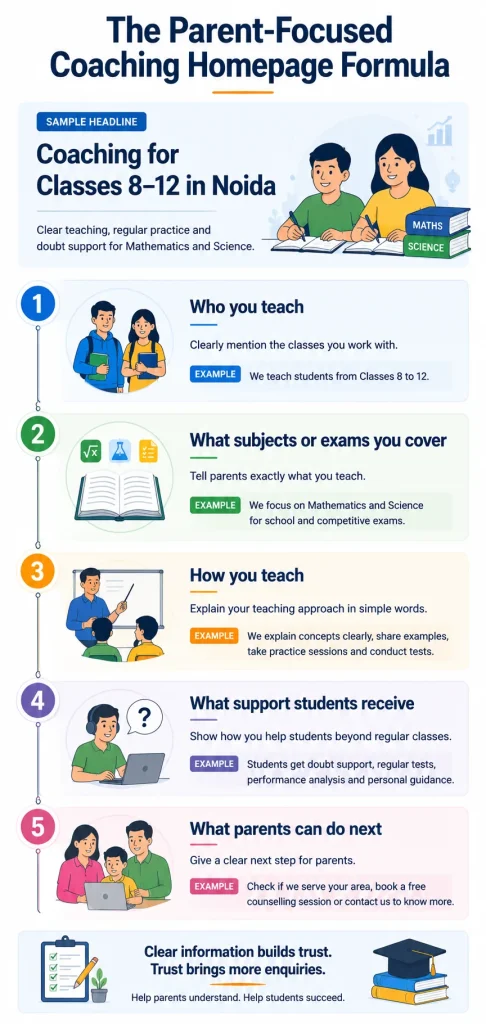
A stronger Coaching Centre Homepage Copy example would be:
Coaching for Classes 8–12 in Noida
Clear teaching, regular practice and doubt support for Mathematics and Science.
We keep batches small so teachers can give students the support they need, with regular tests to help parents and students understand their progress.
Now the parent immediately knows the classes, subjects and some of the teaching approach.
If the centre focuses on a specific examination, mention that when it is genuinely part of the service.
For example:
JEE and NEET preparation with regular tests and doubt support for Classes 11 and 12.
The headline does not need to contain every keyword. Its first job is to make the service clear.
3. Understand What Parents Need Before They Choose a Centre
A parent does not usually visit a coaching website only to read about the centre. They are trying to decide whether the centre is suitable for their child.
This means the website should help them move through a few basic decisions.
First, they need to understand whether the centre teaches the right class, subject or examination.
Then they want to know whether the teaching arrangement suits their child. They may look at batch timings, class frequency, teaching format and the type of support available.
After that, they may want to understand whether they can trust the centre. Teacher information, genuine results, reviews, photographs and clear information about the learning process can help here.
Finally, they need to know what to do if they are interested.
You can think of the parent’s decision like this:
Is this the right centre? → Is this suitable for my child? → Can I trust it? → What will it cost? → What should I do next?
This gives you a useful way to organise Coaching Website Content.
The homepage can help answer the first question. The classes and teachers pages can provide more detail about suitability. Results, reviews and other proof can build trust. The fees page can answer the cost question, while the enquiry page can help the parent take the next step.
The important point is that every page does not need to answer every question.
Instead, the website should make sure that the important questions are answered somewhere without forcing parents to search through several unrelated pages.
4. Make the Classes Page Useful for Parents
The classes or courses page should not only list subjects and batch names. Parents need enough information to decide which option may be suitable for their child.
For example, instead of:
Class 10 Mathematics — ₹2,000/month
you could write:
Class 10 Mathematics
Designed for students who need regular support with school Mathematics, including concept explanation, practice questions and test preparation.
What is included:
Classroom teaching, weekly practice, regular tests and doubt support.Batch size: Up to 20 students
Classes: 3 days a week
Fee: ₹2,000 per month
This is much more useful Tuition Centre Website Content because the parent can understand what they are paying for.
The exact details should, of course, match the real coaching centre. Do not add a batch size, test schedule or support system unless the centre actually provides it.
5. Give Parents the Important Information Early
Parents should not have to read the entire homepage before finding out what the coaching centre actually offers.
The first part of the website should answer the basic questions quickly.
For example, a parent visiting a Mathematics coaching centre should be able to understand something like this within the first few sections:
Classes: 8–12
Subjects: Mathematics and Science
Format: Classroom coaching
Location: Noida
Support: Regular tests and doubt sessions
Next step: Ask about available batches
This does not mean putting a large block of information at the top of the homepage.
The opening section should remain simple. However, important details should appear early enough that parents do not have to search for them.
A useful homepage structure could be:
First section
Explain who the centre teaches and what it offers.
Second section
Show the main classes, subjects or examination programmes.
Third section
Explain the practical details parents are likely to compare, such as timings, batch format or available support.
Fourth section
Introduce teachers, results, reviews or other genuine trust signals.
Final section
Give parents a clear way to ask questions or enquire about a suitable batch.
This approach makes Coaching Centre Homepage Copy easier to scan because the website follows the order in which a parent is likely to think.
The goal is not to put everything above the fold. The goal is to make sure the most important information is not hidden behind vague marketing language.
6. Give Parents the Teacher Information They Actually Need
Parents usually do not need a long paragraph about how passionate or dedicated the faculty is.
They need enough information to understand who will be teaching their child.
A useful teacher section can include:
- Teacher name
- Subject taught
- Classes taught
- Relevant qualification
- Teaching experience
- School or examination experience where relevant
For example:
Rahul Sharma — Mathematics
Classes: 9–12
Experience: 8 years
Focus: School Mathematics and JEE preparation
This gives a parent useful information without turning the teacher section into a long biography.
If the centre has several teachers, the homepage does not need to contain every detail. You can introduce the teaching team briefly and link to a separate faculty page.
For example:
Meet Our Teachers
Our faculty teaches Mathematics, Science and entrance-exam subjects for Classes 8–12. View individual teacher profiles to learn about their qualifications and teaching experience.
This is an important difference between writing about teachers and helping parents evaluate the teaching team.
The website should give enough information for parents to decide whether they want to learn more.
Do not add qualifications, years of experience or examination expertise simply because they sound impressive. Every detail should be accurate and relevant to the teacher’s actual role.
7. Give Parents More Than One Reason to Trust the Centre
A parent may not decide whether to contact a coaching centre based on one sentence on the homepage.
They may look for several signs that the centre is genuine and suitable.
These can include:
- Real teacher profiles
- Student or parent reviews
- Genuine examination results
- Photographs of the centre
- Clear course information
- Details about the teaching format
- Information about batch sizes
- A physical address and contact details
The important point is that these trust signals should support each other.
For example, a coaching centre may say that it provides small batches. The classes page can explain the batch structure, while photographs can show the actual classroom environment.
Similarly, if the website mentions examination results, the results should include useful context such as the year, examination and number of students where appropriate.
A parent may also want to know whether the centre actually exists at the location shown on the website. A clear address, contact information and genuine photographs can make the website easier to trust.
This is why Coaching Website Content should not depend only on statements such as:
“We are trusted by thousands of parents.”
Instead, give visitors several pieces of information that allow them to make their own judgement.
The website does not need to prove that the coaching centre is perfect.
It needs to give parents enough genuine information to decide whether they want to take the next step.
8. Explain Fees Clearly
Fees are one of the most important pieces of information for many parents, yet some coaching websites make visitors contact the centre just to ask for a basic price.
Whether you should display full fees, starting prices or a fee range depends on the business model, but the website should give parents some useful information whenever possible.
For example:
Class 10 Mathematics
₹2,000 per month
Includes three classes per week, weekly practice work and regular tests. Ask us about the current batch timings and any available trial or admission options.
If prices vary by batch or course, explain why.
For example:
Fees depend on the class, subject and number of sessions per week. Contact us with your child’s class and subjects, and we will share the available options.
The goal is not necessarily to publish every fee on every page. The goal is to avoid making parents work too hard to understand the basic cost.
If you want to explore the wider question of whether service businesses should display prices on their websites, you can also read our guide to Website Pricing Strategy.
9. Answer the Parent’s Questions About Class Size
Batch size can be an important factor when parents compare coaching centres. Simply saying “personal attention” does not tell them whether a class has 10 students or 80 students.
If the centre genuinely keeps small batches, say what that means.
Our Mathematics batches usually have up to 20 students. This gives the teacher enough opportunity to answer questions and review common mistakes during class.
If the centre has larger batches, do not hide that information. Instead, explain how support is provided.
For example:
Our larger lecture batches are supported by separate doubt sessions where students can ask questions and get help with difficult topics.
This makes the copy more believable because it explains how the teaching model actually works.
10. Answer the Questions Parents May Not Ask Directly
Parents may have concerns that they do not always mention when they first contact a coaching centre.
For example:
What if my child is already behind?
What happens if my child misses a class?
Can my child ask questions outside the regular class?
How will I know whether the classes are helping?
Can I change the batch if the timing does not work?
Is there a trial class or counselling session before admission?
These questions can be useful when planning Tuition Centre Website Content.
You do not need to create a separate page for every question. Some can be answered in the FAQ section, while others can be addressed on the relevant service or enquiry page.
For example:
What if my child is struggling with a topic?
Students can ask questions during class and use the available doubt-support sessions. Teachers can also suggest additional practice where needed.
Or:
What if my child misses a class?
Information about missed classes, recordings or alternative support is available from the centre. Please contact us to understand the current arrangement.
Notice that the second example does not invent a solution.
The copy should explain the actual policy of the coaching centre.
This kind of information can reduce uncertainty because parents are not only looking for reasons to join. They are also trying to understand what could happen after they join.
11. Use the About Page Differently From This Article
You already have an article on rewriting a coaching centre’s About page, so this article should not repeat that approach.
The About page article focuses on a before-and-after teardown of one About page. This article has a wider purpose: it explains how the entire coaching website can speak to parents.
That means the About page is only one part of the framework here.
The website should carry the same parent-focused message across:
Homepage → Classes → Teachers → Fees → Results → About → Enquiry
For example, the homepage may explain the overall teaching approach, the classes page can explain what each programme includes, the teacher page can explain who teaches the classes, and the enquiry page can make it easy for parents to ask about the right batch.
If you want to see a complete Before and After Example Of a Coaching Centre About Page, see our detailed rewrite.
12. Write the Enquiry Page for the Parent’s Situation
The final step should be easy.
A coaching website may use a button that says:
Join Now
But a parent visiting the website may not be ready to join immediately. They may still have questions about fees, timings, batch size or the right course.
A better CTA could be:
Not Sure Which Batch Is Right for Your Child?
Tell us your child’s class, subjects and the type of support they need. We can explain the available batches, timings and fees.
Then use:
Ask About Available Batches
This reduces pressure while still moving the visitor toward an enquiry.
A good CTA should match the decision stage of the parent. Someone who has just discovered the centre may want information, while someone who has already attended a trial class may be ready to enrol.
For more ideas on writing useful CTAs for local businesses, see our guide to Call To Action Examples For Local Business Websites.
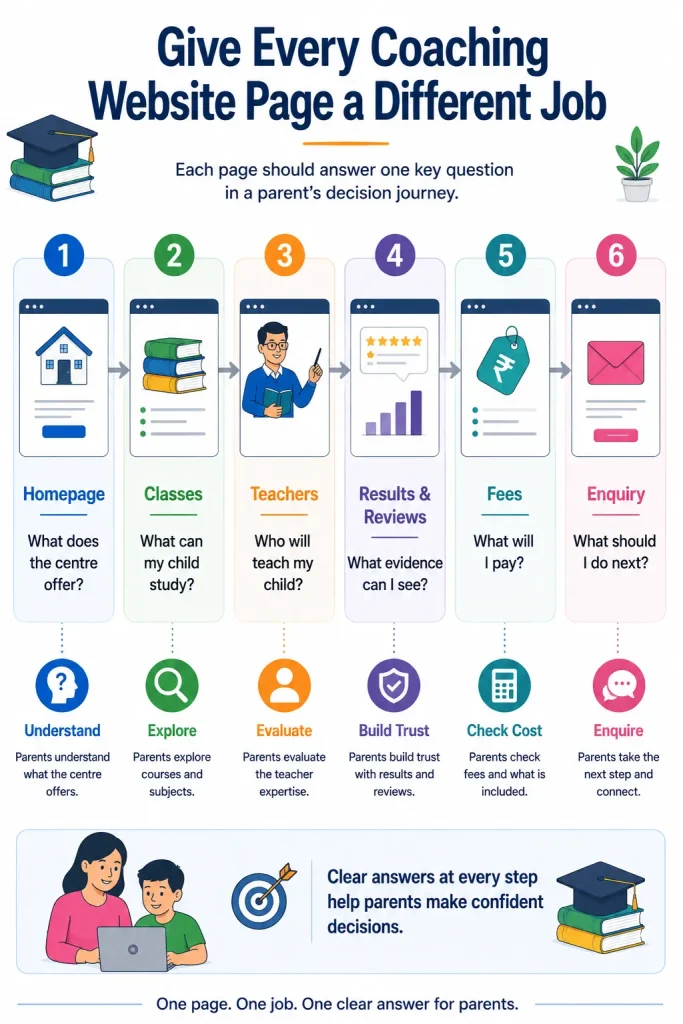
13. Give Each Website Page a Different Job
One reason coaching websites become difficult to use is that every page says almost the same thing.
The homepage says the centre provides quality education.
The About page says the centre has experienced teachers.
The Classes page says students receive personal attention.
The Teachers page says the faculty is dedicated.
The result is a website with several pages but very little new information.
Instead, give each page a clear job.
Homepage
Answer:
What does this coaching centre offer?
Keep the information broad enough to introduce the centre but specific enough to tell parents whether it may be relevant to them.
Classes or Courses Page
Answer:
What can my child study here?
Explain classes, subjects, programmes, timings, duration and other course-specific information.
Teachers Page
Answer:
Who will teach my child?
Give useful information about the teaching team.
Results or Reviews Page
Answer:
What evidence can I look at?
Show genuine results, reviews or other proof where available.
Fees Page
Answer:
What will I pay?
Explain the current fee structure or tell parents how fees are calculated.
About Page
Answer:
Who is behind this centre and why does it exist?
This is where the centre’s story, purpose and background can be explained.
Enquiry Page
Answer:
What should I do if I want to know more?
Give parents a simple way to ask questions or find the right programme.
This page-by-page approach makes Website Copy For Coaching Institutes much easier to plan.
It also prevents the same paragraph about teachers, tests, small batches or student support from appearing across five different pages.
Each page should add something new to the parent’s understanding of the centre.
14. Don’t Make the Website Sound Like It Is Only for Parents
Writing for parents does not mean removing students from the website.
Older students may research coaching centres themselves, and even younger students will interact with the classes after their parents make the decision. The website should therefore use language that both groups can understand.
The difference is mainly in what information receives priority.
For example:
For students:
“Build confidence through regular practice and clear explanations.”
For parents:
“Regular practice and tests help students identify difficult topics before exams.”
Both statements can appear on the website, but the second one gives parents more useful information.
A good Coaching Website For Parents can still feel welcoming to students. It simply recognises that parents often need more practical information before they are comfortable making the decision.
15. Build One Message Across the Whole Website
The biggest mistake is to make the homepage parent-focused while every other page goes back to generic marketing language.
Imagine the homepage says:
Small batches and regular support for Classes 8–12.
But the Classes page says:
Join our world-class learning programme.
Then the Teacher page says:
Our passionate faculty inspires excellence.
And the Fees page says:
Contact us for details.
The website feels disconnected.
Instead, the same basic message should continue across the pages.
Homepage
Small batches and regular support for Classes 8–12.
Classes page
Each batch includes classroom teaching, practice work, tests and doubt support.
Teacher page
Teachers explain difficult topics, review common mistakes and support students through doubt sessions.
Fees page
Fees include regular classes, practice work and tests.
Enquiry page
Tell us your child’s class and subjects, and we will help you find the right batch.
This creates a consistent Website Copy For Coaching Institutes approach where every page supports the same message.
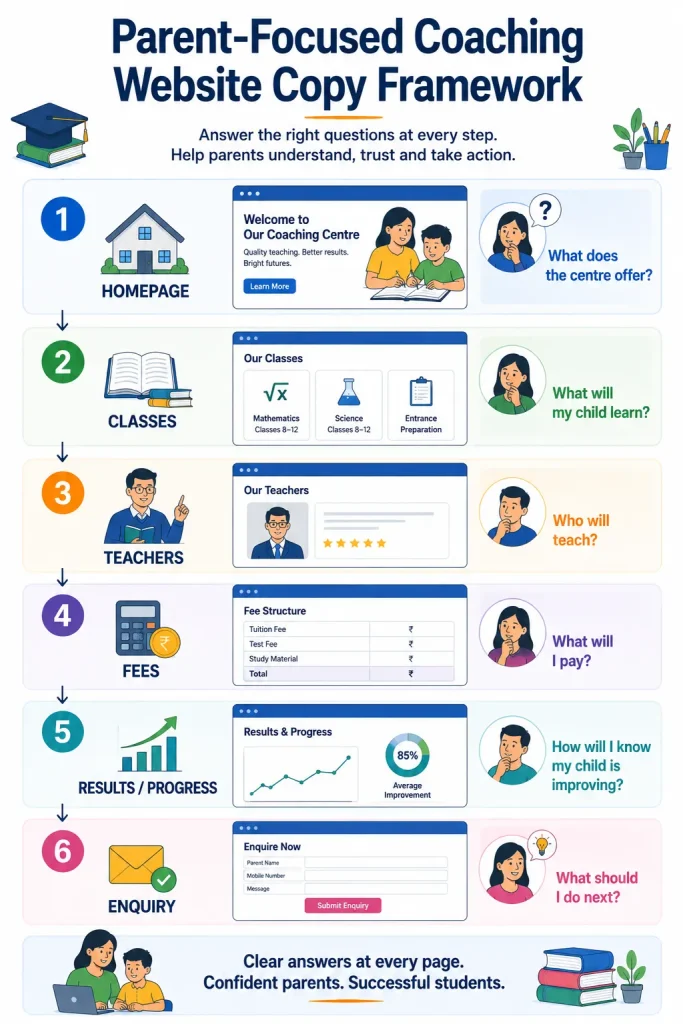
16. A Parent-Focused Coaching Website in Practice
Let’s imagine a parent is looking for Mathematics coaching for their Class 10 child.
They arrive on the homepage.
The first section tells them:
Mathematics Coaching for Classes 9–10 in Noida
They immediately know that the centre may be relevant.
They then visit the Classes page and find:
Class 10 Mathematics
Three classroom sessions per week, regular practice and test preparation.
Now they understand what programme is available.
Next, they visit the Teachers page.
They can see who teaches Mathematics, their relevant qualifications and their teaching experience.
The parent then checks the Results or Reviews page.
They find genuine student results and reviews with enough context to understand what they are looking at.
They visit the Fees page and learn the current fee or how the fee is calculated.
Finally, they reach the enquiry page.
Instead of seeing only:
Join Now
they see:
Need Help Choosing a Class?
Tell us your child’s class and subject, and we will help you understand the available options.
The parent has now received different information from different pages.
That is the main idea behind Coaching Website Copywriting For Parents.
The website does not need to repeat the same selling message everywhere.
It needs to give parents the right information at the right stage of their decision.
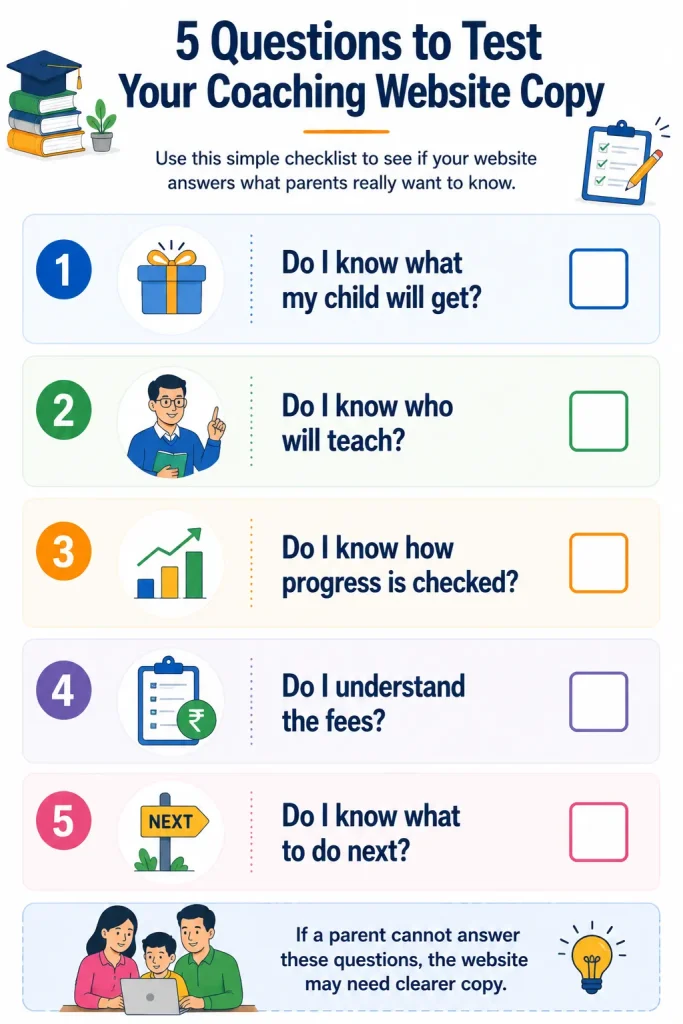
17. Five Questions to Ask Before Publishing Coaching Website Copy
Before publishing any page, read it as a parent rather than as the coaching centre owner.
Ask:
“Do I know what my child will actually get?”
If not, add information about classes, practice, tests or support.
“Do I know who will teach my child?”
If not, improve the teacher section.
“Do I know how progress is checked?”
If not, explain the testing and feedback process.
“Do I understand the cost?”
If not, explain the fee structure or at least explain how parents can get the correct fee information.
“Do I know what to do next?”
If not, improve the CTA.
These questions can help you find weak sections without needing to rewrite the entire website at once.
Final Takeaway
Writing a coaching website for parents is not simply about changing a few words from student-focused to parent-focused language.
It is about understanding what information parents need at different stages of their decision.
The homepage should quickly tell them whether the centre is relevant. The classes page should explain what their child can study. The teachers page should help them understand who will teach. Results, reviews and other genuine information can help them evaluate the centre. The fees page should make the cost easier to understand, while the enquiry page should give them a comfortable next step.
The most important question to ask when planning the website is:
“What does a parent need to know at this point?”
If the answer changes from page to page, the copy should change too.
A parent-focused coaching website does not need to repeat the same promise about quality education, experienced teachers or personal attention on every page.
Instead, each page should add useful information.
When the website works this way, parents can move from understanding the centre → evaluating the options → building trust → checking the cost → making an enquiry without having to search for basic answers.
That makes the website more useful for parents and gives every page a clear purpose.