
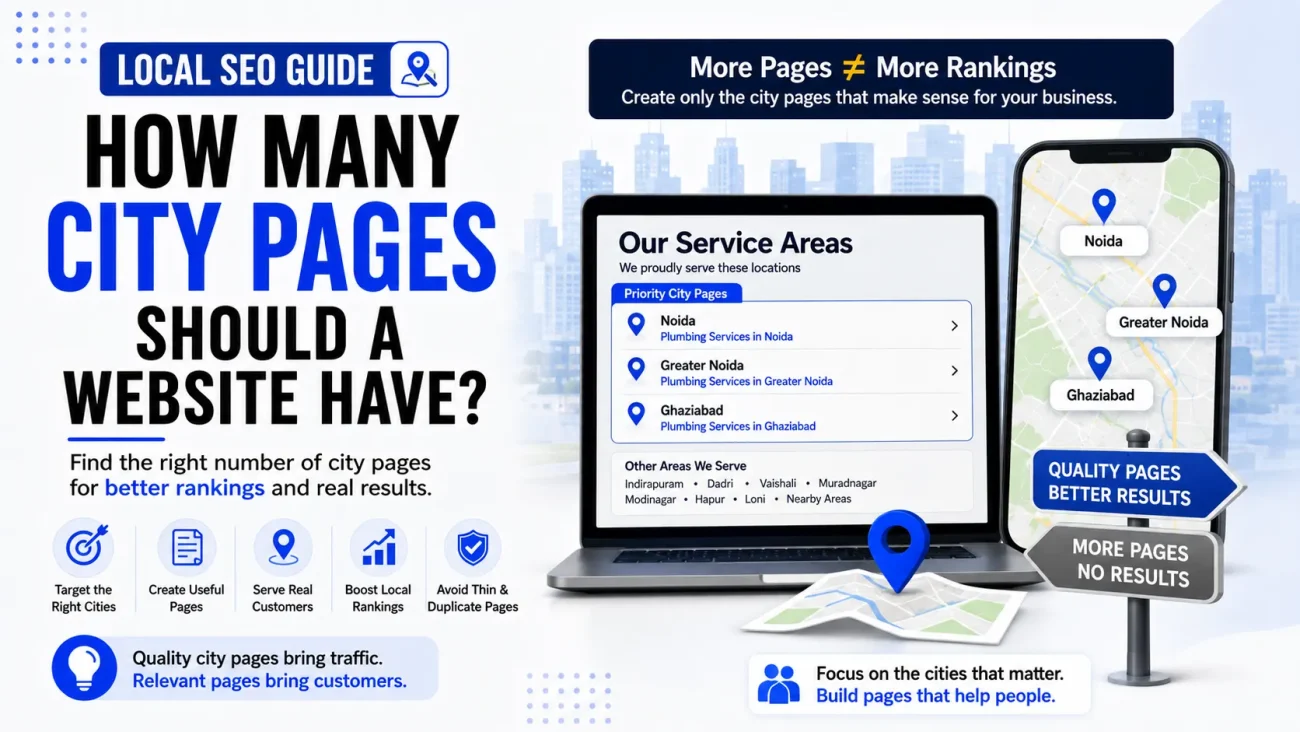
When a local business starts working on SEO, one question often comes up very quickly: how many city pages should a website have? A business may serve five cities, ten towns or an entire group of nearby areas, and it can be tempting to create a separate page for every location in the service area. After all, if people search for “plumber in Noida”, “plumber in Ghaziabad” and “plumber in Greater Noida”, having a page for each location may seem like the obvious SEO strategy.
But there is an important problem with this approach. More city pages do not automatically mean more traffic or better rankings. If the pages are almost the same apart from changing the city name, they may give very little value to visitors. Google specifically warns against doorway abuse, including creating multiple similar pages targeted at cities or regions primarily to influence search results. (Google for Developers)
So, how many city pages should a website have? There is no fixed number that works for every business. The better question is how many locations the business genuinely serves and how many useful pages it can create for those locations. A small local business may only need three or four strong city pages, while a larger business with a wider service area may have many more. The important part is that every page should have a real purpose for the customer, not just a different city name in the title.
There Is No Magic Number of City Pages
If you are looking for an exact answer such as “every local business should have 10 city pages”, you will not find a useful rule because businesses have very different service areas, customer demand and resources.
A plumber working mainly in one city may serve a few nearby areas, while a commercial cleaning company may genuinely serve 20 or 30 cities. A home renovation company may take projects across an entire region but only want work above a certain project value. A coaching centre may serve students from several nearby areas but have only one physical location.
This means the answer to how many city pages should a website have depends on the business rather than on an SEO number.
A better starting point is to make a list of locations where the business actually wants customers. Then divide those locations into useful priorities. The most important locations can receive dedicated pages first, while smaller or less important areas can simply be mentioned on a main service area page until there is enough reason to create a separate page.
This approach is also safer because it prevents the website from becoming filled with pages that exist mainly to target location keywords.
What Is a City Page?
A city page is a website page focused on providing a business’s service in a particular city or local area.
For example:
Plumbing Services in Noida
or:
Electrician Services in Ghaziabad
or:
Wedding Photography in Delhi
A useful city page should do more than repeat the company’s normal service description. It should explain the relationship between the business and that particular location.
For example, a plumber’s Noida page might explain which parts of Noida the company regularly serves, what types of plumbing jobs it handles there, how customers can book a visit and what they should expect from the service.
That is very different from creating this:
We provide plumbing services in Noida.
We provide professional plumbing services in Noida.
Contact us for plumbing services in Noida.
A page like this may contain the target keyword, but it does not give the visitor much useful information.
This is why City Pages For Local SEO should be treated as customer-facing pages first and SEO pages second.
So, How Many City Pages Should a Website Have?
For most small businesses, a good starting point is a small group of priority locations rather than every location they could possibly serve.
For example, imagine a plumbing business based in Noida that regularly gets jobs in:
- Noida
- Greater Noida
- Ghaziabad
- Indirapuram
- Dadri
- nearby smaller areas
The business does not necessarily need six separate pages immediately.
It could start with strong pages for the main markets where it has regular customers and meaningful business value. Smaller areas could be included on a broader service area page until the business has enough useful information to justify separate pages.
So if you are asking how many city pages should a website have, the answer for this example might initially be three strong pages, followed by more only when the additional locations have a clear reason to exist.
The number should grow because the business has more useful local content and business opportunities, not simply because someone wants more URLs.
Start With Your Most Important Locations
One of the easiest ways to decide which pages to create is to rank your locations by importance.
Look at where your existing customers come from, where you want more work and where your business can provide the service without creating problems with travel time or cost.
For example, a mobile electrician might have this list:
| Location | Existing Work | Business Value | Priority |
|---|---|---|---|
| Noida | High | High | 1 |
| Greater Noida | High | High | 2 |
| Ghaziabad | Medium | High | 3 |
| Faridabad | Low | Medium | 4 |
| Meerut | Very Low | Low | 5 |
The electrician does not need to create five pages simply because five locations are possible.
The first three may deserve dedicated pages because they already have customers and business value. Faridabad and Meerut can be reviewed later.
This is a much better way to think about how many city pages should a website have because it connects SEO work with the actual business.
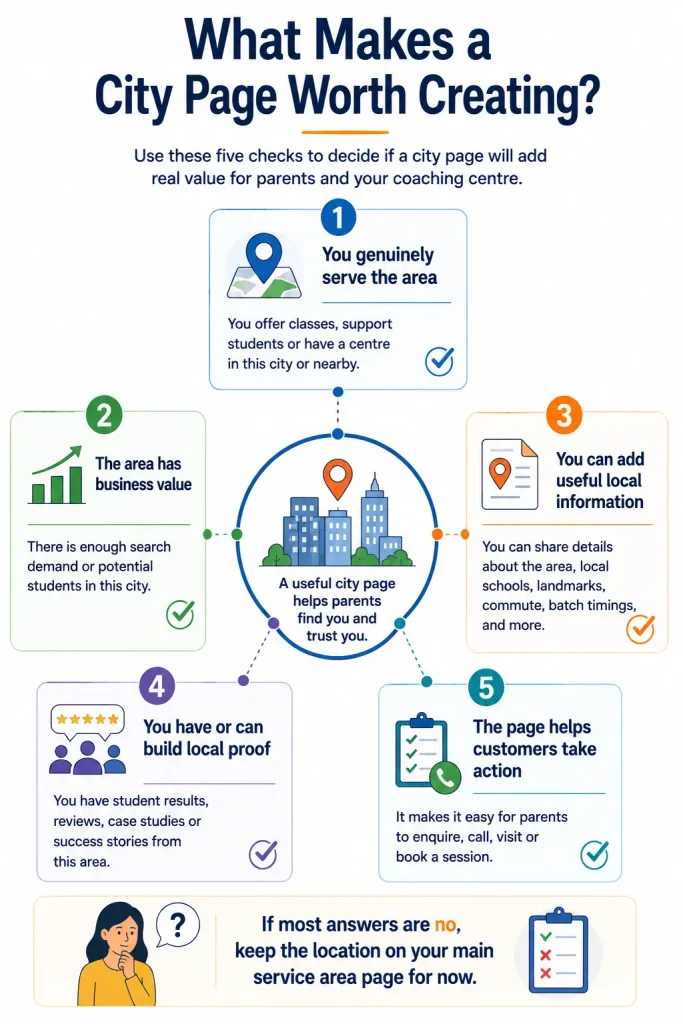
Create a City Page When You Can Add Real Local Information
This is one of the most useful tests for deciding whether a location deserves its own page.
Ask yourself:
“What can I tell a customer about this location that would make a separate page useful?”
If you have a good answer, the page may be worth creating.
For example, a landscaping company might have worked on several gardens in one city and understand the types of properties it commonly serves there. It may be able to explain the areas it covers, the types of landscaping projects it handles and common questions customers ask.
A mobile mechanic may have regular customers in a nearby city and can explain how mobile appointments work there, what areas it covers and which types of repairs can be carried out at the customer’s location.
But if the only thing you can change on a page is the city name, you probably do not need a separate page yet.
Google’s current spam policies warn against creating substantially similar pages for search manipulation, and scaled content that provides little value can also be a problem. (Google for Developers)
Do Not Build a Page for Every Nearby City
This is where many local websites go wrong.
Imagine a business serves a large area and creates these pages:
- Plumber in Noida
- Plumber in Ghaziabad
- Plumber in Faridabad
- Plumber in Delhi
- Plumber in Greater Noida
- Plumber in Meerut
- Plumber in Dadri
- Plumber in Loni
- Plumber in Hapur
If every page has the same introduction, the same services, the same FAQs and the same contact section, with only the location names changed, the website has not really created nine useful resources.
It has created nine variations of the same page.
Google’s doorway abuse policy specifically mentions pages targeted at specific cities or regions when they are created to manipulate search visibility, particularly when they lead users toward the same destination. (Google for Developers)
This does not mean that every city page is automatically a doorway page. A genuine location page can be useful. The problem is creating pages without giving each location a meaningful purpose.
A Better Way to Think About City Pages
Instead of asking:
“How many locations can I create pages for?”
ask:
“Which locations deserve their own useful page?”
That small change can completely improve your strategy.
For example, a cleaning company may technically serve 15 cities, but perhaps 80% of its customers come from four main cities. Those four cities may deserve detailed pages first.
Once those pages are complete, the company can look at the remaining locations and ask whether each one has enough demand, business value and useful local information to justify another page.
This creates a gradual Location Page SEO strategy instead of a large batch of repetitive pages.
What Should a Useful City Page Contain?
A strong city page does not need to be completely different from every other page on the website. Some basic business information will naturally be repeated because the same business is providing the same service.
What should change is the information that makes the page genuinely useful for that location.
A good city page can include:
The Service and Location
Clearly explain what service the business provides and where it provides it.
Local Service Coverage
Mention the neighbourhoods or parts of the city that are genuinely served.
How the Service Works
Explain booking, visits, response times or other details that matter to customers.
Relevant Local Information
Answer questions that customers in that area may actually have.
Local Proof
Use genuine reviews, projects, photographs or examples from that area when available.
Clear Contact Option
Tell the visitor what to do next, such as calling, requesting a quote or checking availability.
The exact structure depends on the business, but every section should have a reason to be there.
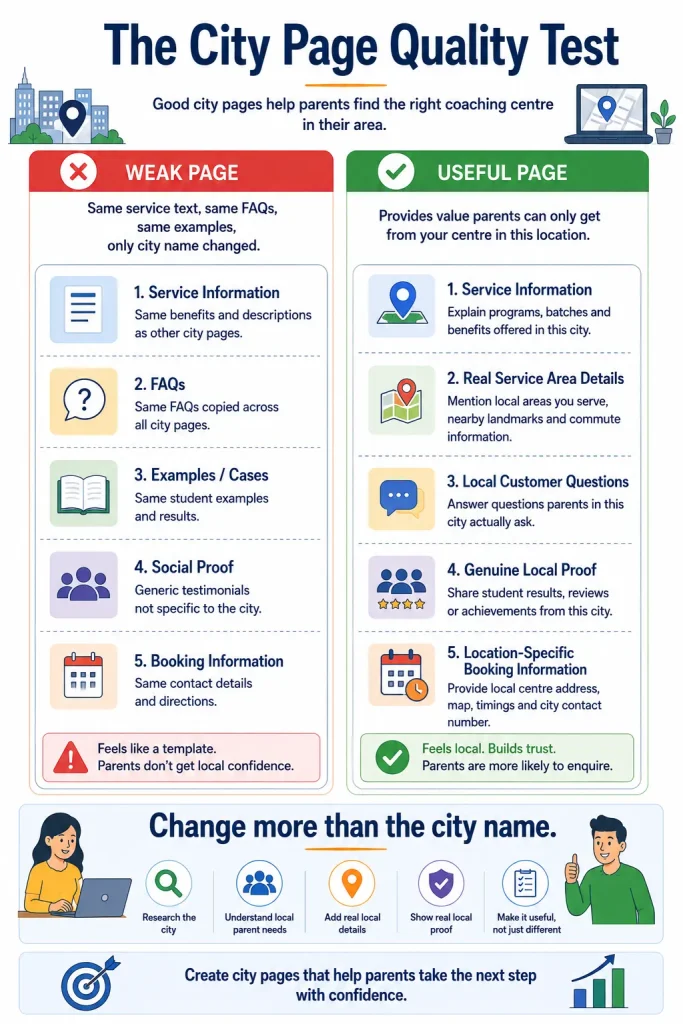
Your City Pages Should Not All Look Identical
Some parts of a local business website will naturally remain consistent.
For example, a plumber’s list of services may be the same on its Noida and Ghaziabad pages. That is not automatically a problem.
The problem is when the entire page is almost identical.
Imagine this:
Plumbing Services in Noida
We provide plumbing services in Noida. Our services include leak repair, drain cleaning and pipe repair. Contact us today.
And then:
Plumbing Services in Ghaziabad
We provide plumbing services in Ghaziabad. Our services include leak repair, drain cleaning and pipe repair. Contact us today.
There is almost no reason for the second page to exist.
Instead, each page should add information about that location.
For Noida:
We regularly serve homes and apartments across several Noida sectors, with plumbing visits arranged directly at the customer’s property.
For Ghaziabad:
We provide plumbing visits across residential areas of Ghaziabad and nearby neighbourhoods, with customers able to send their address before booking so we can confirm service availability.
The copy should always be accurate, but this illustrates the difference between changing a keyword and adding useful local information.
What If You Serve 20 or 30 Cities?
This is where a main Service Area Pages hub can become useful.
Instead of immediately creating 30 separate pages, you can create a central page such as:
Areas We Serve
This page can explain the overall service area and list the locations the business genuinely covers.
Then you can create dedicated pages for the most important locations.
For example:
Areas We Serve
→ Noida
→ Greater Noida
→ Ghaziabad
→ Faridabad
→ Other areas we cover
This gives visitors a simple way to understand the business’s coverage.
It also allows the business to expand gradually. If a smaller location becomes important later, it can receive its own detailed page.
This is often more sensible than publishing 30 thin pages on day one.
Use a Hub and Spoke Structure
A useful way to organise a large service area is through a hub-and-spoke structure.
The hub is the main service area page.
The spokes are the individual city pages that deserve deeper information.
For example:
Service Areas
- Noida
- Ghaziabad
- Greater Noida
- Faridabad
The hub explains the wider coverage, while each important city page explains the service in that location.
This also connects naturally with our earlier guide on The Hub and Spoke Method for Service Area Pages, where we explain how a main service-area page and individual location pages can work together.
The advantage is that your website does not need to treat every small location as equally important. Your structure can reflect the actual business.
When You Should NOT Create Another City Page
Sometimes the best SEO decision is not to create another page.
Do not rush to create a city page when:
You do not actually serve the location.
Do not create a page simply because people search for your service there.
You have nothing useful to say about the location.
If the content would only be your normal service page with the city name changed, wait.
The location is too small to justify a separate page.
You may be able to mention it on your main service area page instead.
The page would be almost identical to another page.
This is a strong sign that the two pages may be better combined.
The business has no interest in getting customers there.
There is little value in spending time creating a page for an area that is outside your preferred market.
The goal is not to build the biggest collection of URLs. It is to build a website that helps customers and supports the business.
What About Neighbourhood Pages?
The same principle applies when moving from cities to smaller neighbourhoods.
A business may serve Noida and want pages for every sector:
- Plumber in Sector 15
- Plumber in Sector 18
- Plumber in Sector 22
- Plumber in Sector 27
- Plumber in Sector 50
- Plumber in Sector 62
- and so on.
This can quickly become a problem if the pages contain almost identical content.
A neighbourhood page can make sense when there is enough genuine local information and business demand to support it. But there is no need to create one simply because a keyword tool shows that people search for “plumber + sector”.
Sometimes a good Noida page that naturally mentions the important areas it serves is better than 20 weak neighbourhood pages.
How Many Location Pages Do I Need If I Am a Small Business?
For a small business, start with the locations that matter most.
Imagine a local electrician who operates one vehicle and mainly works in three nearby cities. It may make sense to build three strong city pages rather than 15 pages covering places that are rarely visited.
The electrician can then monitor enquiries and actual business activity. If another city becomes an important market, a new page can be added later.
This approach also makes the website easier to manage. Writing three useful pages takes time, but maintaining 20 repetitive pages can become a burden.
So, if you are asking how many city pages should a website have, a small business should usually think in terms of priority locations, not maximum possible locations.
How Many City Pages Do I Need If I Serve a Large Area?
Larger businesses may genuinely need more pages.
Suppose a regional home services company has several teams and regularly completes jobs across 20 cities. In that situation, 20 city pages could make sense if the business can provide useful information for each location.
The important difference is that the pages should represent real markets rather than simply being created because there are 20 city names to target.
A larger company may also have more local proof, such as customer reviews, completed projects, local teams or location-specific service information. That gives the pages more substance.
So the answer is not “large businesses can create unlimited city pages”. The answer is that business scale, actual service coverage and available useful information can support a larger set of pages when those pages genuinely help visitors.
Should Every City Page Be the Same Length?
No. A city page does not need to reach an arbitrary word count just to satisfy an SEO checklist. One location may need more explanation because it is a major market with many services and customer questions. Another may need a shorter page because the service is simple and the area is small.
The better question is:
Does this page provide enough useful information for someone searching for this service in this location?
Do not add three extra paragraphs just to reach 1,500 words if those paragraphs repeat information. Likewise, do not create a 300-word page if customers need much more information before they can make a decision.
This is especially important for your website because you are trying to build content that is useful for readers, not simply a large collection of pages.
Use Local Proof Where You Have It
One of the strongest ways to make a city page genuinely different is to use real proof from that location.
For example:
Recent plumbing work in Noida:
We recently repaired a leaking water line at a residential property in Sector 50. The issue was traced to a damaged connection, which was replaced after discussing the repair with the customer.
This is much more useful than:
“We have many happy customers in Noida.”
If you have real photographs, reviews or project examples from the city, they can make the page more useful.
Do not create fake projects or rewrite the same customer story for several cities. Local proof should be genuine.
How City Pages Fit Into Your Website
City pages should not sit separately from the rest of your website.
They should connect naturally with your service pages, homepage and useful blog content.
For example, a plumber’s main service page about drain cleaning could mention that the business provides drain cleaning in Noida and link naturally to its Noida service area page.
A blog post about common plumbing problems could also mention a relevant city page when the link genuinely helps the reader.
This makes the location pages part of the website rather than a collection of pages created only for search engines.
Our earlier Service Area Business Website Copywriting guide also covers how service-area businesses can explain their coverage when they do not have a customer-facing shop or office.
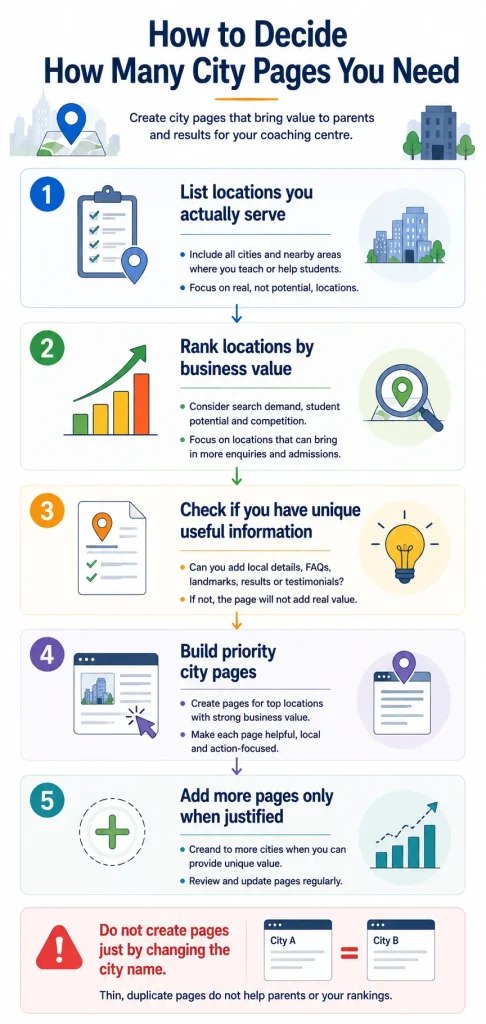
A Simple Formula for Deciding Your Number
If you are still unsure how many city pages should a website have, use this simple process.
Step 1: List every location you serve
Include cities, towns and important nearby areas.
Step 2: Mark your most important locations
Look at existing customers, enquiries, revenue and future business plans.
Step 3: Check whether each location deserves its own page
Ask whether you can provide useful local information instead of just changing the city name.
Step 4: Build your priority pages first
Start with the locations that have the strongest combination of business value and useful content.
Step 5: Add more pages gradually
Once the main pages are useful and working well, review the next group of locations.
This approach is much more practical than deciding that your website needs 20, 30 or 50 city pages before you have even written the first one.
What If You Already Have Too Many City Pages?
If your website already has dozens of city pages, do not assume that you need to keep all of them.
Review the pages and look for patterns.
If several pages are almost identical, ask whether each page provides enough value to justify existing separately. Google Search Console can also help you understand whether pages are receiving impressions or clicks, although traffic alone should not be the only reason for keeping or removing a page.
Some pages may be useful but need better content. Others may be better combined into a broader service area page. Google’s documentation notes that thin pages with little or no added value can be a quality problem, and its spam policies also cover doorway and scaled content practices.
The answer is not always “delete everything”. Review the purpose of each page first.
City Pages Are Not a Numbers Game
There is a common SEO mindset that says:
More pages = more keywords = more traffic.
That can be a dangerous way to build a local website.
A page should exist because it is useful, not simply because there is another keyword variation available.
Imagine two websites.
Website A has 40 city pages, but most pages are nearly identical.
Website B has 7 city pages, and each one contains useful service information, local coverage details, genuine proof and clear next steps.
Website B may have a much stronger foundation because the pages actually serve a purpose. Google’s guidance is clear that content created at scale primarily to manipulate rankings, especially when it provides little value to users, can fall under scaled content abuse.
So when you ask how many city pages should a website have, do not start with a number. Start with the quality and purpose of the pages.
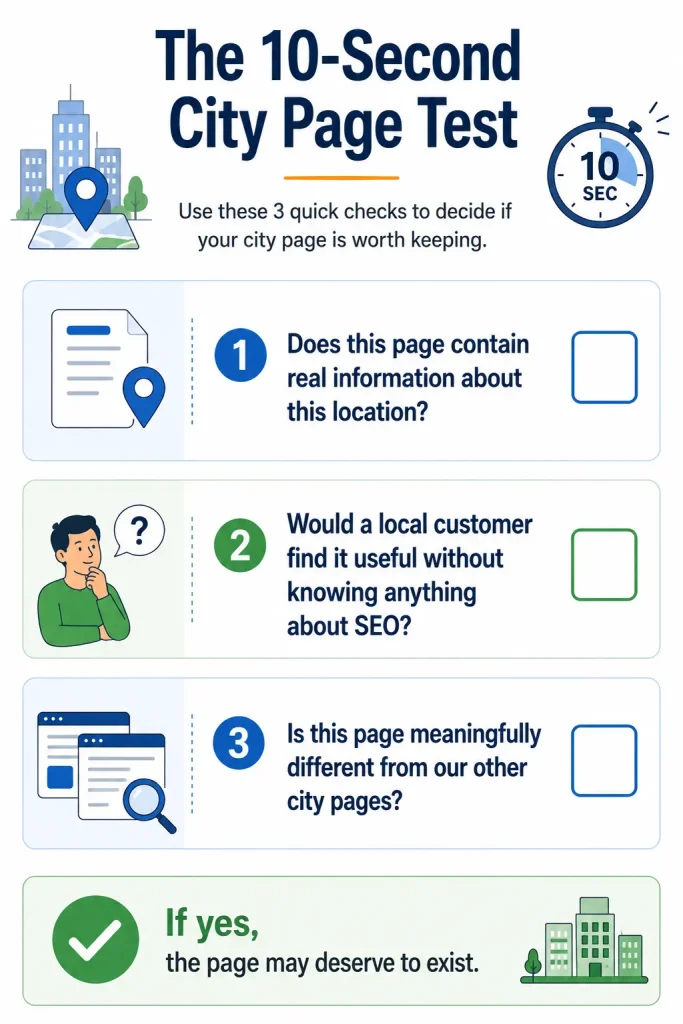
The 10-Second Test for Every City Page
Here is a simple test you can use before publishing a new page.
Imagine you remove the city name from the page.
Now ask:
“Would there still be anything on this page that tells me about this particular location?”
If the answer is no, the page probably needs more useful local information.
Then ask:
“Would a customer in this city find this page useful even if they had never heard of SEO?”
If the answer is yes, you are probably moving in the right direction.
This test helps keep Local Landing Pages focused on the visitor rather than the search engine.
A Practical City Page Strategy for a Small Local Website
If you are building a new website, you do not need to publish dozens of city pages at the beginning.
A better plan could look like this:
Phase 1: Build the homepage, main service pages and one main service area page.
Phase 2: Create three to five detailed city pages for the most important locations.
Phase 3: Improve those pages with real customer questions, local proof, useful FAQs and better internal links.
Phase 4: Review your next group of locations and create new pages only where the business case is strong.
This approach gives you time to improve quality instead of creating a large amount of content that later needs to be rewritten.
If you are working specifically on service area businesses, this also connects well with the strategy of using One Main Service Area Hub and Useful City Level Pages Underneath it.
Final Takeaway: How Many City Pages Should a Website Have?
So, how many city pages should a website have?
There is no universal number.
A small local business may need only a few strong city pages. A larger business with a wide service area may genuinely need many more. The right number depends on where the business actually works, which locations matter commercially, what customers search for and whether the business can create useful information for each location.
The safest and most useful approach is to start with your most important locations and build pages that deserve to exist. Explain the service, show the real service area, answer local customer questions, include genuine proof where available and give visitors a clear next step.
Do not create 30 pages simply because you can find 30 city keywords. And do not assume that changing “Noida” to “Ghaziabad” is enough to make two pages meaningfully different.
A strong local website is not the one with the most city pages. It is the one where each important page gives the visitor a reason to stay, understand the service and take the next step.
That is the principle to remember when deciding how many city pages should a website have: create as many as you can genuinely make useful, and no more than that.

4 thoughts on “How Many City Pages Should a Website Have for Local SEO?”