
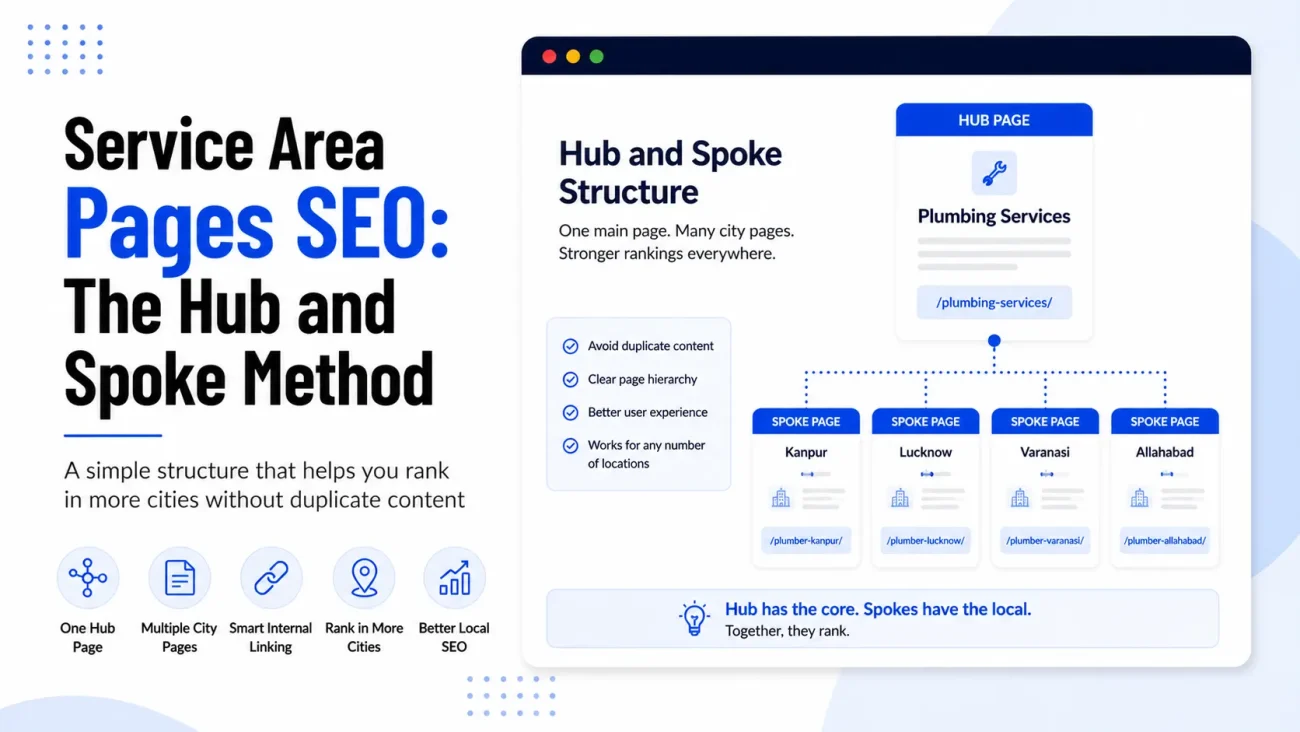
If your business works in more than a handful of towns, you have probably run into one of two problems, and both of them come from the same root cause. Either you have written a full page of service detail for every single town, and most of it repeats itself word for word, or you have written one page trying to cover every town at once, and it ranks for none of them properly. Both problems are really the same problem looked at from opposite ends, and the fix for both is the same underlying structure. Getting service area pages SEO right is less about clever sentences and more about deciding, ahead of time, what belongs on one page and what belongs on many.
This article is about that structure specifically, which is usually called hub and spoke. If you have read the earlier article on writing city pages without repeating yourself, this one picks up where that left off, moving from how to write a single page to how to organise dozens of them so they support each other instead of competing with each other.
Why service area pages SEO needs a structure, not just good writing
A well-written page can still fail if it sits in the wrong place on your site. This is the part of service area pages SEO that gets missed most often, because business owners naturally think about the problem as a writing problem, when a large share of it is actually an architecture problem, decided before a single sentence gets typed. This structural side is really what separates casual service area pages local SEO advice from a plan that actually scales past a handful of towns.
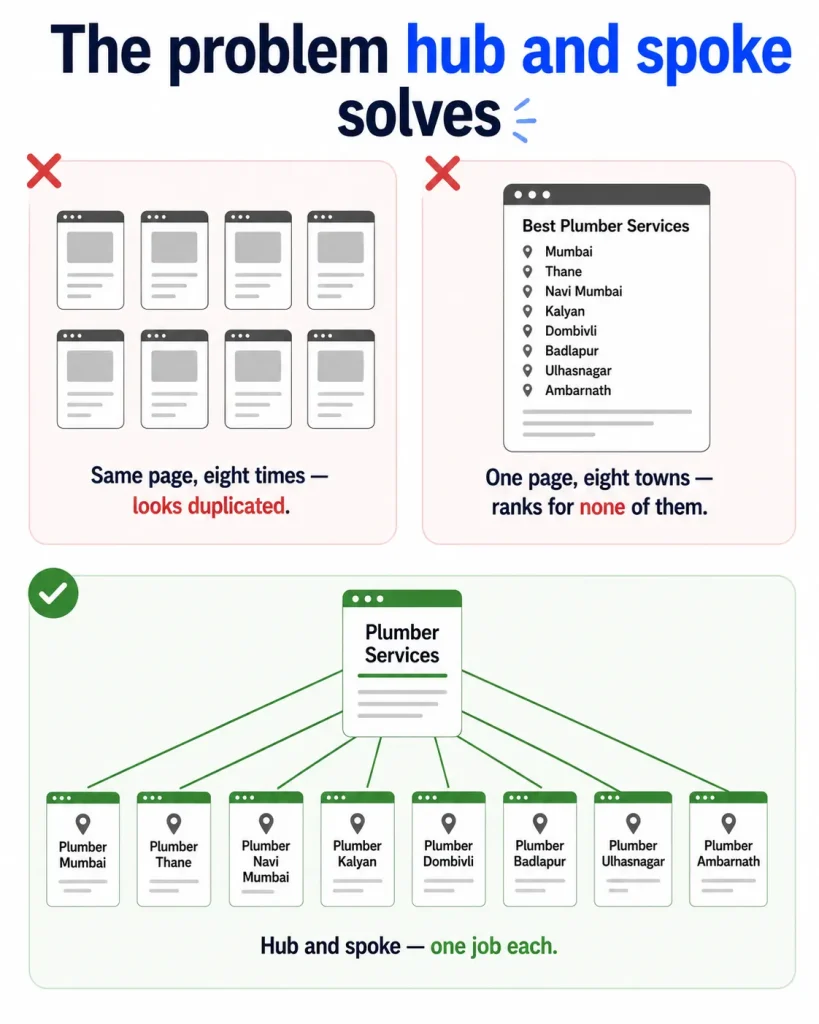
Picture a business that works across eight towns. If every one of those eight pages tries to explain the full service, the pricing logic, the process, and the local detail all at once, you end up writing the same explanation eight times, and Google has already seen enough of that pattern to treat it with suspicion. If instead you try to solve this by building one enormous page that mentions all eight towns somewhere in its text, that page becomes too broad to rank well for any specific one of them, since a search for “plumber in Kanpur” is not well served by a page that also talks about Lucknow and Varanasi in the same breath.
Hub and spoke solves this by splitting the job in two. One page, the hub, carries the parts of your service that do not change from town to town. A set of smaller pages, the spokes, carry only the parts that genuinely do change. Neither page is trying to do the other one’s job, and that division is the whole idea behind good service area pages SEO at any scale beyond two or three towns.
The basic shape of a hub and spoke structure
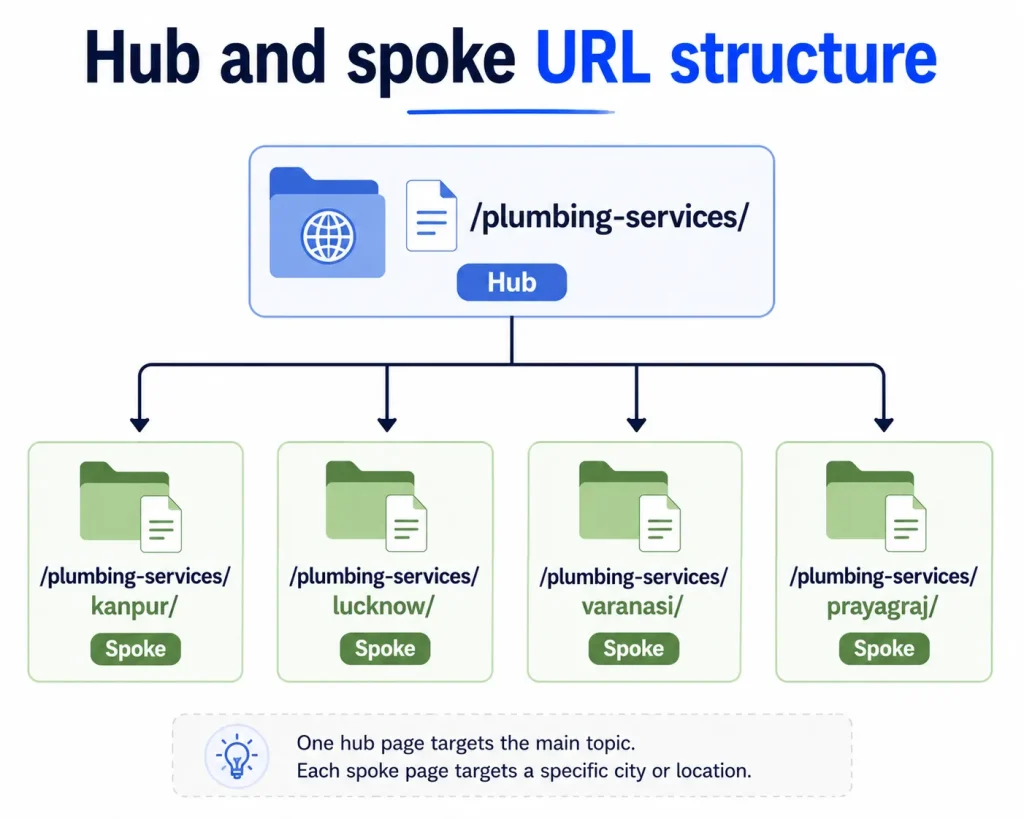
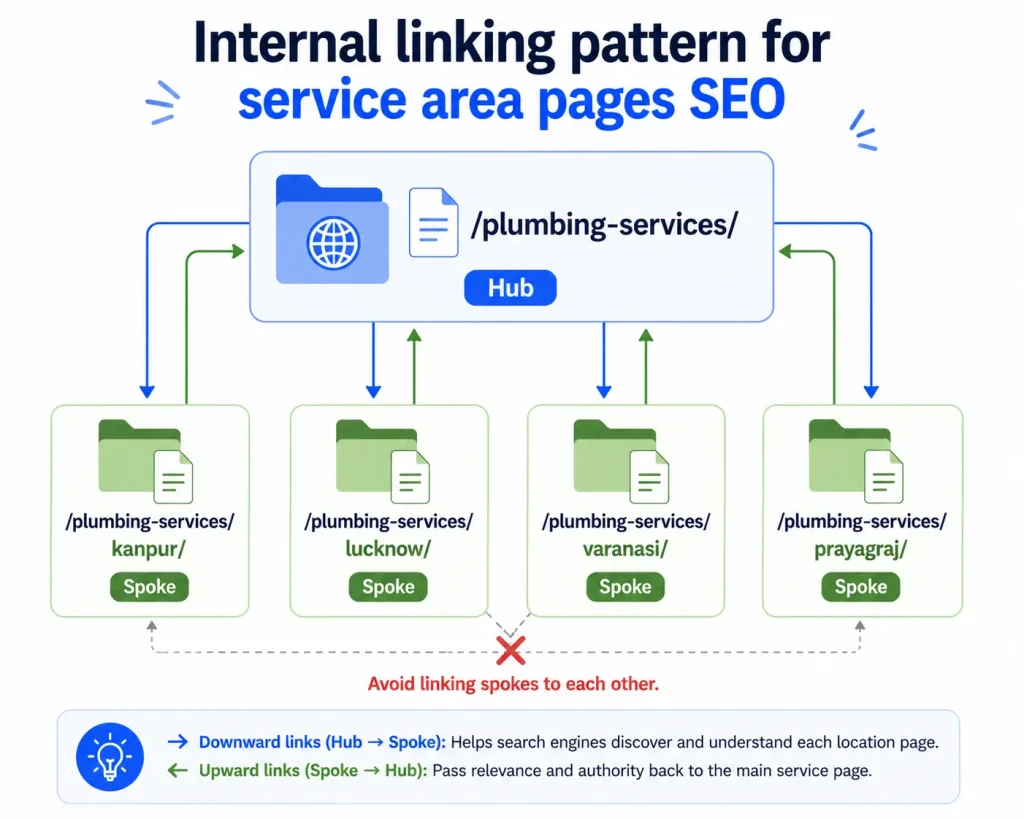
Before deciding what goes where, it helps to see the shape of the whole thing, since service area page structure is easiest to plan visually rather than as a list of rules.
The hub sits at the top of the structure and usually lives at your main service URL, something like /plumbing-services/. It explains what the job involves, how your pricing generally works, what the process looks like from enquiry to completion, and it answers the questions that are true no matter which town the reader is calling from.
The spokes sit underneath it, usually at URLs like /plumbing-services/kanpur/ or /plumbing-services/lucknow/, and each one carries only the detail that is genuinely local: which areas within the town you cover, a landmark or two, how people there tend to reach you, and one honest limit on your coverage. None of that content should try to re-explain the service itself, because that job already belongs to the hub.
What belongs on the hub, and what belongs on the spoke
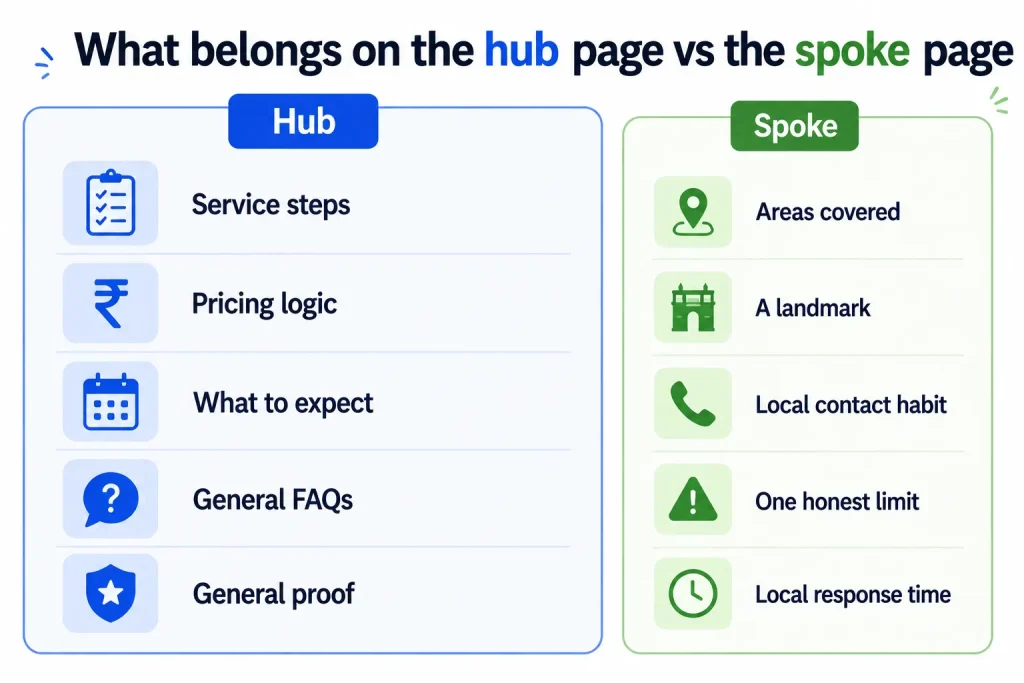
This is the decision that most service area page strategy actually comes down to, and it is simpler than it looks once you apply one test. Ask whether a piece of information would still be true if you deleted the town’s name from the sentence. If it would, it belongs on the hub. If deleting the town’s name would make the sentence meaningless or untrue, it belongs on the spoke.
| Belongs on the hub | Belongs on the spoke |
|---|---|
| What the service involves, step by step | Which areas within the town you actually cover |
| How your pricing generally works | A landmark or two a local resident would recognise |
| What a customer should expect, start to finish | How people in that specific town tend to contact you |
| General FAQs about the service itself | One honest limit on coverage in that town |
| Photos and proof that apply to the business as a whole | A note on typical response time in that area, if it differs |
Notice that the spoke side of this table is short by design. A well-built spoke page is usually four or five sentences of real local detail plus a link back to the hub, not a full page trying to stand on its own. Read: How to write city pages for local SEO
How the pages should link to each other
Good local landing page strategy pays as much attention to the links between pages as it does to the words on them, since Google follows those links to work out which pages matter and how they relate to one another.
The hub should link out to every spoke, usually through a simple list or a dropdown menu labelled something like “Areas we serve,” since this is what tells Google, and your reader, that the spokes exist at all. Every spoke should link back up to the hub, typically in a sentence such as “for the full details of how this service works, see our main plumbing page,” which sends both authority and a lost reader back to the page built to answer broader questions.
What spokes generally should not do is link heavily to each other. A spoke for Kanpur linking to a spoke for Lucknow rarely helps either page, since a visitor reading about Kanpur has no obvious reason to care about Lucknow, and spreading links sideways like this dilutes the hub-and-spoke pattern rather than reinforcing it. Keep the linking vertical: spoke up to hub, hub out to spokes, and leave it there.
An example: an electrician working across three cities
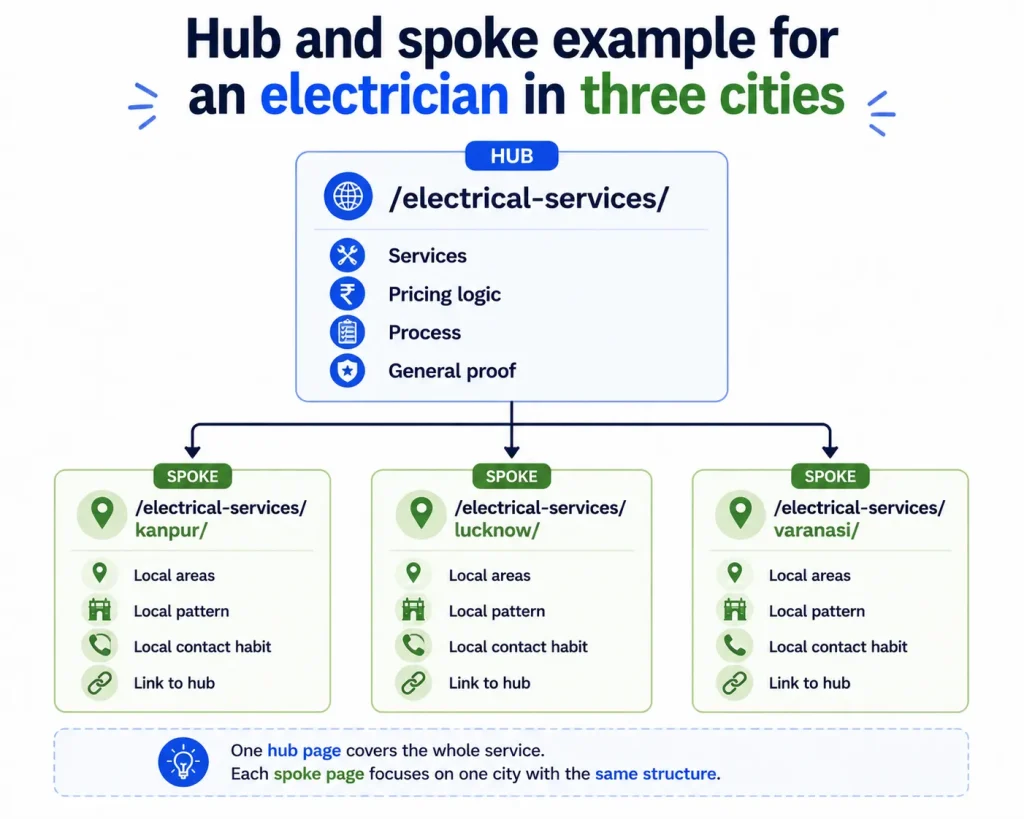
Here is what this looks like for a specific business, an electrician working in Kanpur, Lucknow and Varanasi. The outline below shows the split rather than full page text, since the earlier article on writing city pages already covers how to phrase the spoke content itself in full.
The hub page, /electrical-services/, would cover:
- What kinds of jobs are handled — wiring faults, MCB tripping, fan and light installation, full rewiring
- How the first visit and quote generally works, and what it costs to have someone come out
- What happens after the quote is accepted, from booking to completion
- General photos of finished work and any licences that apply to the business as a whole
The Kanpur spoke, /electrical-services/kanpur/, would cover only:
- The specific areas of Kanpur usually covered, such as Kakadeo and Kidwai Nagar
- One local pattern worth mentioning, such as older wiring being common in a particular part of town
- How people in Kanpur specifically tend to get in touch, if that differs from the general pattern
- A line linking back to the hub for anyone wanting the fuller explanation
The Lucknow and Varanasi spokes would follow the identical shape, each with its own genuinely local detail slotted into the same four points. This is really the whole of service area pages SEO once the structure is in place: the hub stays fixed, and only the four local points change from spoke to spoke.
How many spokes is too many
A common mistake in service area pages local SEO is building a spoke for every town a business has ever visited, rather than every town it actually works in regularly. A spoke page built from almost nothing, because the business has done one job there in the past year, tends to hurt the site rather than help it, since a thin page with no real local detail behind it looks the same to Google whether it is a spoke or a standalone page.
A reasonable rule is that a town deserves its own spoke once you have done enough real work there to honestly fill in all four points from the table above. If you cannot fill in a landmark, a local pattern, and a genuine note on how people there contact you, that town is better mentioned as a line on a broader “areas we also cover” list on the hub page itself, rather than being given a page of its own. Getting this right is as much a part of your service area page strategy as the writing itself, since knowing when a town does not yet deserve its own page matters just as much as knowing how to write one that does.
Checklist before you build your service area pages
Run through this list before adding a new spoke to your service area page structure.
- Does the hub page cover everything that stays true regardless of town?
- Does every spoke page contain at least three genuinely local details?
- Does every spoke link back to the hub, and does the hub link out to every spoke?
- Have you avoided linking spoke pages to each other directly?
- Could you honestly fill in all four local points in the table above for this town? If not, it may not deserve its own page yet.
Frequently asked questions
Is hub and spoke only useful for businesses with many locations? It becomes necessary once you are covering more than three or four towns, since below that number the duplication problem is small enough to manage by hand. Above that, service area pages SEO without this structure tends to collapse into either heavy repetition or one page trying to do too much.
Does the hub page need to rank on its own, separately from the spokes? Yes, and this is worth planning for deliberately. The hub page should be able to rank for broader searches, such as “electrician near me” or your service name plus your general region, while each spoke handles the narrower, town-specific version of the same search. If the hub is thin or an afterthought, the whole structure weakens, because it is the page carrying most of the weight.
What’s the difference between city pages SEO and service area pages SEO? In practice, very little. City pages SEO usually assumes a business with a fixed presence in each town, while service area pages SEO is the more accurate term when a business travels to customers without a shop or office in every place it works. The hub and spoke structure applies equally well to both.
Can one spoke page cover more than one town? Sometimes, and this is a reasonable compromise for towns too small or too infrequent to justify a page each. A single spoke titled something like “and the surrounding towns” can sit alongside your named spokes, covering minor areas without pretending each one deserves full local detail it does not have.
What to do next
List out every town your business genuinely works in on a regular basis, and sort that list into two piles: towns with enough real local detail to fill in all four points from the table above, and towns that do not yet have that. Build spokes for the first pile, mention the second pile in a single line on your hub page, and you will have a structure that scales cleanly as the business grows into new areas, which is really the point of any local landing page strategy worth building. Read: 15 call-to-action button examples for local business websites

4 thoughts on “Service Area Pages SEO: The Hub and Spoke Method”