
How to Write City Pages for Local SEO (With Examples)
If you have searched for how to write city pages for local SEO, you have probably already built a page for every town you cover, and you have probably already noticed the problem, which is that they all read like one page with the town name swapped out. In this field, that kind of page goes by more than one name depending on who you ask. Some people call it city page SEO, some call it location page SEO, and if your business has no fixed shop or office in every town, what you are really writing is service area page content instead. The name changes, but the underlying question stays the same: how do you write pages for six, ten or twenty towns without Google, and the person reading them, noticing that you copied and pasted?
Getting this right matters more than most business owners expect, because a badly built set of city pages is one of the most common reasons a local website never ranks for anything beyond its own name. Google is not judging whether your plumbing work is different from one town to the next, which it usually is not. It is judging whether the local landing page copy in front of it says anything the last page did not already say, and when the answer is no, both pages tend to lose.
Why city page SEO fails before it starts
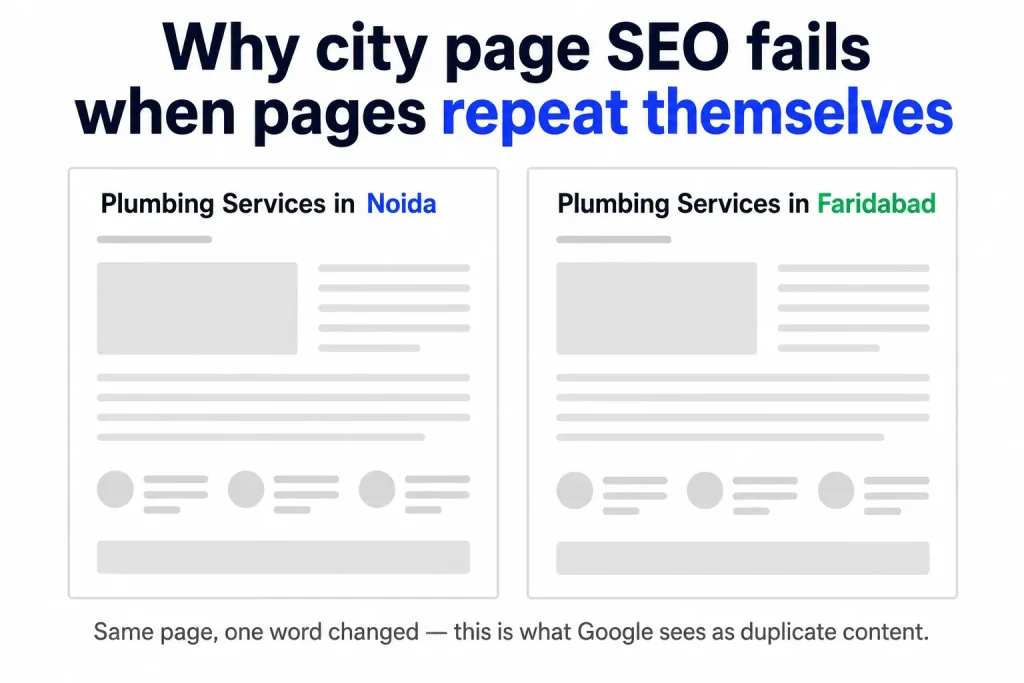
City page SEO fails for a very ordinary reason, and once you see it, you stop doing it without thinking. When somebody builds their tenth page for a new town, they are tired, and the work they actually do in each place genuinely is the same. A plumber does not fix different kinds of leaks in Ghaziabad than he does in Noida, so when he sits down to write the next page, the easiest thing in the world is to open the last one, change the town name, and move on. Nobody sets out to create duplicate content. It happens because the underlying service really is identical, and the writing follows that reality unless you deliberately push against it.
The trouble is that Google is not comparing your plumbing work from one town to the next. It is comparing the pages themselves, and a page that only swaps a place name gives it nothing to compare in its favour. Pages built this way tend to sit quietly on page four of the results, technically live but never actually found by anybody, which is a waste of the time it took to publish them in the first place. This is the exact pattern to break if you are working out how to write city pages for local SEO that actually get found.
How to write city pages for local SEO without losing the local detail
The good news is that you do not need a different service for every town, you only need a handful of details that genuinely are different, and those details are usually easy to find once you know what to look for. This is really the whole answer to how to write city pages for local SEO — not a trick, just knowing your own business a little better than the page currently shows.
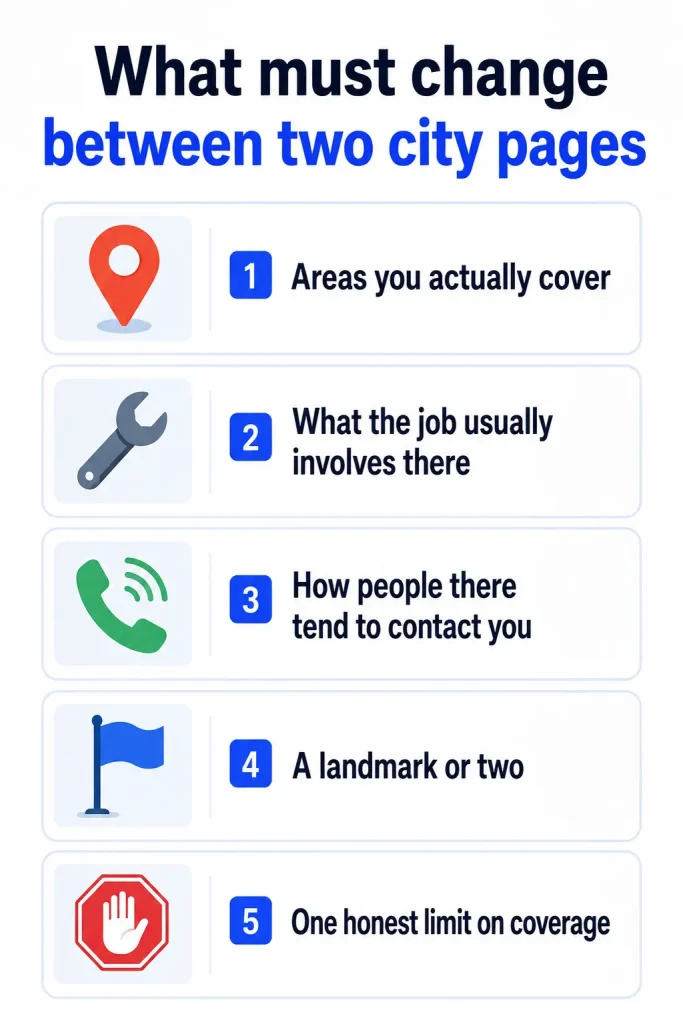
Here are the things that are almost always different from one town to the next, even for the same business:
- The areas within the town you actually cover. A cleaning business in Pune does not serve all of Pune equally. It probably does most of its work in three or four specific colonies or sectors, and naming them is instantly more convincing than naming the city.
- What the job usually involves there. Older buildings need different electrical work than new ones. Areas near a highway get more dust-related cleaning calls. A town with a lot of independent houses needs different pest control than one full of high-rise flats.
- How people there tend to ask for the job. In some areas, everybody calls. In others, WhatsApp is where most enquiries land. This is worth mentioning, because it also tells the reader which method you expect them to use.
- A landmark or two that a local person would recognise. Not for decoration, but because “near the Sector 62 metro station” tells a real resident something a street address never will, especially in towns where addresses are unreliable.
- One honest fact about coverage. How far you travel from that town, or which nearby areas you do not currently cover, which is the same kind of honest limit that works well on an About page. Reade How to write an About page people actually believe.
None of this requires new equipment, new pricing, or new staff. It requires you to sit down and write out what you actually know about your own business, rather than guessing at what sounds impressive.
An example: two local business city pages, before and after
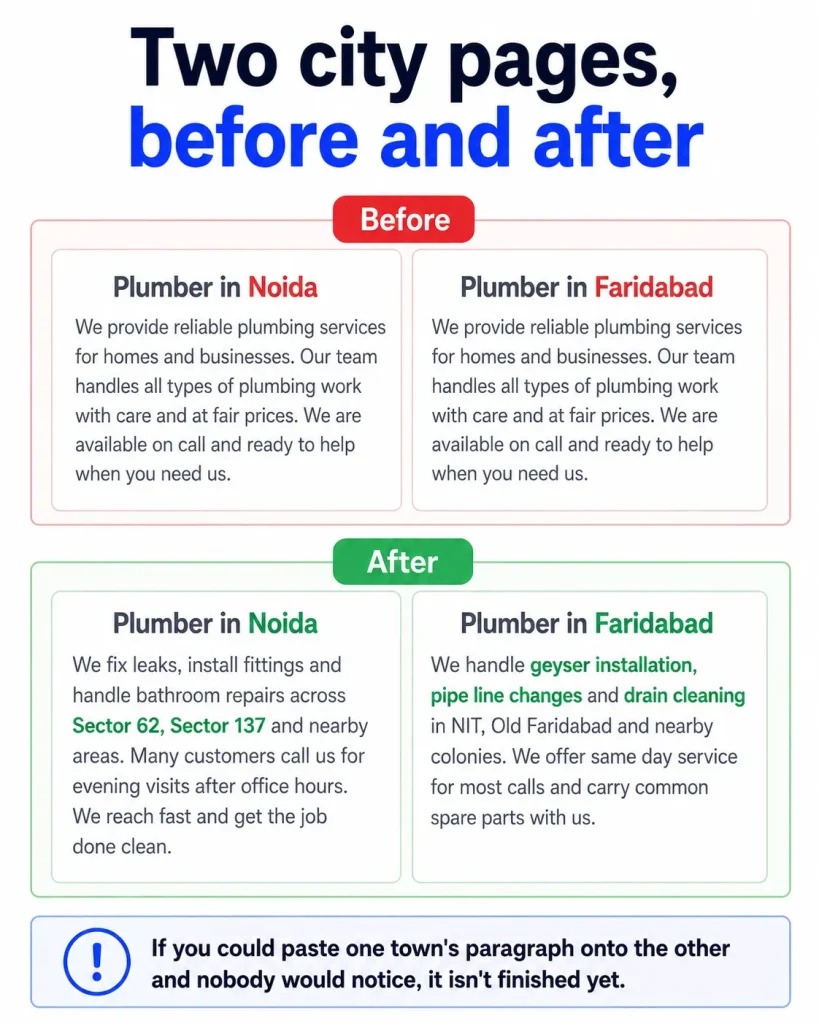
Here is what the problem looks like in practice. Both examples below are composites, built from patterns seen across many real local business city pages, not the wording of any one business, and the business itself is invented for the same reason.
Before, for a pest control business working in two towns:
Meerut: We provide expert pest control services in Meerut. Our team uses safe and effective methods to eliminate pests from your home or office. Contact us today for a free inspection.
Muzaffarnagar: We provide expert pest control services in Muzaffarnagar. Our team uses safe and effective methods to eliminate pests from your home or office. Contact us today for a free inspection.
Read those two paragraphs one after the other and the problem is obvious immediately, because the only difference between them is a single word. Google can read the same thing.
After, using the differences described above:
Meerut: Most of our Meerut jobs are in Shastri Nagar and around the Sadar area, where the older houses tend to bring in a lot of termite work alongside the usual cockroach and rodent visits. We keep one technician based on that side of town, so a same-day visit is usually possible if you call before two in the afternoon.
Muzaffarnagar: In Muzaffarnagar we mostly cover the area around Meenakshi Chowk and the newer colonies further out on the Meerut road, where the calls tend to be more about rodents getting into new construction than anything else. We do not currently cover the far side of town past the railway line, so it is worth checking before you book if you are out that way.
Neither paragraph is trying to sound impressive, and neither one needed research beyond what the owner already knew. What makes them work as separate pages is that the second one could not be pasted onto the first town without becoming untrue, and that single test is the whole method.
The hub and spoke structure for location page SEO
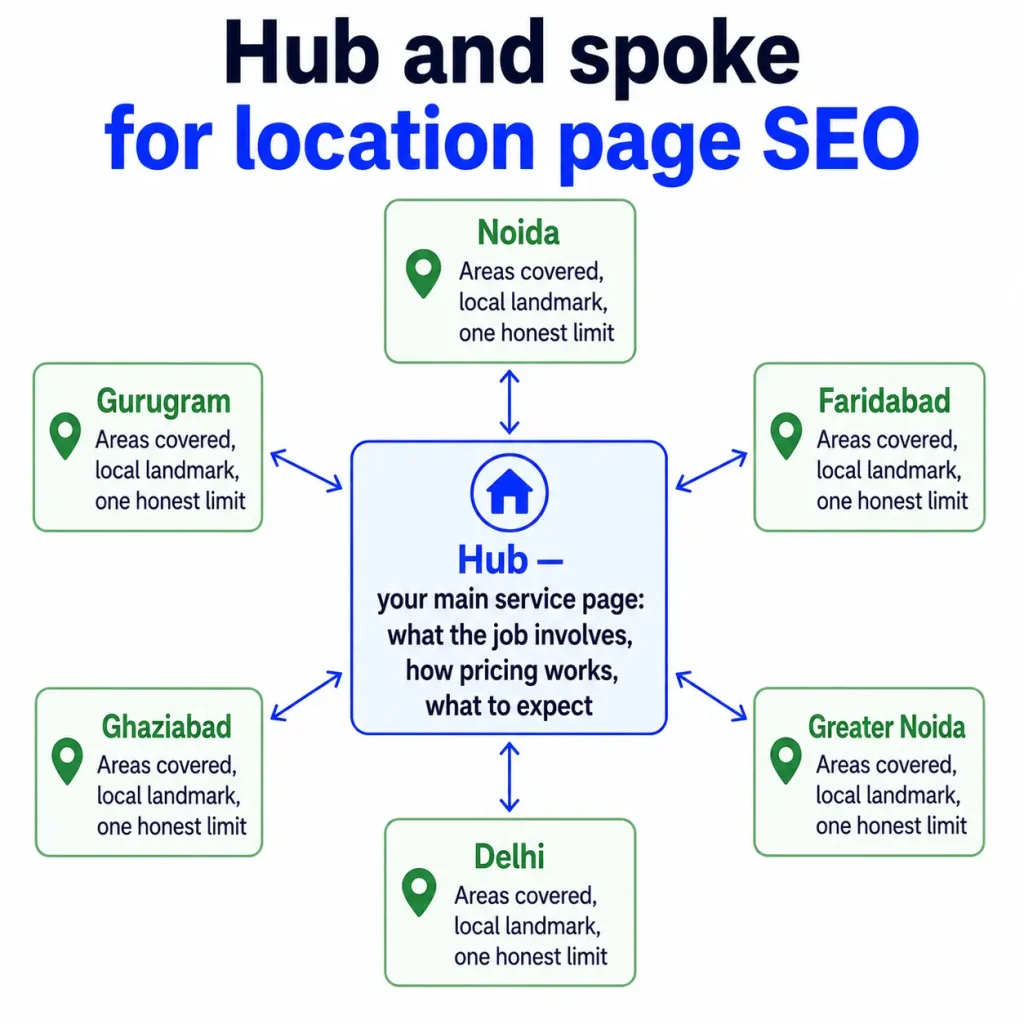
Once you are writing pages for more than four or five towns, repeating every detail on every page becomes its own problem, because you end up writing the same explanation of your service seven or eight times, which is exhausting for you and unnecessary for the reader. The way around this is a structure sometimes called hub and spoke, and it is the backbone of most well-built location page SEO, as well as one of the more reliable answers to how to write city pages for local SEO once you are past four or five towns. One main page carries everything that does not change, while each city page carries only what is different about that place.
Your main service page, the hub, explains what the job involves, how your pricing generally works, and what a customer should expect from start to finish. Each city page, the spoke, then focuses almost entirely on the local detail: the areas covered, the landmark, the honest limit, and a short line linking back up to the hub for anyone who wants the fuller explanation. Pages built this way stay short, stay honestly different from one another, and stop repeating the same three paragraphs about your process that nobody needed to read seven times over.
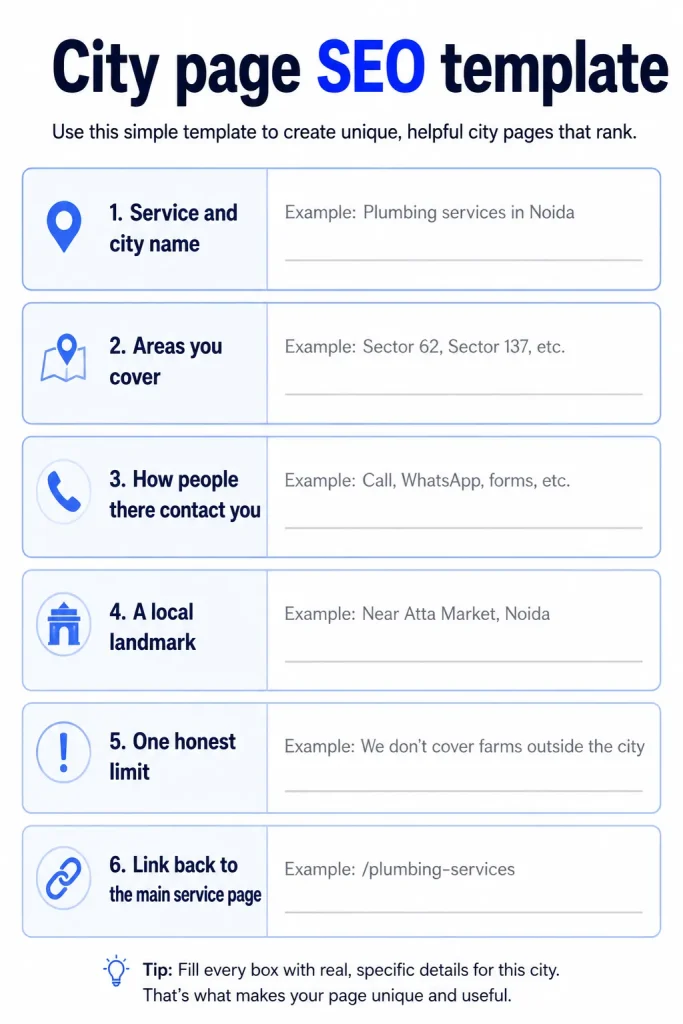
A city page SEO template you can copy today
Copy this out for each town you work in and fill in the brackets. Notice that most of it cannot be answered without knowing your own business, which is exactly why it will not end up sounding the same twice.
[Service] in [City]
Most of our [City] jobs are around [two or three specific areas, colonies or sectors], where [one thing that tends to come up in those areas more than elsewhere].
[One sentence on how people there usually reach you, if it is different from your general pattern — for example, if WhatsApp gets more use there than the phone.]
[One landmark a local resident would recognise, used naturally rather than as a list — “near the Sector 62 metro station” rather than just naming the sector.]
[One honest limit — how far from the centre you go, or one part of the town you do not currently cover.]
For the full details of how [service] works and what it costs, see [link to your hub page].
To book in [City], call [number] or [WhatsApp / form].
If you cannot fill in three or more of those brackets honestly for a particular town, that is worth noticing, because it usually means you do not have enough real activity there yet to justify a page of its own, and a thin page you cannot honestly fill in is worse for your site than no page at all.
What to write if you have no shop or office in every town
Some of what has been said so far assumes a fixed base in each town, and plenty of businesses do not have one. A painter, a wedding photographer or a mobile car detailer often works across a wide area without a shop front anywhere inside it, and for a business like that, city page SEO in the strict sense does not really apply. What you are writing is service area page content instead, and the honesty at the centre of it shifts slightly: rather than naming a landmark near your premises, you are naming the edge of where you will travel, and rather than describing a base, you are describing a pattern of work across an area. The rest of the method, real detail over generic claim, stays exactly the same, and the standard for good local landing page copy does not drop just because there is no shop front to describe.
Frequently asked questions about how to write city pages for local SEO
Is it worth learning how to write city pages for local SEO, or is this just extra work? They do help, but only the ones written the way described above. Pages built by swapping a town name rarely rank for anything, because Google has no reason to treat them as separate from each other. Pages built around real local detail can rank for searches that include the town name, which your main service page usually cannot reach on its own.
What is the difference between city page SEO and location page SEO? In practice, nothing. City page SEO and location page SEO are two names for the same idea, and which one a person uses usually just depends on which term they came across first. Some people also use “service area page content” for the same thing when the business does not have a fixed address in the town being written about.
How is a city page different from a Google Business Profile listing? A Google Business Profile is a listing Google controls the format of, while a city page is a page on your own website that you fully control, and the two work best together rather than instead of each other.
Should every town I work in get its own page? Not necessarily. A town where you have done real, regular work deserves its own page. A town you have visited twice deserves a mention on a broader area page instead, because a page built from almost nothing tends to hurt a site rather than help it.
Can I use the same photos on more than one city page? Only if the work in the photo genuinely happened in both places, and it is worth being honest with yourself about how often that is true. A photo taken in one town, captioned for another, is the same underlying problem as copied text, just in a different form.
What to do next
Pick your two busiest towns, open both pages side by side, and read them the way a visitor would, one after the other. If you could swap the city names between the two paragraphs without anybody noticing, that is the page to fix first, and the template above will get you most of the way there in under half an hour. That, in the end, is the whole answer to how to write city pages for local SEO: once your pages are genuinely different from each other, the next thing worth deciding is how many of them you actually need, since more pages is not automatically better.

2 thoughts on “How to Write City Pages for Local SEO (With Examples)”