
Before and After Plumber Website Copywriting: A Plumber’s Home Page Rewritten
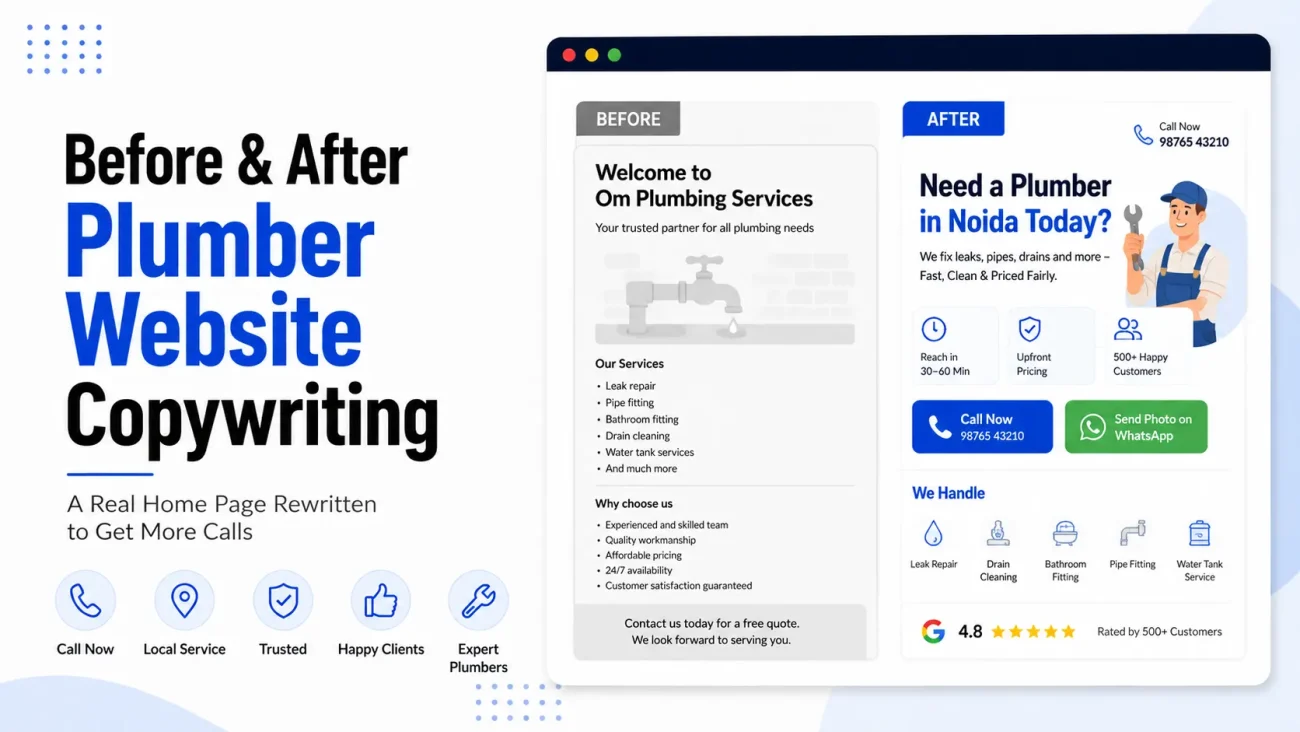
The fastest way to learn plumber website copywriting is not to read rules about it, it is to watch a real home page get taken apart and put back together, because the mistakes are much easier to see in somebody else’s copy than they are in your own. That is what this article does. Below is a home page you have probably seen a version of a hundred times, followed by the same page rewritten line by line, with the reasoning behind every change laid out so you can apply it to your own site without guessing.
Both versions you are about to read are composites, built from patterns that turn up again and again across real plumbing websites, not the wording of any one business. That matters for two reasons. It means the mistakes in the “before” version are not being pinned on anybody in particular, and it means the improvements in the “after” version are patterns you can actually reuse, rather than one business’s private wording.
Why most plumber website copywriting sounds the same
Almost every plumber’s home page is trying to do the same job, which is to convince a stranger with a wet floor that this is the person to call in the next five minutes, and yet almost every plumber’s home page uses the same handful of sentences to try to do it. This is not because plumbers are bad at writing. It is because there is a default version of plumber website content that everybody reaches for when they are in a hurry, usually copied loosely from whichever competitor’s site came up first, and once one plumber in a city has that copy, four more end up with something close to it.
The result is that a visitor comparing three plumbers in the same area often cannot tell them apart from the home page alone, and when nothing on the page tells them apart, price becomes the only thing left to decide on, which is rarely the outcome the business actually wanted.
The plumber home page before
Here is the composite home page. Read it the way a visitor would, quickly and while distracted, because that is the only way it is actually read in real life.
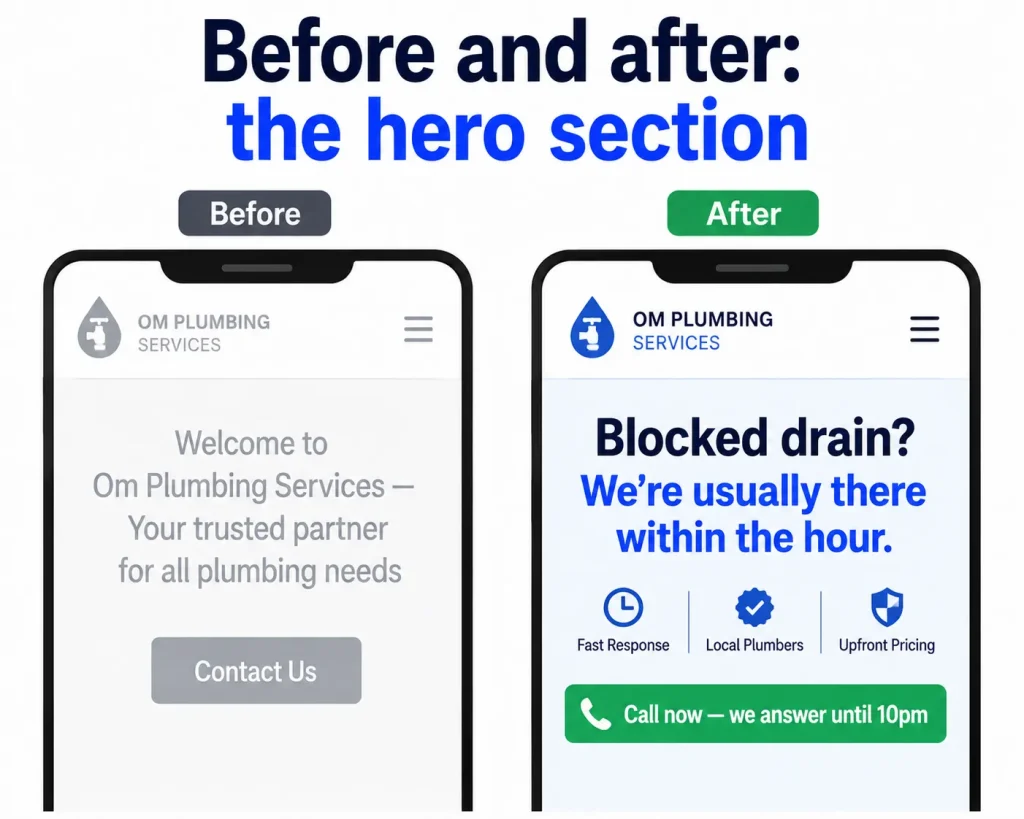
[Hero heading] Welcome to Om Plumbing Services
Your trusted partner for all plumbing needs
[Sub-heading] We are a leading plumbing service provider committed to delivering quality workmanship and 100% customer satisfaction. With years of experience in the industry, our team of skilled professionals is here to solve all your plumbing problems.
[Services]
- Leak repair
- Pipe fitting
- Bathroom fitting
- Drain cleaning
- Water tank services
- And much more
[Why choose us]
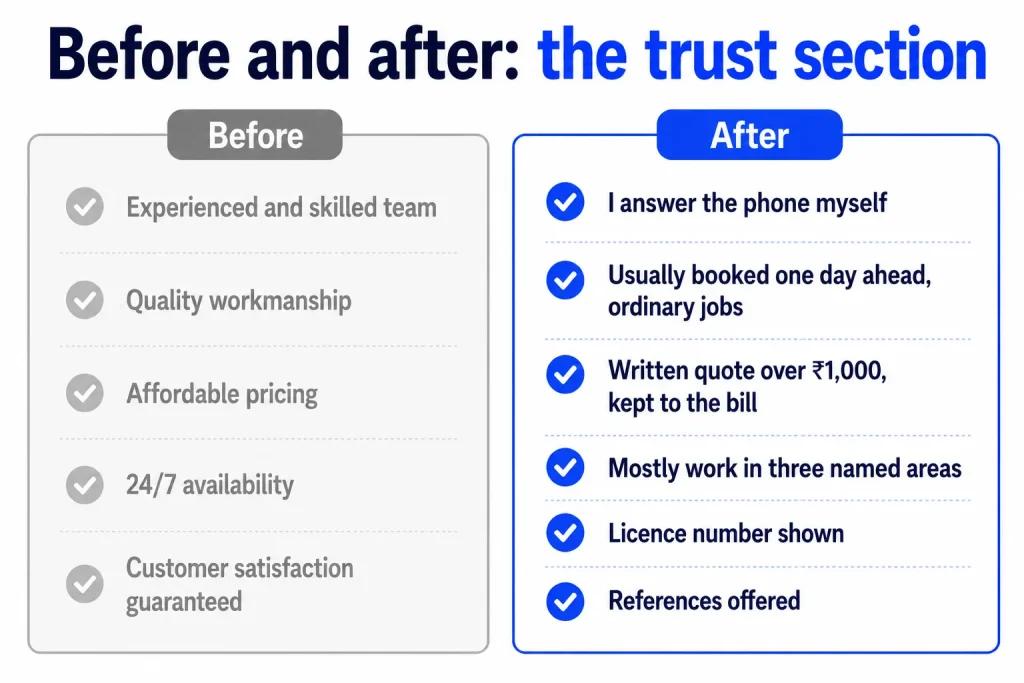
- Experienced and skilled team
- Quality workmanship
- Affordable pricing
- 24/7 availability
- Customer satisfaction guaranteed
[Footer] Contact us today for a free quote. We look forward to serving you.
Nothing in this page is technically wrong, which is exactly the problem with it. Every claim in it could sit on any plumber’s site in any city in the country without a single word needing to change, and a page that could belong to anybody does not actually belong to the plumber whose name is at the top of it.
Why this plumbing website copy fails
Look closely and the page is not short of words, it is short of anything a reader could act on. “Trusted partner” and “quality workmanship” are not facts, they are the kind of thing every business says about itself, so a reader’s mind quietly discounts them the moment they are read, the same way you stop hearing a radio playing in the next room.
The service list has the same problem from a different angle. “Leak repair” and “pipe fitting” tell the reader what category of work happens here, but not what a specific job costs, how fast someone can arrive, or which of these jobs this plumber actually does most. And the “why choose us” list is the part that damages the page most, because “24/7 availability” and “customer satisfaction guaranteed” are promises with no proof attached to them, and a promise with no proof reads as marketing rather than as fact, however true it might genuinely be. This is the single most common trap in plumber website copywriting: filling the page with words that sound confident but prove nothing.
The same page, rewritten
Here is the rewrite. Every line answers a question the visitor was actually holding, and nothing in it needed a copywriter’s vocabulary to write, only the details the business already had sitting in the owner’s head. This is what plumber website copywriting looks like once it is built from real detail instead of habit.
[Hero heading] Blocked drain or a leak that won’t stop? We’re usually there within the hour.
[Sub-heading] Om Plumbing Works has been fixing homes and small offices across Indore since 2014. It’s me and three others, and between us we handle around 40 jobs a week, mostly blocked drains, leaking taps and geyser fitting.
[Services, with detail]
- Blocked drains — most jobs cleared same day, ₹350 call-out which comes off the bill if you go ahead
- Leak repair — taps, pipe joints and under-sink leaks, usually fixed in one visit
- Geyser installation and repair — all major brands, and we carry common spare parts on the van
- Bathroom fitting — full fitting for new bathrooms, usually a 3 to 5 day job depending on size
- Water tank cleaning — quarterly and one-time, ₹800 for a standard rooftop tank
[Why call us]
- I answer the phone myself on most calls, not a call centre
- We are usually booked one day ahead on ordinary jobs, and same day for blocked drains and leaks
- Every job over ₹1,000 gets a written quote before we start, and that figure is the figure on the bill
- We mostly work in Vijay Nagar, Bhawarkuan and the areas around AB Road, so if you’re further out, ask before booking
- Licence number PL/IND/2014/3312, and I’m happy to give you two numbers of people we’ve worked for
[Footer] Call 98xxxxxxxx, or send a WhatsApp message with a photo of the problem — it usually gets you a faster answer than a call does.
This version is not trying harder than the first one, it is simply saying more of what was already true.
Why each change works
There are really only four things happening across the whole rewrite, and all four apply to any trade, not only plumbing, which is why the same four ideas turn up in good plumber homepage copy again and again.
The headline names the problem instead of the business. “Welcome to Om Plumbing Services” tells the reader who you are before they have decided they care, while “Blocked drain or a leak that won’t stop?” meets them in the exact moment they are searching, which is usually the moment they have a wet floor and forty seconds of patience left.
Numbers replace adjectives everywhere they can. “Years of experience” becomes “since 2014”. “Affordable pricing” becomes an actual figure. “24/7 availability” becomes an honest statement about when the business is usually booked. A number cannot be copied by a competitor without becoming a lie, which is exactly why it works, and it is the single habit that does the most to separate real plumber website content from the generic version of it.
The services list answers cost and speed, not just category. Knowing that a plumber does “leak repair” tells a visitor almost nothing they did not already assume. Knowing the call-out charge, and roughly how long the job takes, tells them whether to keep reading or call immediately, which is the whole point of a home page.
One honest limit makes the rest of the page believable. Admitting that ordinary jobs are usually booked a day ahead is a small thing to say, and it is the sentence that makes every other claim on the page easier to trust, because a business willing to tell you one inconvenient fact is a business you assume is telling the truth about the convenient ones too.
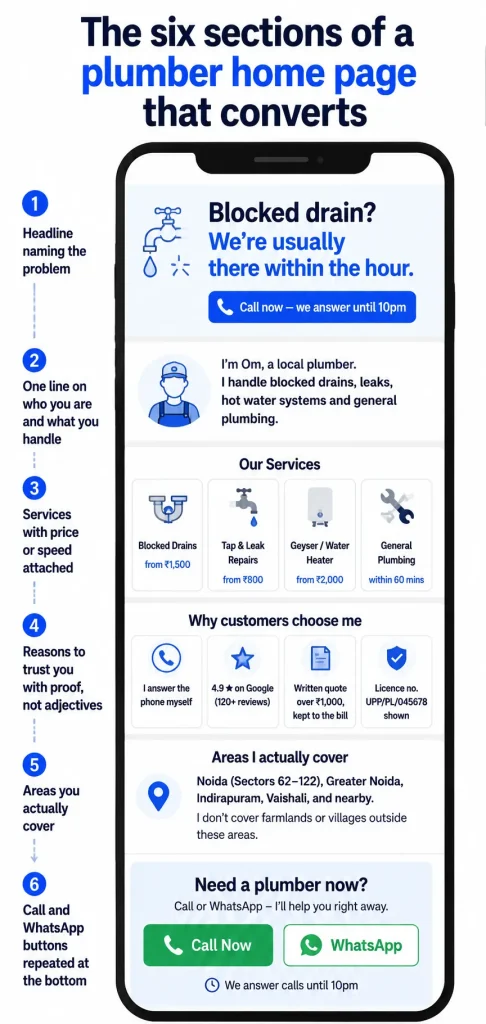
Turning this into your own plumbing website copy
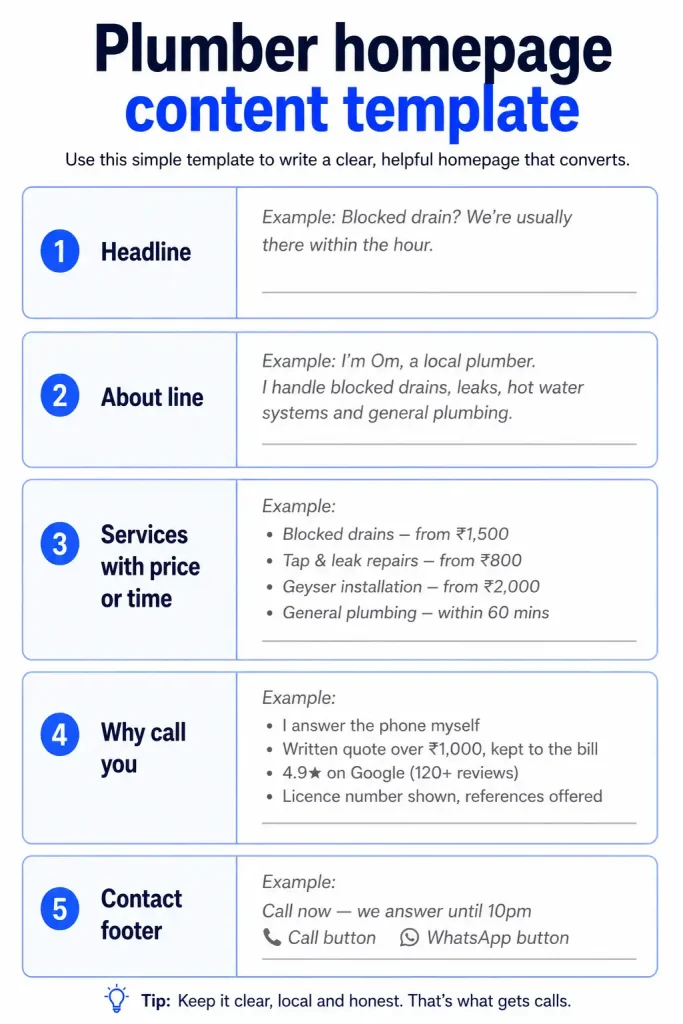
You do not need to copy the example above word for word, and you should not, because the whole point is that your version needs to be built from your own numbers rather than borrowed ones. What you can copy is the shape of it, which is really the whole method behind plumber website copywriting: take real detail you already know and put it where a habit or a cliché used to sit. Use this as a working structure for your own plumber homepage content, and fill in the brackets with what is actually true for your business.
[Headline] — name the problem your most common customer has, not your business name.
[One sentence] — who you are, since when, how many of you there are, and the two or three jobs that fill most of your week.
[Services] — each one with either a price, a rough time, or both. If a job varies too much for a fixed price, say what the visit costs instead.
[Why call you] — three or four points, each one something a competitor could not copy without lying. A licence number, a specific area, a real policy on quotes, a way to reach you personally.
[Footer] — your number, and a WhatsApp option if that is realistic for how your customers actually reach you.
Keep the whole page short enough to read on a phone in under a minute, because that is roughly how long most visitors are willing to give it before deciding.
Common plumbing website examples worth learning from
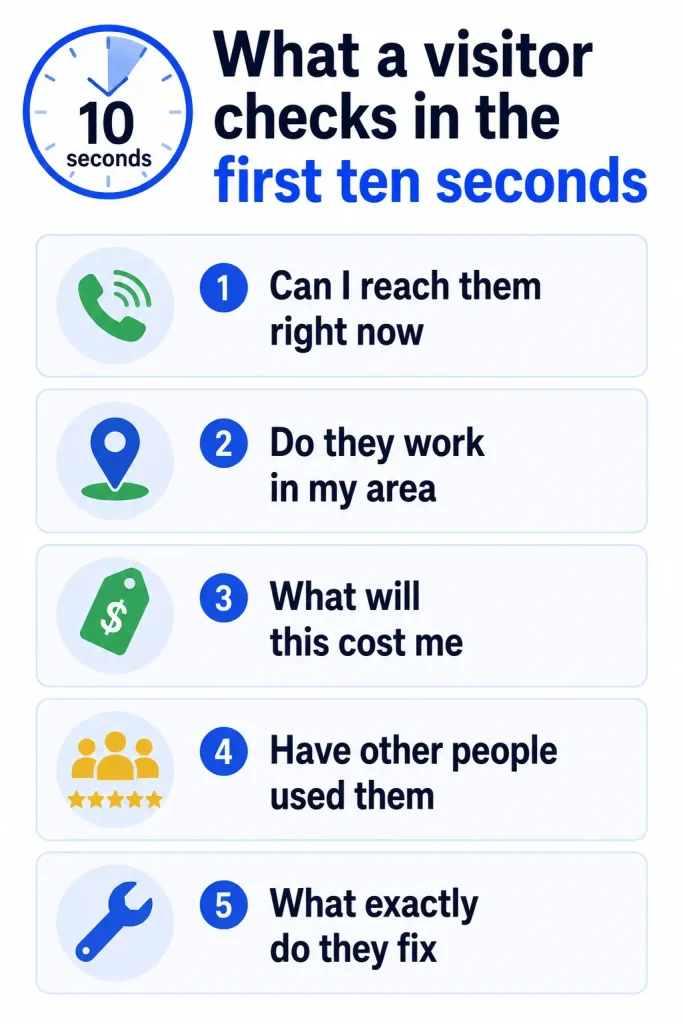
Reading other plumbing website examples is a reasonable way to learn, but it is worth doing carefully, because most of what is easy to find online is closer to the “before” version above than the “after” one, and copying a page that has the same problem does not fix anything. When you look at a competitor’s site, the useful question is not whether it looks professional, since most generic pages do. The useful question is whether you could answer the same five questions a visitor is asking — who, where, what it costs, why trust them, what happens next — from that page alone, using the same test applied to the composite examples in this article, which is really the test behind any plumber homepage content worth learning from.
Checklist before you publish your home page
Run through this list as a last check on your plumber homepage copy before it goes live.
- Does the headline name a problem or a benefit, rather than just the business name?
- Is there at least one number in the first two sentences — a year, a count, a price?
- Does every service on the list carry a price, a rough time, or both?
- Is there one honest limit stated somewhere on the page?
- Could a competitor copy any single sentence on this page without it becoming false for them?
- Would the whole page still make sense read out loud, the way you’d actually explain your business on the phone?
Frequently asked questions
How is plumber website copywriting different from copywriting for other trades? The underlying method is the same one used across this whole site, and it applies just as well to an electrician or a cleaning business as it does here. What changes with plumbing is the detail: the specific jobs, the specific fears (mainly water damage and cost), and the specific proof that matters, such as a licence number or the brands of geyser you can service. The method stays constant, only the content changes. That is the real core of plumber website copywriting — not special tricks for pipes and taps, just the same honesty applied to a different set of facts.
Do I need a professional photographer for my plumber home page? No. A clear phone photograph of you, your van, or a recent job is worth more than a polished stock photo of a stranger in a hard hat, because visitors have learned to recognise stock photography and it quietly reduces trust rather than building it.
Should every plumber home page include prices? Not every price needs to be fixed, but every service should say something about cost, even if that something is “free inspection, then a written quote before any work starts.” Leaving cost out entirely is one of the most common reasons visitors leave a plumbing website without calling.
How long should the home page be? Long enough to answer the five core questions and no longer. For most plumbing businesses that works out to somewhere between four hundred and seven hundred words across the whole page, including the service list, which is short enough to read on a phone without scrolling for a long time.
What to do next
Open your own home page next to the composite “after” version above and go section by section, checking whether your headline names a problem, whether your services carry any number at all, and whether your “why choose us” list could survive the test of a competitor trying to copy it. Most plumber website copywriting only needs the details that are already sitting in the owner’s head, written down properly for the first time, and that is usually a job you can finish in an afternoon rather than a week. Read: How to write an About page people actually believe.
Once your home page is done, the button underneath your new headline is worth a second look too, since a strong page wastes its work if the button at the bottom still says “Contact Us.”

2 thoughts on “Before and After Plumber Website Copywriting: A Plumber’s Home Page Rewritten”