
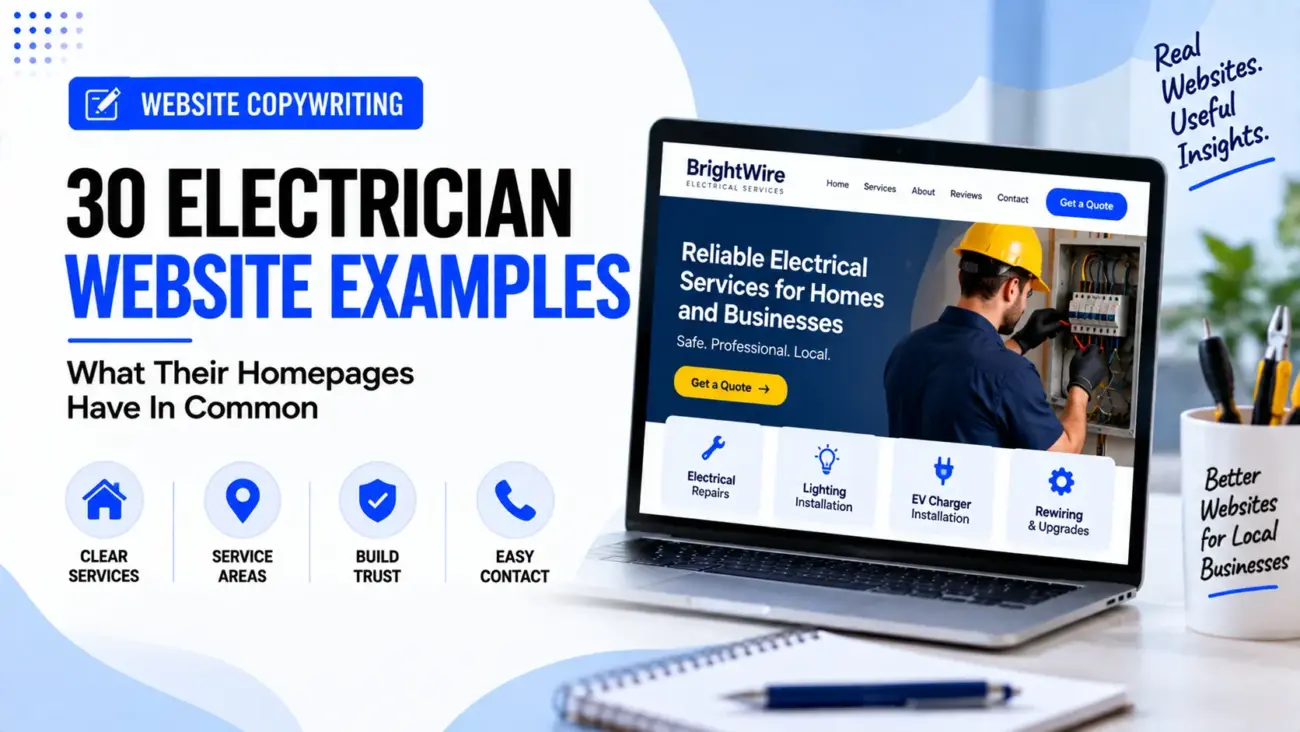
If we look at a large number of electrician websites, the designs can look very different at first. Some use dark backgrounds and large photographs, some use bright colours, some focus on emergency electrical work, while others mainly target commercial projects, EV charger installation or home electrical services. However, once we look past the colours and layouts, many of these websites are trying to solve the same customer questions.
The visitor usually wants to know what the electrician does, whether the electrician serves their area, whether the business looks trustworthy, how quickly they can make contact and what they should do next. Current collections of electrician website examples repeatedly show these elements, including clear service sections, service areas, reviews, contact details, real project photographs and visible calls to action.
That makes Electrician Website Examples useful for more than design inspiration. They can also show us how electrical businesses explain their services, present trust information and organise their homepages. Instead of copying the appearance of another electrician’s website, we can study what information keeps appearing and then ask why that information is useful to a customer.
This article looks at those common patterns from a copywriting point of view. The goal is not to decide which electrician website is the best, but to understand what a good electrician homepage needs to communicate clearly.
What We Learn From Electrician Website Examples
A useful way to study Electrician Website Examples is to ignore the colours and animations for a moment and read the homepage as a customer would. The first question is whether we can understand the business quickly. The second is whether we can see what services are available. The third is whether we can tell where the electrician works. After that, we need enough information to decide whether contacting the business feels reasonable.
Recent electrician website collections show that these basics appear again and again. Jobber’s 2026 collection, for example, highlights clear contact information, mobile-friendly design, service pages, service areas, reviews, team photographs and quote or booking forms as common elements. Wix’s current electrician examples similarly recommend showing services, service areas, customer reviews and clear contact or quote buttons.
This tells us something important about Electrician Website Content: the homepage does not need to explain every electrical service in detail. Its main job is to help the visitor understand the business and move to the right page or contact option.
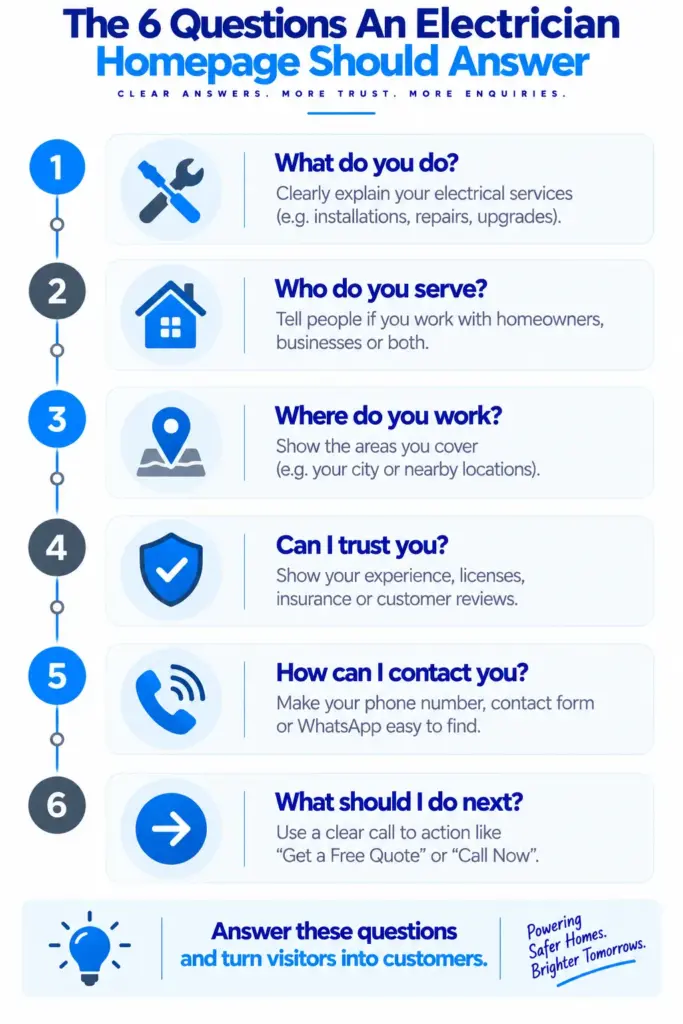
1. The Homepage Says What The Business Does
The first common pattern across Electrician Homepage Examples is simple: the visitor should not have to work out whether the website belongs to an electrician. The main headline normally makes the service clear, while the supporting text explains the type of electrical work offered.
A weak headline might say:
Powering Your Future
There is nothing wrong with the phrase as a brand message, but it does not tell a new visitor what the business actually does.
A clearer version could be:
Residential Electrician In [City] For Repairs, Installations And Upgrades
The supporting sentence can then add more detail:
We provide electrical repairs, lighting installation, rewiring and other residential electrical services across [service area].
The headline does not need to contain every keyword. It simply needs to make the main service clear enough for a person arriving from Google, a referral or a local directory.
Google’s Search Essentials recommends using words that people would use to look for the content and placing them in prominent locations such as the title and main heading, while also focusing on helpful, reliable, people-first content.
2. The Main Services Are Easy To Find
A second common pattern in Electrician Website Examples is a clear service section. The electrician may provide many different types of work, but the homepage normally highlights the main services instead of putting everything into one large paragraph.
For example:
Electrical Services
Electrical Repairs
Fault finding, damaged wiring, switches, sockets and other common electrical repairs.
Lighting Installation
New lighting, replacement fittings, outdoor lighting and other lighting work.
Rewiring
Electrical rewiring for homes that need updated or replaced wiring.
EV Charger Installation
Installation of suitable home EV charging equipment.
Electrical Inspections
Electrical checks and inspections where offered by the business.
The important point is not the exact services in this example. The website should list the services the electrician actually provides and use names that customers understand.
A common Electrician Website Mistake is writing “Complete Electrical Solutions” and then expecting the visitor to click through to discover what that actually means. A clearer service list removes that extra step.
3. The Homepage Does Not Try To Explain Every Service
While service information is important, the best structure is not necessarily a homepage containing 2,000 words about every electrical job. Current electrician website guides commonly recommend dedicated service pages for specific jobs such as panel upgrades, rewiring, lighting, EV chargers or emergency electrical work.
This creates a simple relationship between the homepage and service pages.
The homepage says:
Need an electrician for your home?
We provide electrical repairs, installations, upgrades and inspections across [area].
Then the visitor can click:
Electrical Repairs →
Rewiring →
EV Charger Installation →
Lighting Installation →
Each service page can then answer more detailed questions.
This is better Electrician Website Copy because each page has a clear job. The homepage introduces the business, while the service pages explain individual services in more detail.
Our earlier article, “A Fill-In-The-Blank Service Page Template” explains how the homepage can introduce services and send visitors to detailed service pages.
4. The Service Area Is Clearly Stated
Another repeated feature in Electrician Homepage Examples is location information. Customers do not usually want to hire an electrician who does not work in their area, so the homepage should make the service area easy to understand.
A simple section might say:
Electrical Services Across [City] And Nearby Areas
We provide residential electrical services across [City], including [Area 1], [Area 2], [Area 3] and nearby areas.
The exact locations should be genuine service areas. Do not create a long list of towns simply because their names have search volume.
Google says local results are mainly based on relevance, distance and prominence, and recommends complete and accurate business information to help Google understand what a business does and where it operates.
This is why location information is useful, but it should be written for people first.
A list such as:
Delhi electrician, Delhi electrician service, Delhi electrician near me, best electrician Delhi, electrician Delhi NCR…
does not make the homepage better. It simply makes the writing unpleasant.
5. The Homepage Shows Evidence Of Actual Work
An electrician website can describe many services, but examples of completed work give visitors something more concrete to understand. A homepage can use project photographs, short project descriptions or small case examples to show the type of work the business actually carries out.
For example:
Recent Project: Home Rewiring in [Area]
Rewiring work completed for a residential property, including replacement of outdated wiring and electrical testing.
Or:
Recent Lighting Installation
New interior and exterior lighting installed at a residential property in [City].
The purpose is not to turn the homepage into a portfolio. A few relevant examples can be enough to show the type, scale and location of work the electrician handles.
This is particularly useful when the business provides several different services. Instead of simply listing “rewiring, lighting and electrical repairs”, real project examples can demonstrate those services in context.
6. The Homepage Shows What Type of Electrical Customer It Serves
Electricians do not all serve the same type of customer, and this can often be understood from the homepage. Some businesses mainly work with homeowners, while others focus on landlords, property managers, shops, offices, builders or larger commercial properties.
This information can help visitors decide quickly whether the business is relevant to their needs. A homeowner looking for lighting installation does not necessarily need the same information as a property manager looking for ongoing electrical maintenance.
For example:
Electrical Services For Homeowners
Repairs, lighting, rewiring, installations and other electrical work for residential properties.
Or:
Electrical Services For Businesses And Property Managers
Electrical maintenance, repairs, installations and planned work for offices, shops and managed properties.
The important point is that the homepage should reflect the customers the business actually wants to serve. There is no need to list every possible customer type simply to make the website appear broader.
This also gives the homepage a clearer content structure because the services, examples and calls to action can then be written around the needs of the actual audience.
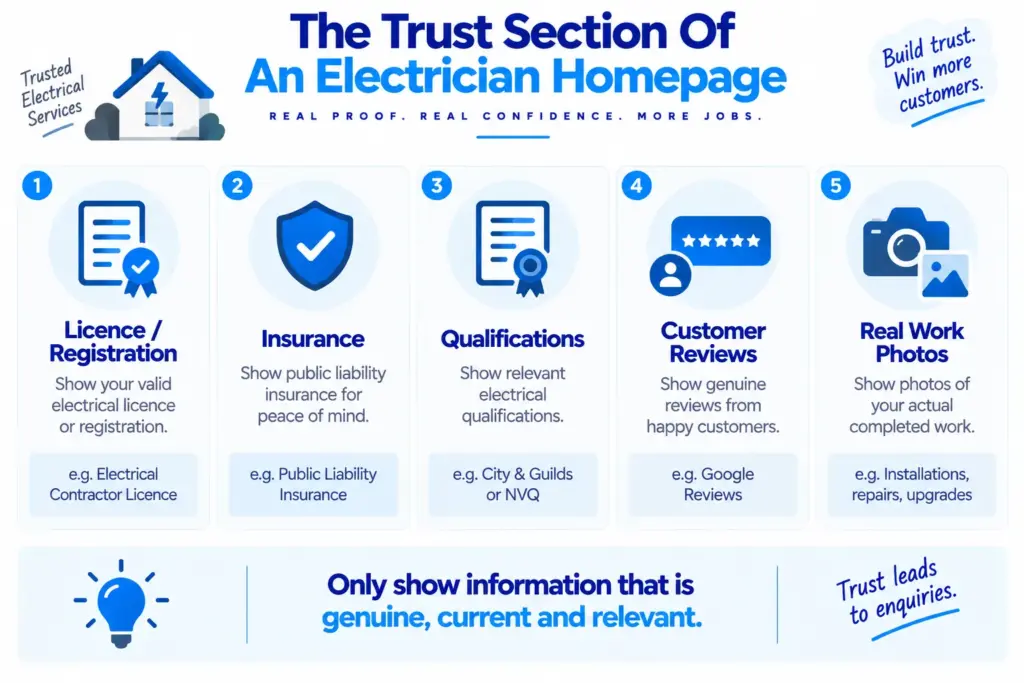
7. Trust Information Appears Before The Visitor Has To Search For It
Electrical work involves safety, so trust information matters. Current electrician website examples commonly make licences, certifications, insurance or professional credentials visible when these apply to the business and jurisdiction.
The wording should be factual rather than vague.
Instead of:
The Most Trusted Electricians
the website could say:
Licensed Electrical Contractor
Licence No. XXXXX
or:
Qualified Electricians
[Relevant qualification or registration detail]
The exact requirements vary by location, so the website should only display credentials that are current and relevant.
This is one of the more important lessons from Electrician Website Analysis because electrical customers often cannot judge the technical quality of a job simply by looking at the finished website. Clear business information and relevant credentials can help explain who is behind the service.
8. Real Work Photos Are More Useful Than Generic Electrical Images
Many electrician websites use photographs of electricians, electrical panels, tools, wiring, houses or lighting. The more useful question is not whether a photo looks attractive, but whether it helps the customer understand the business.
A real photograph of the electrician working on an actual project can provide context that a generic stock image cannot. The same applies to photographs of completed installations, EV chargers, lighting projects, consumer units or other work, provided the photographs genuinely represent the business.
This does not mean every electrician needs a professional photoshoot. Good photographs taken during real work can be useful when they are clear and presented properly.
The image can also have a simple caption:
EV charger installation at a residential property in [City]
or:
Consumer unit replacement completed in [Area]
This creates useful context without turning the image caption into a keyword list.
9. Reviews Are Used As Evidence, Not Just Decoration
Customer reviews appear frequently across Electrician Homepage Examples, but the way they are presented matters. A section saying “Our Customers Love Us” followed by one anonymous sentence is not as useful as genuine reviews that give some context about the work.
For example:
“The electrician replaced several faulty sockets and explained what needed to be changed before starting the work.”
This tells the visitor what type of job the business handled.
The website can also introduce reviews with simple copy:
What Our Customers Say
Read feedback from customers who have used our electrical services.
Google says reviews and helpful replies can help businesses stand out, and its local ranking guidance notes that reviews are one of the information sources considered in local prominence.
The important point is to use genuine reviews. Do not invent testimonials simply to make the homepage look complete.
10. The Homepage Explains Who The Electrician Serves
Not every electrical business serves the same customers. Some focus on homes, some on commercial properties, some on industrial work, and some work across several groups.
A homepage can make this clear:
Electrical Services For Homes And Businesses
Then divide the offer:
Residential
Repairs, installations, lighting, rewiring and other home electrical work.
Commercial
Electrical installation, maintenance and repair for offices, shops and other commercial properties.
If the electrician only works with homeowners, there is no need to add commercial information simply because competitor websites do it.
This is a useful lesson from Electrician Website Analysis: the homepage should reflect the actual business model rather than copying the structure of a larger electrical contractor.
11. The Copy Explains The Process
A short process section can answer another common customer question: “What happens after I contact you?”
For example:
How It Works
1. Tell us what you need
Call or send an enquiry with a short description of the electrical work.
2. We discuss the job
We ask for the information needed to understand the work and arrange a suitable visit.
3. We carry out the work
The agreed electrical work is completed according to the confirmed scope.
The process should reflect the real business. If the electrician provides quotations before visiting, say so. If some small jobs can be booked directly, explain that instead.
The process is not there to fill space. It reduces uncertainty.
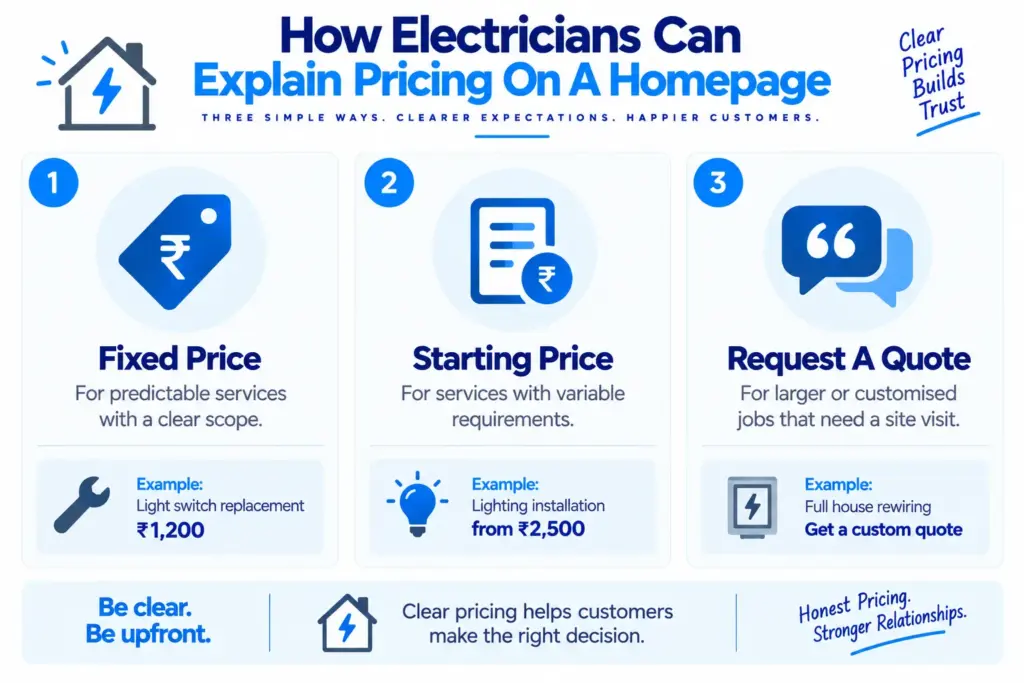
12. Pricing Information Is Handled Carefully
Price is another common feature in Electrician Website Examples, but there is no single correct way for every electrician to display it. Small, predictable jobs may have clear prices, while larger work such as rewiring, upgrades or complex installations may need a quotation.
Wix’s current electrician website guidance similarly notes that predictable smaller services can use clearer pricing, while larger jobs may need starting prices or quote-based wording.
For example:
Electrical inspection from ₹X,XXX
Final pricing depends on the property and inspection requirements.
Or:
Need a quote for rewiring?
Tell us about the property and the work required, and we will explain the next step.
The important thing is to avoid vague promises such as “cheapest electrician in town” unless the business can genuinely support such a claim.
Our earlier article, “Website Pricing Strategy: Should You Put Prices on Your Website?” explains how electricians can decide between fixed prices, starting prices and quotation-based services.
13. The Homepage Gives Visitors A Reason To Explore Further
A homepage does not need to answer every question itself. One useful pattern is to give visitors enough information to understand the business and then guide them toward pages where they can learn more.
For example, the services section might introduce three main areas:
Electrical Repairs
Common electrical faults, repairs and troubleshooting.
View Electrical Repair Services →
Rewiring
Electrical rewiring for properties that need updated wiring.
Learn About Rewiring →
Lighting Installation
Interior, exterior and replacement lighting work.
View Lighting Services →
This creates a clear relationship between the homepage and the rest of the website. The homepage introduces the service, while the individual page provides the detailed information needed by someone who is considering that service.
The same approach can be used for areas served, customer types and project examples. Instead of putting every detail on the homepage, the website can give visitors a useful overview and provide a clear route to deeper information.
14. The Navigation Uses Customer Language
Another pattern in Electrician Website Examples is simple navigation. The main menu normally includes some combination of Home, Services, About, Reviews, Areas or Contact, with additional pages depending on the business.
The service names should also be understandable.
Instead of:
Solutions
use:
Electrical Repairs
Instead of:
Capabilities
use:
Services
Instead of:
Coverage
use:
Areas We Serve
The website can still have a professional tone without using business language that customers would not normally search for.
15. Mobile Reading Is Treated As A Basic Requirement
Electricians are often searched for while someone is away from a desktop computer, so the mobile version of the homepage needs to make basic information easy to find. Current electrician website guidance repeatedly recommends mobile-friendly layouts and easy contact options.
From a copywriting point of view, this means the homepage should not depend on huge blocks of text. The important information should be easy to scan:
Electrician in [City]
Repairs | Installations | Rewiring
[Call Now] [Request Quote]
Then the page can provide more detail as the visitor scrolls.
This does not mean every paragraph needs to be one or two lines. Good website copy can still use proper, connected paragraphs, but the page should have enough headings and useful sections to make longer information easy to navigate.
What Most Electrician Homepages Have In Common
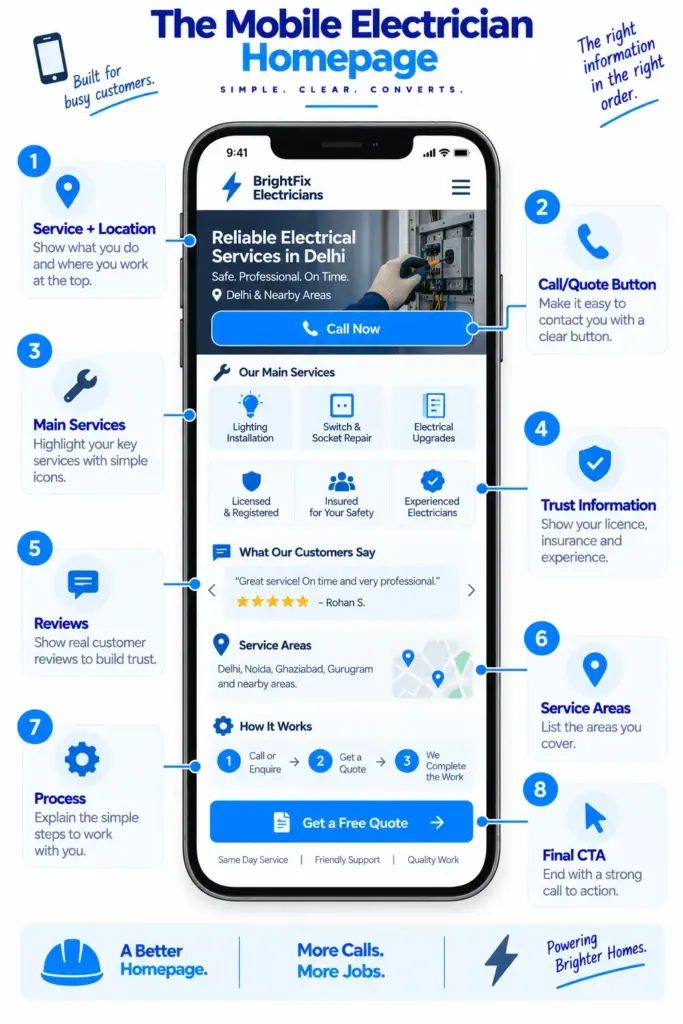
When we put these patterns together, the similarities become much easier to see. The homepage is not really trying to be a long company brochure. It is trying to answer a small group of practical customer questions and then help the visitor take the next step.
Across current Electrician Website Examples, the common structure looks roughly like this:
Hero
What the electrician does + where they work + clear contact action.
Services
The main electrical services, with links to detailed pages.
Trust
Relevant qualifications, licences, insurance, experience or other genuine proof.
Reviews
Real customer feedback that gives some context.
Service Areas
The city, towns, suburbs or areas genuinely covered.
Process
A short explanation of what happens after the enquiry.
Work Examples
Real photographs or project examples where available.
Final CTA
A clear way to call, request a quote or discuss the job.
The order can change depending on the business, but the information itself appears repeatedly because these are the questions customers need answered.
What We Should Not Copy From Other Electrician Websites
Studying Electrician Website Examples does not mean copying the exact words, package names or layout from another business. The useful part of research is identifying patterns and then adapting them to our own business.
There are several things worth avoiding when looking at competitor websites.
Generic claims
Best electrician in the city.
Empty service descriptions
We offer complete electrical solutions.
Unclear locations
Serving the whole region.
Unsupported guarantees
Guaranteed same-day service.
Fake urgency
Call now before all appointments disappear.
Keyword-heavy copy
Electrician in Delhi, Delhi electrician, best electrician Delhi, electrician near Delhi…
These phrases may fill a page, but they do not answer the visitor’s questions.
Google’s people-first guidance asks whether content provides original, useful information and whether readers leave feeling that they have learned enough to achieve their goal. That is a much better standard for reviewing electrician website copy than simply asking whether the keyword appears enough times.
A Simple Electrician Homepage Copy Template
Based on the common patterns found in current Electrician Homepage Examples, we can create a simple working structure for a local electrician.
H1
Electrician In [City] For Repairs, Installations And Electrical Upgrades
Introduction
We provide [residential/commercial] electrical services across [city and service areas], including [main services]. Contact us for [quotes/emergency help/bookings], depending on the service required.
Main Services
Electrical Repairs | Rewiring | Lighting | EV Chargers | Inspections
Why Customers Contact Us
Explain the real reasons customers choose the business, such as qualifications, local experience, clear communication or a specific service focus.
Reviews
Show genuine customer feedback.
Areas We Serve
Name the genuine locations served.
How It Works
Explain the enquiry, quotation and work process.
Recent Work
Show real project photographs where available.
Final CTA
Need An Electrician In [City]?
Call [number] or [request a quote].
This template is a starting structure, not a page that should be copied word for word. The strongest pages will add details based on the actual electrician and the customers they serve.
Our earlier article, “How to Write a Headline for a Local Service Website” explains how to turn the electrician’s service and location into a clear homepage headline.
The Biggest Electrician Website Mistakes To Check
Before publishing or redesigning an electrician homepage, it is useful to check for the problems that appear repeatedly across weaker examples.
The first is a homepage that looks attractive but does not clearly say what the business does. The second is a services section that uses broad phrases without explaining the actual work. The third is hiding the service area, which forces visitors to search for an answer that should be obvious. Another problem is placing the phone number or quote option too far down the page, particularly when the business handles urgent work.
Other problems include using only stock photographs, hiding important credentials, showing vague testimonials, creating huge walls of text, using too many generic buttons, and creating separate location pages that contain almost the same content.
That last point matters for local SEO. Google specifically warns against doorway abuse, including substantially similar pages targeted at different regions or cities. If an electrician serves several locations, the website should create location pages only when they have a genuine purpose and useful information rather than simply changing the city name.
A Final Electrician Homepage Review
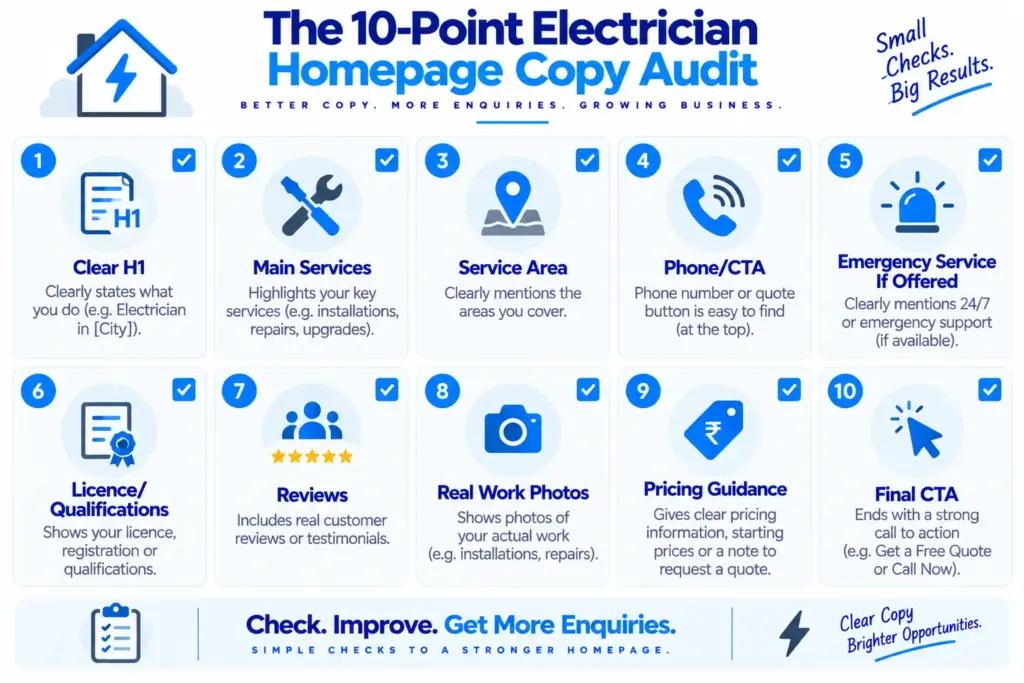
Before publishing an electrician homepage, read it as if you have never heard of the business. Start at the top and ask whether you can understand the service immediately. Then check whether you can find the service area, the main services, relevant trust information, customer reviews and a clear way to make contact.
Next, check the copy itself. Are the claims specific? Does the website explain what the electrician actually does? Are emergency services mentioned only when genuinely available? Are qualifications and licences accurate? Are the service areas real? Does the pricing information match the actual business process?
Finally, check the links. Each service should lead to a useful service page where more information is available. The service-area information should make sense. The contact buttons should lead somewhere useful, and the visitor should not have to click through several generic pages to reach the actual enquiry process.
The Main Lesson From 30 Electrician Website Examples
The most useful lesson from studying Electrician Website Examples is that a good homepage does not need to be complicated. The businesses may work in different markets and offer different services, but the basic information visitors need remains quite similar.
People want to know what the electrician does, whether the electrician works in their area, whether the business appears legitimate and suitable for the job, and how they can make contact. A homepage that answers those questions clearly has a stronger foundation than one that spends most of its space describing how professional, reliable or customer-focused the business is.
The research also shows why Electrician Website Copy should be specific. “Electrical solutions” tells us very little, while “residential electrical repairs, lighting installation and EV charger installation” gives the visitor something they can understand. The same principle applies to location, trust, pricing and calls to action.
The goal is therefore not to build the most impressive-looking electrician website. It is to build a website where the customer can quickly understand the business and find the information needed to take the next step. That is the common thread worth taking from Electrician Website Examples.
And when the homepage does its job properly, the rest of the website becomes easier to structure as well. Service pages can answer detailed service questions, area pages can provide genuine local information, the About page can explain the people and credentials behind the business, and the contact page can make the final enquiry simple.
That is a much more useful way to study competitor websites: do not copy what they look like; understand what information they are trying to communicate, then make that information clearer and more useful on our own website.