
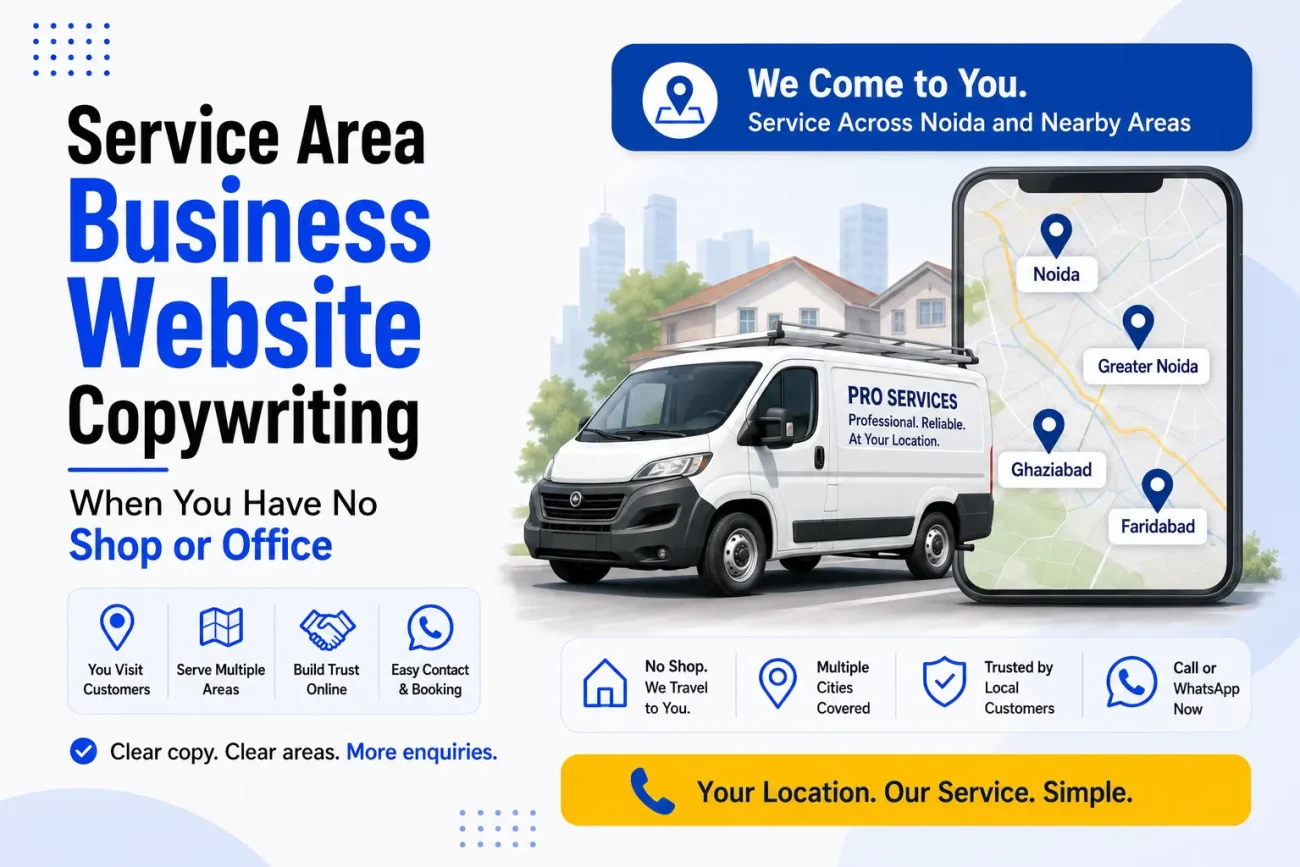
A business does not always need a shop, office or customer-facing location to have a useful local website. Plumbers, electricians, cleaners, mobile mechanics, photographers, landscapers and many other service businesses may travel to customers instead of asking customers to visit them. In these cases, the website has a different job because it needs to explain not only what the business does, but also where the business provides its services.
This is where Service Area Business Website Copywriting becomes important. When there is no shop or office that customers can visit, the website needs to make the service area clear without making the business look less trustworthy. A customer should be able to understand that the business is real, that it works in their area and that they can contact it even though there is no public address to visit.
The challenge is that some businesses try to solve this by adding city names everywhere. The homepage may mention the same city ten times, and then the business creates separate pages for every nearby town using almost the same text. This does not make the website more useful. Good service area copy should instead explain how the business works, which areas it covers, what customers can expect and why the business is a good choice for people in those locations.
What Is a Service Area Business?
A service area business is a business that travels to its customers instead of mainly serving customers at a public business location. A plumber who visits homes, an electrician who travels to properties, or a mobile car mechanic who repairs vehicles at the customer’s location are simple examples.
This type of business can still have a strong Service Area Business Website. The important difference is that the website should not give the impression that customers can walk into a shop or office if that is not actually the case.
For example, instead of writing:
Visit our office in Noida for plumbing services.
a plumber who travels to customers could write:
We provide plumbing services at homes and businesses across Noida and nearby areas. Call us or send your location to check availability.
The second version is much clearer because it explains how the business works. It does not try to hide the lack of a public location, and it gives the customer a simple way to move forward.
The same approach can work for many businesses that do not have a customer-facing location. The website should focus on the service being delivered rather than making the lack of an office seem like a problem.
1. Be Clear About How Your Business Works
The first step in Service Area Business Website Copywriting is to explain the business model in simple words. Do not make visitors guess whether you visit customers, work from a home office, meet at project locations or provide mobile services.
For example, an electrician could write:
Electrical Services at Your Property
We visit homes and small businesses across Noida for electrical repairs, installations and other common electrical work. We do not have a customer-facing shop, so all work is carried out at your property by appointment or based on emergency availability.
This short explanation removes a possible question before the customer needs to ask it.
A mobile mechanic could use:
Mobile Car Repairs at Your Location
We come to your home, workplace or another agreed location in Greater Noida to handle common car repairs and maintenance.
The goal is not to apologise for having no office. If the business model is based on visiting customers, that is simply how the service works.
A Local Business Without Physical Location can still look professional and trustworthy when the website clearly explains the service process.
2. Make the Homepage About the Service, Not the Missing Office
A common mistake is spending too much time explaining why the business does not have a shop or office. Customers are usually more interested in whether you can solve their problem.
Instead of beginning with:
“We don’t have a physical office, but…”
start with the service:
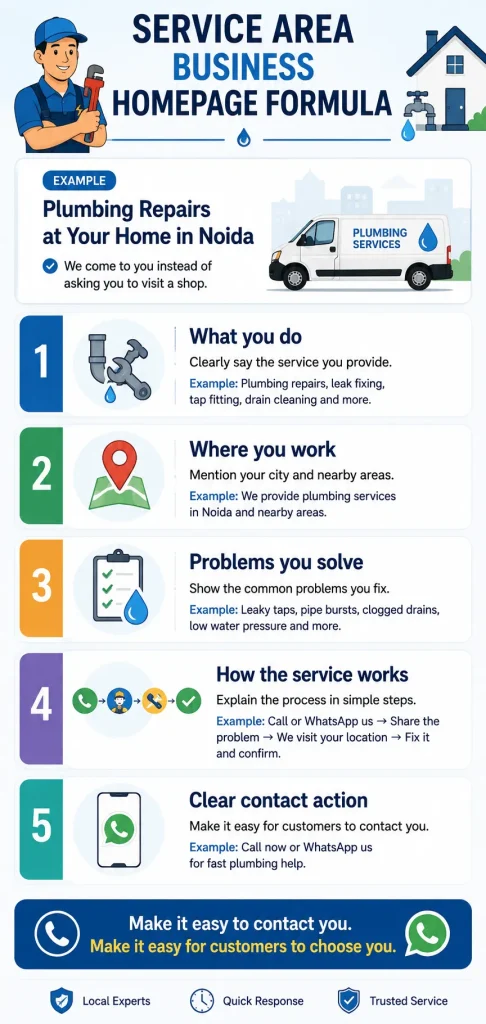
Plumbing Repairs at Your Home in Noida
We visit homes and small businesses across Noida for leaking taps, blocked drains, pipe repairs, bathroom plumbing and other common plumbing problems.
Then, if needed, explain the business model later:
We are a service-area plumbing business, so we come to you rather than asking you to visit a shop.
This approach keeps the customer’s needs at the centre of the page. The fact that there is no public office becomes useful information rather than the main story.
Your homepage should answer three basic questions early:
- What service do you provide?
- Which areas do you serve?
- What should the customer do next?
Once those questions are clear, you can add reviews, service details, pricing information, photographs and other trust information.
3. Clearly Explain Your Service Areas
A Service Area Website Content strategy should make the service area easy to understand without turning the page into a list of keywords.
If you serve Noida, for example, you can mention the main areas where you regularly work:
Areas We Serve in Noida
We regularly provide plumbing services in Sector 18, Sector 22, Sector 27, Sector 50 and nearby residential areas. If you are outside these locations, send us your address before booking and we will confirm whether we can visit.
This is more useful than writing:
“Plumber Noida, plumber Sector 18, plumber Sector 22, plumber Sector 27, plumber Sector 50.”
The second example may contain location terms, but it does not help the person reading the page.
Your location information should describe real service coverage. If some areas have limited availability or additional travel charges, explain that clearly where appropriate. This helps customers understand what to expect before contacting you.
You should also avoid claiming that you serve an entire city or region if you regularly turn away customers from parts of it. Accurate service area information is more useful than a large list of locations that the business does not actually cover.
4. Create Location Pages Only When You Have Something Useful to Say
A Location Page For Service Area Business can be useful when a business serves several important locations, but creating a separate page for every nearby town is not automatically a good SEO strategy.
Imagine a cleaning company serves Noida, Greater Noida and Ghaziabad. It may make sense to create separate pages for these locations if customers genuinely search for the service in each area and the business can provide useful information about serving them.
For example, a Noida page could discuss the types of homes the business commonly cleans, the main service areas, common booking requirements and how customers can arrange a visit. A Ghaziabad page could contain different local information where appropriate.
The problem starts when every page looks like this:
Cleaning Services in Noida
We provide professional cleaning services in Noida.
Then:
Cleaning Services in Ghaziabad
We provide professional cleaning services in Ghaziabad.
Then:
Cleaning Services in Greater Noida
We provide professional cleaning services in Greater Noida.
Changing only the city name does not create three genuinely useful pages. Your location pages should have a real reason to exist.
If you want to learn how to create useful city-focused pages rather than simply changing location names, see our guide on City Pages For Local SEO.
5. Explain Why Customers Choose a Service Area Business
Some customers may feel more comfortable with a business that has a shop or office because they can visit the location if they have a question. A service area business can answer this concern by explaining the benefits of its service model.
For example:
Why choose a mobile electrician?
You do not need to take time out of your day to visit a shop. We come to your home or workplace, inspect the electrical problem at the property and explain the available repair options.
The important thing is to describe real benefits rather than making broad claims such as “better than every local electrician.”
A service area business may be convenient because the customer does not have to travel, but the actual benefit depends on the type of service. A mobile mechanic can work at the customer’s location, while a photographer may travel to a wedding venue. Explain the benefit that is actually relevant to your business.
This is an important part of Service Area Business Website Copywriting because the website needs to make the service model feel normal and useful rather than unusual.
6. Show Customers What Happens After They Contact You
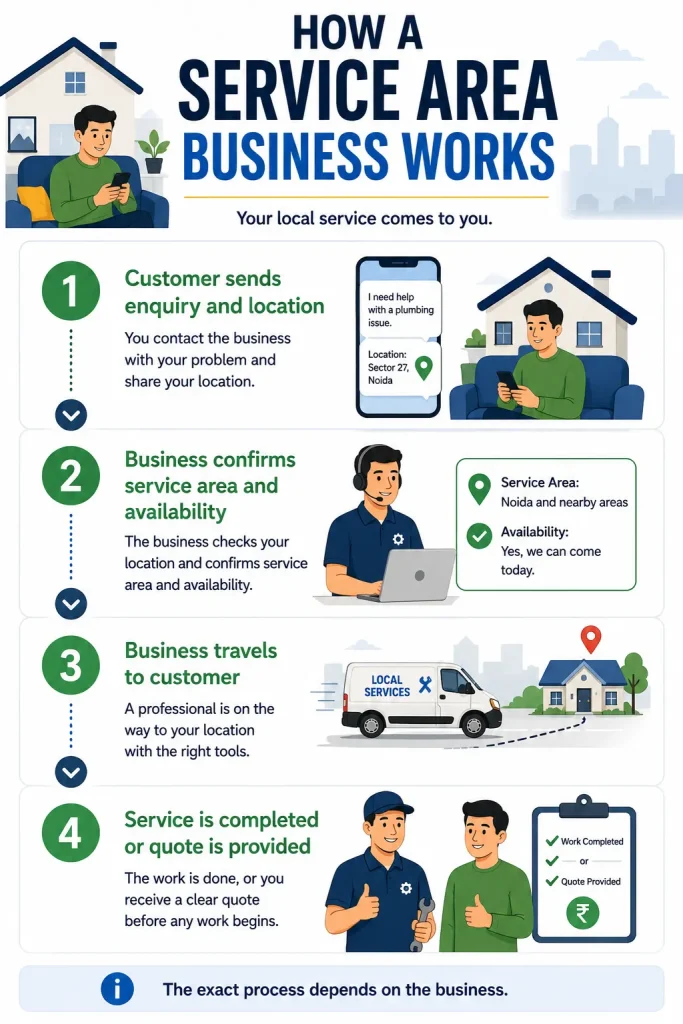
When customers cannot visit a shop or office, they may have more questions about how the service works. The website can answer these questions with a simple process.
For example:
How Our Service Works
1. Tell us what you need
Send us your location and a short description of the service you need.2. We check availability
We confirm whether we cover your area and discuss a suitable time.3. We come to you
Our team visits the agreed location and checks the work required.4. We explain the next step
For larger jobs, we explain the work and price before starting.
This type of information is useful because it removes uncertainty. The customer does not have to wonder whether they need to visit somewhere first or whether the business will simply arrive without confirming the appointment.
Keep the process accurate. If your business requires an advance payment, inspection or booking confirmation, include it. The website should reflect what actually happens.
7. Build Trust Without a Shop Address
A common concern for a Local Business Without Physical Location is how to show that the business is real. A public shop address is one type of trust signal, but it is not the only one.
A service area business can use genuine customer reviews, photographs of completed work, information about the team, years of experience, relevant qualifications and a clear description of the service process.
For example:
Serving homes across Noida since 2019
We have completed plumbing repair and maintenance work for homes and small businesses across the city. Customers can contact us with their location and service requirement before arranging a visit.
This is much stronger than:
We are Noida’s most trusted plumbers.
The first statement provides information that a customer can understand. The second is simply a claim.
Your About Us page can explain more about the business, but the main service and location pages should still contain enough trust information for someone who has never heard of you.
If you are working on the trust section of your website, our guide explains how to create an About Us Page People Actually Believe without filling it with general claims.
8. Be Honest About Your Business Address
If your business does not have a public shop or office, do not create a fake location just because you think having an address will make the website look more local. The website should accurately describe where customers can receive the service.
You can write:
Service area: Noida and nearby areas
Customer visits: We travel to your home or business location.
This is enough for many service businesses.
The important thing is that the website, business listings and other public information should not give customers the impression that they can walk into a location if there is no customer-facing office there.
The copy should explain the actual business model instead of trying to make it look like a traditional shop-based business.
9. Use Local Information Naturally
Good Service Area Website Content should contain useful local information, but that does not mean every paragraph needs to repeat the city name.
For example:
We provide emergency electrical repairs for homes and small businesses across Noida. Our team regularly travels to residential areas including Sector 18, Sector 27 and Sector 50. If you are not sure whether your address is covered, send us your location before booking.
This paragraph naturally contains the city and relevant areas because the information is useful.
You can also mention local service conditions when they are genuinely relevant. A landscaper could explain that certain types of garden work are common in the local area. A mobile mechanic could mention that it serves customers at homes and workplaces. A cleaning company could explain how apartment size affects the service.
The key is to write information for local customers rather than writing paragraphs simply to include location keywords.
10. Write a Strong Service Area Page
A good Location Page For Service Area Business should have a clear purpose. It should not be a copy of the homepage with a different city name.
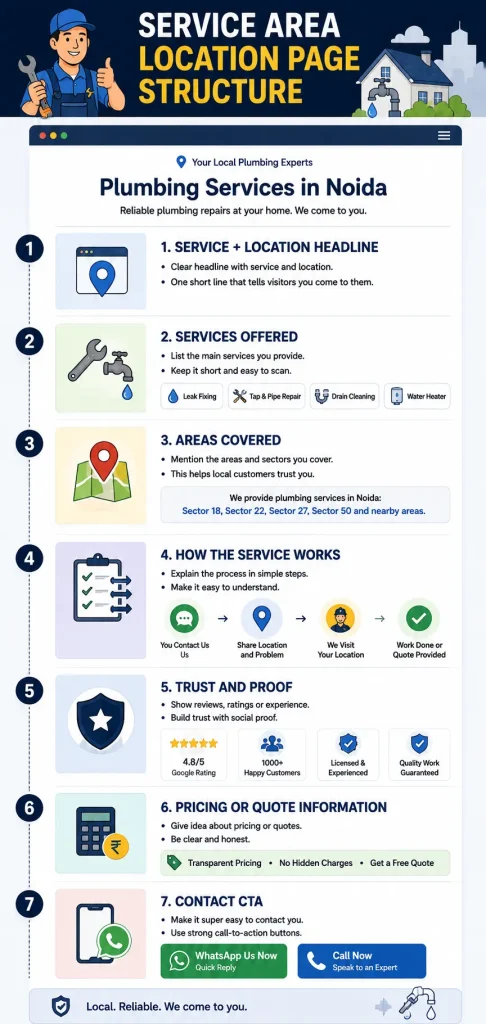
A simple structure can look like this:
[Service] in [Location]
Start with a clear introduction that explains the service and location.
Services We Provide
Explain the main services that customers in this location can book.
Areas We Cover
Mention the neighbourhoods or nearby areas that are genuinely served.
How Our Service Works
Explain how customers book and how the business travels to them.
Why Customers Choose Us
Add genuine trust information, reviews or useful proof.
Pricing or Quote Information
Explain fixed prices, starting prices or how quotes are provided.
Common Questions
Answer questions that customers in the area may have.
Contact / Booking
Give the customer a clear next step.
This structure gives the page a natural flow from service → location → process → trust → action.
If your business has several service areas, you can also organise them using a Hub and Spoke Structure, where a main service area page connects with useful individual location pages.
11. Do Not Create Fake Local Content
One of the easiest ways to make a location page look weak is to add made-up local details simply because the page needs to be different from another location page.
For example, a plumber should not claim to have “many customers in Sector 50” unless that is true. A cleaning company should not say that its team knows every apartment complex in a city if it does not. The same applies to local landmarks, customer stories and project examples.
Use information that the business can actually support.
If you have completed a genuine project in a location, you can talk about it. If customers regularly ask for a certain service there, you can mention it. If you do not have location-specific information, it may be better to keep the page focused on the actual service area rather than inventing local details.
This approach also makes your content easier to maintain because you are not trying to remember which local claims were written on which page.
12. Explain Pricing When Customers Cannot Visit You
A customer who cannot visit a shop may also wonder how they will receive a price. Your website should explain the process.
For a mobile repair business, you might write:
How we provide quotes
Send us your location and a description of the problem. Where possible, we may ask for photographs before arranging a visit. For larger jobs, we inspect the work and explain the cost before starting.
For a photographer:
Event photography pricing
Share your event date, location and expected hours, and we will recommend a suitable package and provide a quotation.
This information makes the service easier to understand and can reduce unnecessary questions.
If you are unsure how much pricing information should appear on a service business website, our guide to Website Pricing Strategy explains when fixed prices, starting prices and price ranges can work.
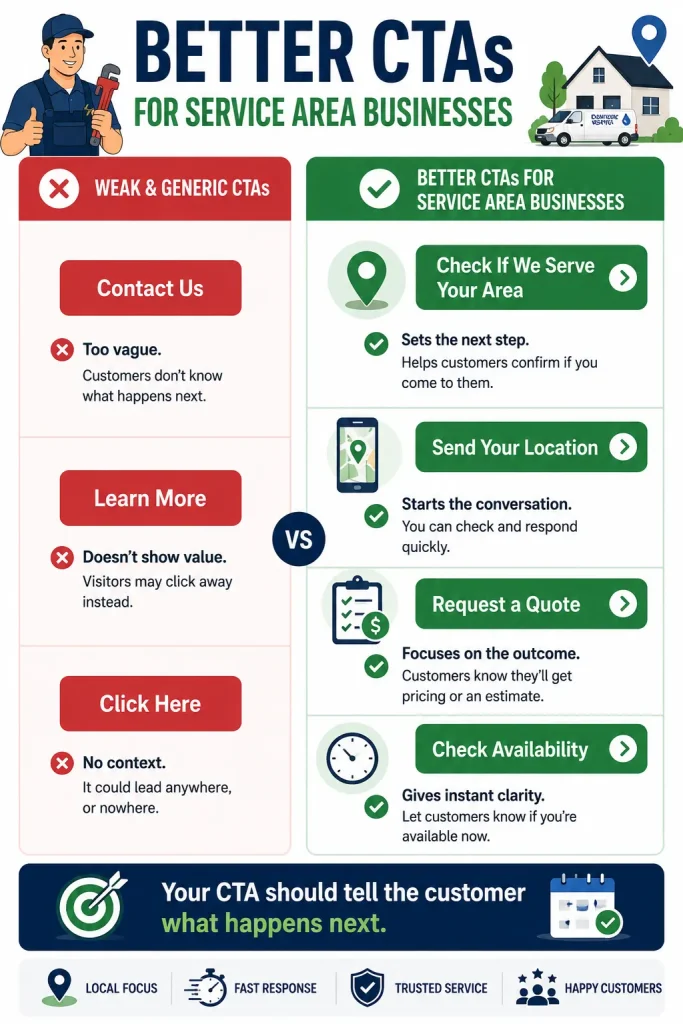
13. Use a Clear CTA for a Service Area Business
A service area business often needs the customer to provide their location before the business can confirm whether it can help. Your CTA should reflect that.
Instead of:
Contact Us
try:
Check If We Serve Your Area
or:
Send Your Location for Availability
or:
Request a Quote for Your Area
The CTA should match the actual next step. If you need to speak to the customer first, use a phone CTA. If you normally collect enquiries through WhatsApp, make that option clear.
A good CTA does not need to sound exciting. It simply needs to tell the customer what they can do next.
14. What Should You Put on a Service Area Business Website?
If you are building a website from the beginning, you do not need dozens of pages. Start with the information customers need most.
A simple Service Area Business Website could include:
- A clear homepage explaining the service and main service area
- Individual service pages for important services
- Useful location pages where there is enough local information
- An About Us page with genuine business information
- A contact or booking page
- Reviews or other trust information
- Pricing or quote information where appropriate
The exact structure depends on the business. A plumber may need separate pages for drain cleaning, leak repair and emergency plumbing, while a photographer may need pages for wedding photography, family photography and corporate photography.
The important thing is that every page should have a clear reason to exist. More pages do not automatically make a website better.
A Simple Example of Service Area Website Copy
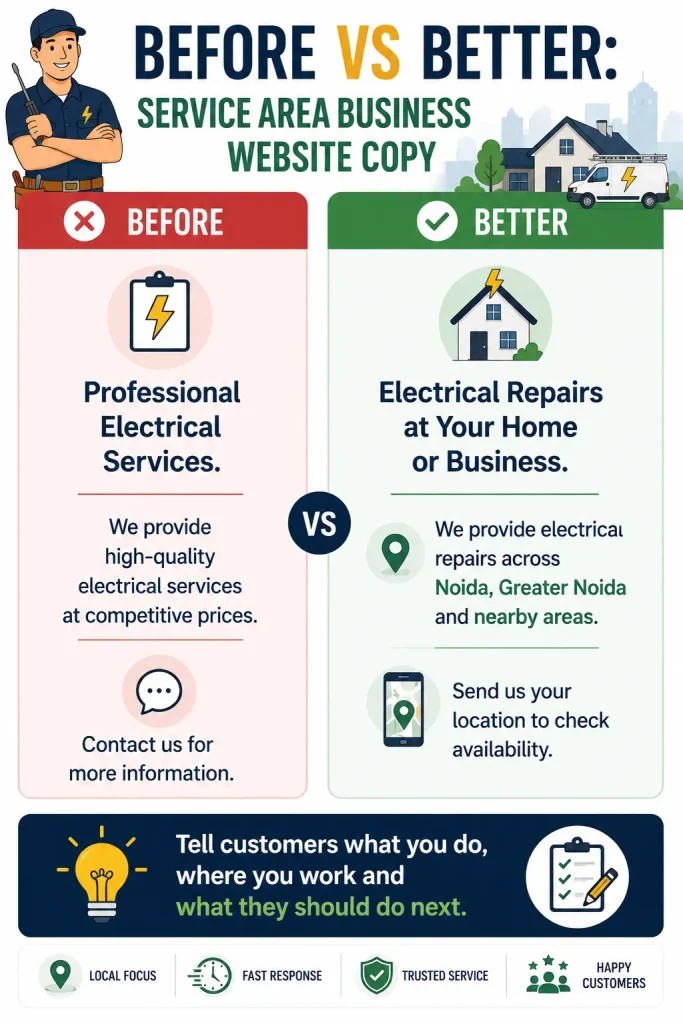
Imagine a mobile electrician serving three nearby cities. A weak homepage might say:
Professional Electrical Services
We provide high-quality electrical services at competitive prices. Contact us today for more information.
There is nothing obviously wrong with the grammar, but the customer still does not know where the electrician works, what problems they handle or how the service works.
A stronger version would say:
Electrical Repairs at Your Home or Business
We provide electrical repairs and installations across Noida, Greater Noida and nearby areas. Our electrician travels to your property for common electrical problems including faulty switches, lighting issues, power trips and wiring repairs.
Not sure if your address is covered? Send us your location and a short description of the work, and we will confirm availability before arranging a visit.
This is a better example of Service Area Business Website Copywriting because it explains the service model without making the lack of an office the main focus.
A Quick Checklist for Service Area Business Website Copy
Before publishing your website, read the homepage as if you are a customer who has never heard of your business. You should be able to understand the service, service area and next step without looking through several pages.
Then check the location pages and ask whether each page contains genuinely useful information or simply repeats another page with a different city name.
Your checklist should include:
- Clear explanation of the service
- Clear explanation that the business travels to customers
- Accurate service areas
- Useful location pages where appropriate
- Simple booking or enquiry process
- Genuine trust information
- Clear pricing or quote process
- A CTA that asks for the right next step
- No fake addresses or made-up local claims
- No large collection of repetitive city pages
If these basics are covered, the website has a much stronger foundation.
Final Takeaway
A business does not need a shop or public office to have a useful local website. What matters is that the website explains how the business works and gives customers enough information to feel comfortable contacting it.
Good Service Area Business Website Copywriting should make the service, location and next step clear. Instead of trying to hide the fact that customers cannot visit an office, explain that the business comes to them. Instead of filling location pages with repeated city names, provide real information about the areas served and how customers can book the service.
The strongest service area websites are usually simple. They explain what the business does, where it works, how the service works, what customers can expect and how to get started. When the copy answers these questions naturally, a business without a shop or office can still present itself as a clear and trustworthy local service provider.

2 thoughts on “Service Area Business Website Copywriting Without Shop or Office”