
A local business in India does not always serve a whole city in the same way. A plumber in Noida may get most of their work from a few sectors. A property consultant in Delhi may focus on particular colonies and residential pockets. A restaurant in Bengaluru may attract customers from nearby tech parks, metro stations and well-known neighbourhoods rather than from the entire city.
This is why a simple “City + Service” approach is often not enough.
A page targeting “real estate agent in Noida” is trying to cover a very large area. But a person searching for a property agent in Sector 62 may have a much more specific need. They may be looking for someone who understands the buildings, nearby offices, metro access, markets and residential areas around that particular part of Noida.
This is where a hyperlocal content strategy for Indian cities becomes useful. Instead of treating a city as one large location, we break it into smaller areas that people actually use when describing where they live, work, shop or want a service.
The important part, however, is not to create hundreds of pages just because we can name hundreds of areas. Each area page should have a real purpose and enough useful information to make it different from the other pages.
Why Standard Local SEO Can Be Too Broad In India
A basic local SEO plan often starts with keywords such as:
- Plumber in Delhi
- Interior designer in Mumbai
- Property dealer in Noida
- AC repair in Lucknow
- Dentist in Jaipur
These searches are useful, but they do not always describe the full way people look for local businesses.
Indian cities can contain large residential areas, planned sectors, old colonies, apartment communities, markets, industrial areas, business districts and smaller neighbourhoods within the same city.
A person may therefore search for:
“AC repair in Indirapuram”
instead of:
“AC repair in Ghaziabad”
Or:
“property dealer near Sector 137 Noida”
instead of:
“property dealer in Noida”.
This does not mean that every business needs a page for every locality. It means that our content planning should first understand how customers describe the places they actually care about.
Google says local results are mainly influenced by relevance, distance and prominence. It also recommends keeping business information complete and accurate so Google can better understand the business and match it with relevant local searches.
A hyperlocal content strategy for Indian cities takes this idea one step further at the website-copy level. We ask not only, “Which city does the business serve?” but also, “Which smaller areas matter to its customers?”
Our earlier article, “How To Write A Headline For A Local Service Website” explains how a local page should clearly communicate the service and location from the beginning.
Understanding India’s Micro-Geography
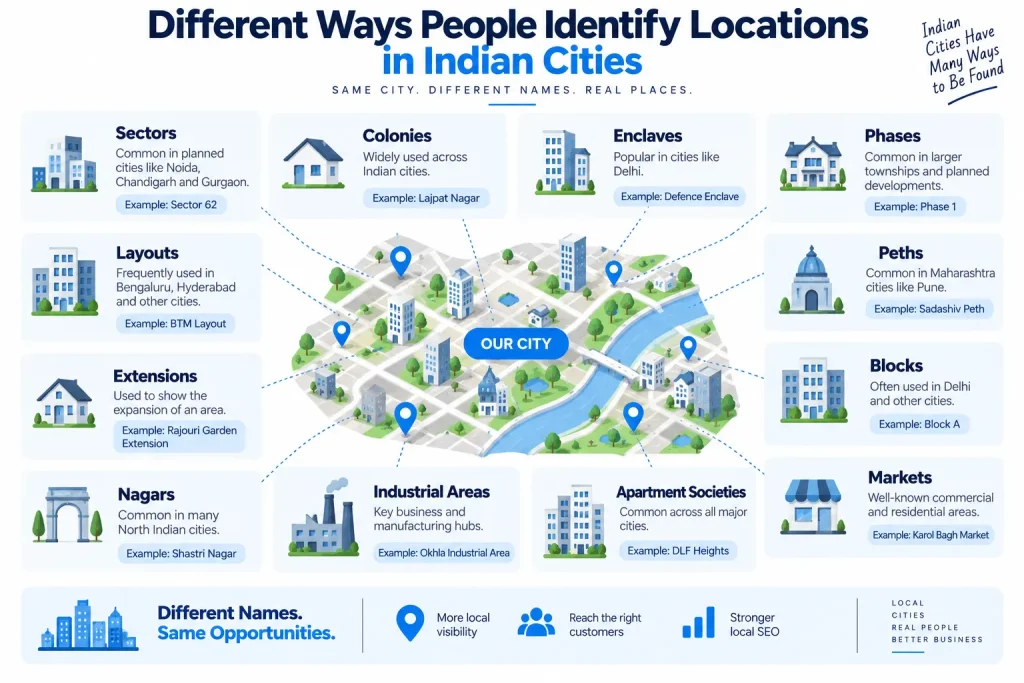
One reason local copywriting in India needs more care is that there is no single way of naming a neighbourhood.
Different cities and regions use different systems.
You may find:
- Sectors
- Colonies
- Enclaves
- Phases
- Layouts
- Nagars
- Peths
- Extensions
- Blocks
- Markets
- Industrial areas
- Apartment societies
- Villages that have become part of growing cities
This matters because customers often use these names naturally when describing their location.
Sectors And Phases
Planned cities and planned parts of cities often use sector or phase numbers.
Noida is an obvious example, with areas such as Sector 18, Sector 62, Sector 137 and many others. Chandigarh and parts of other North Indian cities also use sector-based addressing.
For a local business, a useful page might therefore focus on a particular sector when there is a genuine business reason to do so.
Instead of writing:
We provide professional services across Noida.
a more useful page could explain:
We provide home and office services in Sector 62 and nearby areas, with customers in residential societies and offices around the sector.
The second version gives the reader a clearer idea of who the business serves.
Colonies, Enclaves And Older Neighbourhoods
Older parts of Indian cities often have a very different local identity.
Delhi, for example, has well-known areas such as Defence Colony, Greater Kailash, Safdarjung Enclave and many other established neighbourhoods.
A customer may identify their location by the colony name rather than by a broader administrative area.
That creates opportunities for local SEO copywriting for sectors and colonies, but the same rule applies: the page needs genuine local information.
A colony page could discuss:
- The types of properties commonly served
- Nearby commercial areas
- Local service availability
- Access or parking issues where relevant
- The type of customers the business works with
- Nearby landmarks
- Actual service boundaries
We should not invent local details simply to make the page look local.
If a business does not serve Defence Colony, creating a page called “Service in Defence Colony” does not become a good SEO strategy simply because the keyword looks attractive.
Regional Names Matter Too
India’s local geography is not limited to sectors and colonies.
Pune has areas commonly referred to through terms such as Peth and Nagar. Mumbai has many neighbourhoods and areas where local names are more familiar than a broad city label. Bengaluru has layouts, extensions and neighbourhood names that people use in everyday conversations.
The exact naming system changes from city to city.
That is why a copywriter should research how people actually describe the area before creating location pages.
This is an important part of a hyperlocal content strategy for Indian cities. We are not simply adding more locations to a spreadsheet. We are learning the language customers use to identify where they are.
Why Landmarks Are Important In Local Copy
Think about how someone gives directions in an Indian city.
They may say:
“It is near the metro station.”
Or:
“The shop is opposite the main market.”
Or:
“We are close to the flyover.”
Or:
“The office is near the tech park.”
People often understand a location through familiar reference points.
This makes landmark-based content optimization useful when it reflects real local information.
For example, instead of writing:
We serve Indiranagar, Bengaluru.
a business could write:
We serve customers around Indiranagar, including areas close to the metro station and the main commercial streets.
This is more natural because the landmark or local reference helps explain the area.
However, we should be careful with exact travel claims such as “five minutes from X” unless the business can support that information. Traffic, routes and starting points can change, so copy should not make precise claims that are not reliable.
Useful Types Of Local Landmarks
Depending on the business and location, useful local references can include:
- Metro stations
- Bus terminals
- Major roads
- Flyovers
- Shopping markets
- Business parks
- Hospitals
- Colleges
- Schools
- Religious places
- Famous local shops
- Large residential communities
- Industrial estates
The purpose is not to create a list of landmarks.
The purpose is to help the reader understand where the service operates.
The Local Hook: Start With The Area
When writing an area page, the first paragraph should make it clear that the page is actually about that area.
For example, imagine a real estate business serving Noida.
Weak opening
We are a leading real estate company offering residential and commercial property solutions to customers. Our experienced team helps buyers find suitable properties.
This could appear on almost any real estate website.
Better opening
Looking for a home or investment property around Sector 137, Noida? Our team helps buyers compare available apartments and understand the location, nearby facilities and property options before making a decision.
The second version immediately tells the reader:
- Which area the page covers
- What service is offered
- Who the page is for
- What information the business can help with
This is the basic starting point for how to write city landing pages for Indian businesses.
The page should feel connected to the location from the beginning rather than adding the location name after several generic paragraphs.
Our earlier article, “How To Write A Google Business Profile Description That Gets Read” explains the importance of keeping business information clear, accurate and locally relevant across different online pages.
Build The Area Page Around Real Local Information
A good area page should do more than mention the name of a locality several times. It should explain how the business actually serves people in that particular location and what makes the service relevant to customers there. The goal is not to turn the page into a mini travel guide, but to connect the customer’s need with useful information about the area. When the local details support the customer’s decision, the page becomes more helpful and more meaningful.
For a home cleaning company serving a residential area, the page could explain the types of homes, apartments or societies the company normally serves. A property consultant could discuss the types of properties available in the area, nearby facilities and the factors that may matter to buyers or tenants. An electrician could explain the residential and commercial electrical services commonly provided in the area, while a restaurant could focus on genuine delivery coverage and the nearby locations it serves.
The information should always depend on the business and its customers. A real estate page will need different local information from an AC repair page, just as a restaurant will have different location-related details from an interior design company. This is why a geo-targeted copywriting framework should begin with the business model and customer needs rather than forcing every location page into the same fixed SEO template.
A Simple Structure For Indian Area Pages
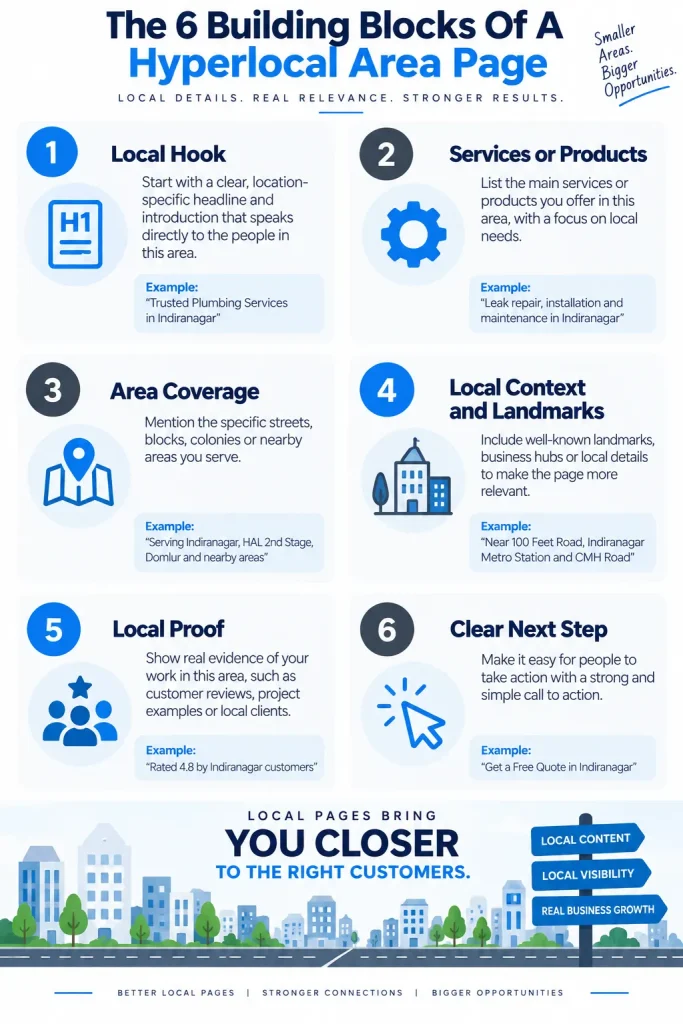
If we are creating an area page for a local business, this structure can work well.
H1: [Service] In [Area], [City]
The headline should clearly tell the visitor what the page is about.
Local Introduction
Explain the service and identify the specific area.
What We Offer
Explain the relevant services or products.
Areas And Nearby Locations We Cover
Mention genuine nearby areas, sectors, colonies or communities where appropriate.
Local Context
Add useful information about landmarks, access, property types, customer needs or other relevant local factors.
Why Customers Choose The Business
Use real strengths rather than empty claims.
Local Proof
Add genuine reviews, case studies, photographs or examples connected to the area where available.
FAQs
Answer questions customers may have about the service and location.
Contact Or Next Step
Tell the reader what to do next.
This structure is simple enough to repeat but flexible enough to avoid creating identical pages.
Add Local Pain Points Carefully
One of the strongest parts of hyperlocal copy can be information about problems that are genuinely relevant to an area.
For example, a property-related business may need to explain:
- Apartment types
- Gated societies
- Parking
- Nearby offices
- Schools
- Public transport
- Rental demand
A home service business may need to explain:
- Apartment access
- Society entry requirements
- Parking for service vehicles
- Availability during working hours
- Service coverage
But we should never assume that a particular area has a problem just because it sounds local.
For example, writing:
“Parking is always difficult in this colony.”
is a factual claim.
If the business has no basis for making it, it is better to avoid it.
Instead:
“If parking or society access may affect the visit, customers can share the property details when making an enquiry.”
The second version still helps the customer without pretending to know something we have not verified.
Use Local Social Proof When It Exists
Local proof can make an area page much more believable.
Imagine a real estate company has actually helped customers buy homes in Sector 137.
A useful page could include:
“We recently helped a family compare apartment options in Sector 137 based on their budget, work location and preferred school access.”
That is more useful than:
“We have many happy customers.”
The same idea works for service businesses.
If a plumber has completed work in specific societies and has permission to mention them, that information can make the page more relevant.
If there are genuine reviews from customers in the area, they can also provide useful context.
Google notes that information about businesses can come from many sources, including the business website, public information, users and other sources. Keeping business information accurate and consistent therefore matters beyond the copy on a single page.
Scaling Area Pages Without Creating Thin Pages
This is where many local SEO projects go wrong. Imagine a company wants to create pages for 40 different sectors in Noida. The easiest approach would be to create one page and simply replace “Sector 62” with “Sector 63”, then repeat the same process for the remaining locations. This may give the website 40 different URLs, but it does not mean that the website has created 40 genuinely useful pages.
Google’s current documentation explains that when multiple pages are very similar, Google can group them and choose a representative canonical page. Duplicate content itself is not automatically a spam violation, but having substantially similar pages can still create indexing and user-experience problems. This is why simply changing the location name while keeping almost everything else the same is not a strong approach to building area pages.
The goal should not be to make every page 100% different just for the sake of creating unique content. Some parts of an area page can naturally remain similar because the business, services and general process do not change from one location to another. What needs to change is the information that actually matters to customers in that particular location.
Make every page genuinely useful for the location it represents.
A Practical 70/30 Approach
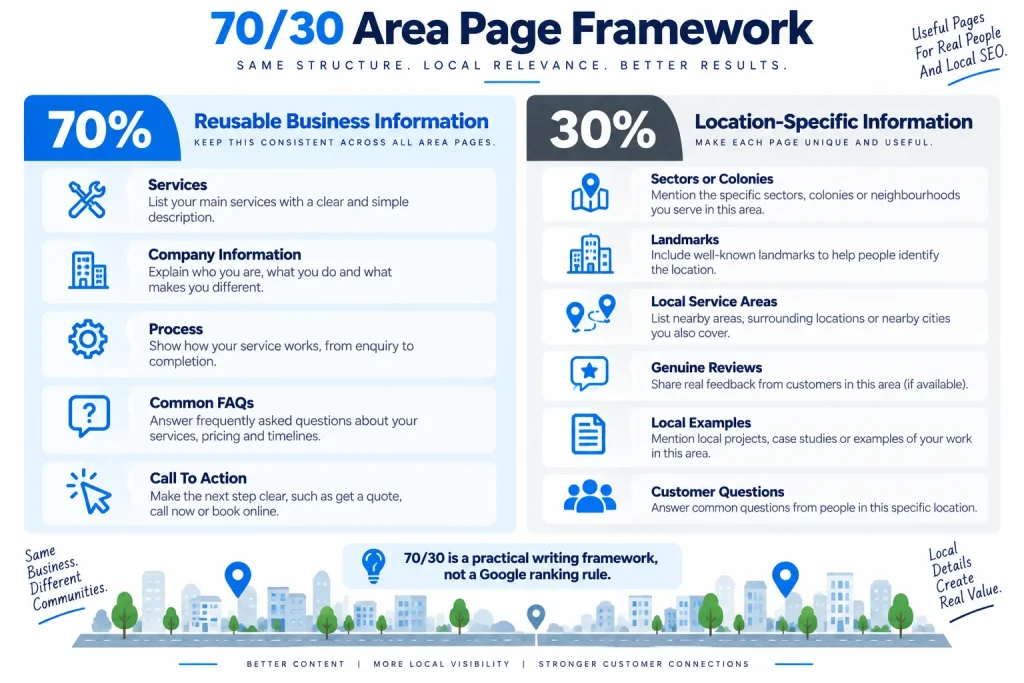
The 70/30 rule in this article is a working copywriting framework, not a Google rule.
The idea is simple.
Around 70% of the page structure can remain consistent.
For example:
- Company introduction
- Main services
- General process
- Common FAQs
- Main CTA
The remaining part should contain meaningful local information where available.
That could include:
- Specific sectors
- Colonies
- Nearby landmarks
- Service boundaries
- Local customer questions
- Real projects
- Local reviews
- Property types
- Local access information
- Genuine local examples
The exact percentage does not matter.
What matters is whether the local part adds enough value to justify the page.
This is a safer geo-targeted copywriting framework than simply using software to replace location names automatically.
How E-Commerce And Real Estate Can Use Hyperlocal Pages
A hyperlocal content strategy for Indian cities is not limited to plumbers, electricians or other local services.
It can also be useful for businesses where location affects what people buy or enquire about.
Indian Real Estate
Real estate is naturally location-focused.
A broad page such as:
Apartments in Noida
may need supporting pages around genuinely important areas.
For example:
Apartments in Sector 137 Noida
A useful page could explain:
- Property types
- Typical buyer intent
- Nearby facilities
- Connectivity
- Project locations
- Who the area may suit
- What buyers should check
The copy should be based on actual properties and verified information rather than generic descriptions.
E-Commerce
E-commerce is slightly different because the website may serve a much larger area.
A local page could make sense when delivery, store pickup or product availability genuinely differs by location.
For example:
Furniture Delivery In Noida
could be useful if the business actually provides a local delivery service.
But creating hundreds of pages such as “Furniture Delivery in Sector 1”, “Furniture Delivery in Sector 2” and so on without meaningful differences would not automatically make the website better.
The location needs to affect the customer’s experience in some meaningful way.
Tier 2 And Tier 3 Cities Need A Different Approach
A Tier 2 and Tier 3 city hyperlocal marketing India strategy should not simply copy the approach used for Delhi or Mumbai.
Smaller cities can have their own local terms, markets and reference points.
People may identify an area through:
- A famous market
- A railway station
- A bus stand
- A major road
- A university
- A hospital
- A temple
- A local shopping area
- A well-known residential colony
A local business may therefore benefit from understanding these real references before creating content.
For example, instead of writing only:
We provide home appliance repair across Lucknow.
a more useful page might focus on a specific area if the business genuinely receives enough customers there and can add useful information about its service.
The important thing is not whether a city is Tier 1, Tier 2 or Tier 3.
The important question is whether the smaller location is meaningful to customers.
Landmark-Based Copy Should Sound Natural
There is a difference between useful local copy and keyword stuffing.
Natural
Our delivery service covers the residential areas around the main market and nearby apartment communities.
Unnatural
We provide delivery near the main market, delivery near the market road, delivery near the metro station and delivery in the nearby area.
The second version is clearly trying to include location phrases rather than help the reader.
Good landmark-based content optimization should feel like a person explaining the service to another person.
A landmark should answer a useful question such as:
Where are you?
Which area do you serve?
How can I recognise the location?
Is this service available near me?
It should not simply exist because the landmark has search volume.
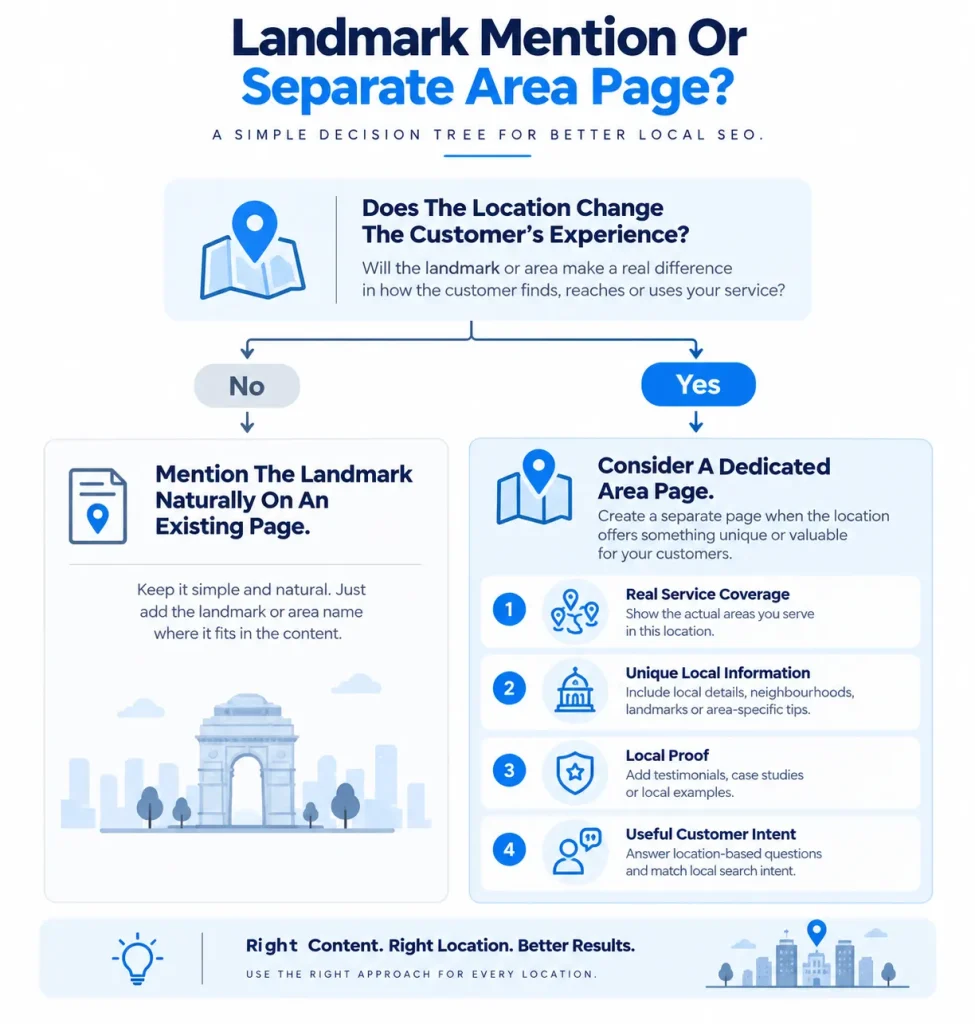
Do Not Turn Every Landmark Into A Page
This is another important point.
If a business serves one large area, it does not mean it needs separate pages for:
- Near the metro station
- Near the mall
- Near the market
- Near the flyover
- Near the hospital
A landmark can often be mentioned naturally within a useful area page.
Creating a separate page makes sense only when there is a genuine reason for that page to exist.
For example, a restaurant with separate delivery zones may have different local pages if the delivery information and customer experience genuinely differ.
A property business may also have useful pages for distinct neighbourhoods where it has real listings.
The page should follow the business reality.
The Final Check Before Publishing An Area Page
Before publishing any sector, colony or landmark page, ask these questions.
1. Does the business actually serve this area?
If the answer is no, do not create the page.
2. Would a customer find the page useful?
Read it without thinking about SEO. If it feels like a generic service page, it probably needs more useful local information.
3. Does the location change anything?
If the service, availability, customer type or information is completely identical, a separate page may not be necessary.
4. Are the local details accurate?
Check names, landmarks, service boundaries, addresses and other local facts before publishing.
5. Is the page different for a useful reason?
Do not aim for artificial uniqueness. Aim for meaningful usefulness.
6. Does the page have a clear next step?
The visitor should know whether to call, enquire, book, visit, request a quote or explore a relevant service.
This final check is one of the most useful parts of a hyperlocal content strategy for Indian cities, because it keeps content planning connected to the actual customer journey.
Build A Hyperlocal Content Strategy Around Real Customer Behaviour
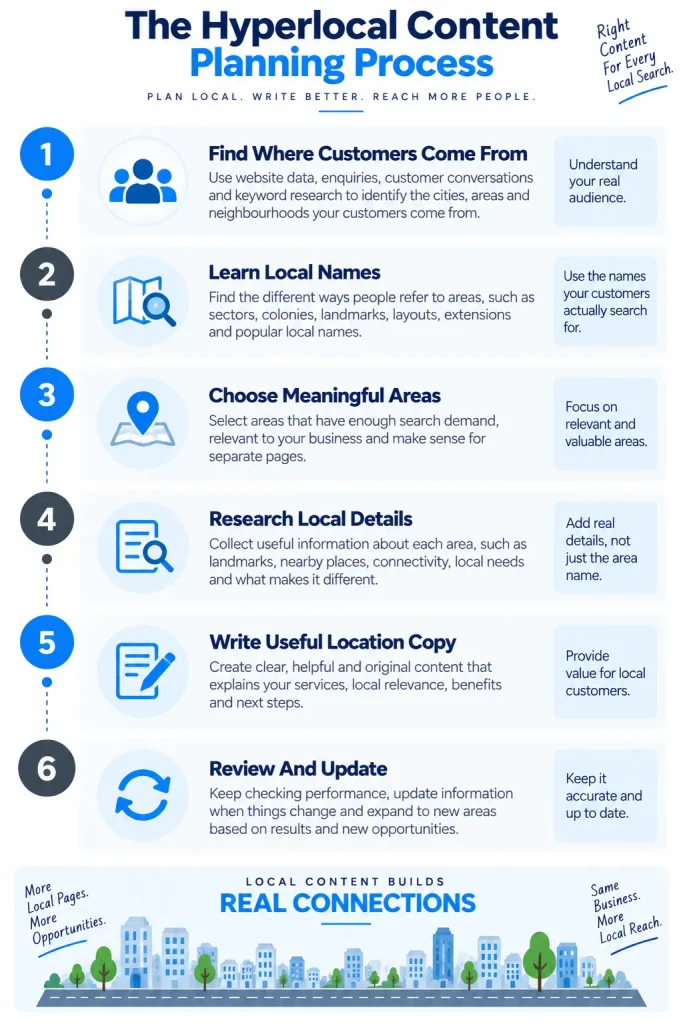
The biggest mistake with hyperlocal content is treating it as a simple list of place names. A spreadsheet might contain 100 sectors, 50 colonies and 200 landmarks, but that does not mean the website needs 350 separate pages. Creating a large number of location pages without understanding their purpose can make the website repetitive and give customers very little useful information.
The better approach is to start with the business and understand where its customers actually come from. We should then look at how those customers naturally describe their locations, whether through sectors, colonies, markets, landmarks or other local references. Once we understand this behaviour, we can identify the areas where a dedicated page could genuinely answer a customer’s questions or make it easier for them to choose the business.
From there, each page should be built around a meaningful location and filled with information that is actually useful to people in that area. The content could explain genuine service coverage, local customer needs, nearby reference points, relevant products or services, real examples and other details that connect the business with the location. This makes the page useful for the reader instead of making it another variation of the same city-level service page.
That is what makes a hyperlocal content strategy for Indian cities different from simply adding more city keywords. The goal is not to create as many location pages as possible or make Google see hundreds of different place names. The goal is to create useful pages that are clearly relevant to the people who live, work, shop or search in each location.
Our earlier article, “The Hub And Spoke Method For Service Area Pages” explains how individual area pages can be organised within a wider service-area website structure.
Final Thoughts
Indian cities are not simple points on a map. They are made up of sectors, colonies, layouts, markets, extensions, apartment communities, business districts and smaller areas that people use every day when they describe where they live, work or need a service. This makes local copywriting more interesting, but it also means that businesses need to be careful about how they create location-based content.
A business should not create a page for every location it can find simply because the location has a name or a potential keyword. A dedicated page makes more sense when the location has a real connection with the service, product or customer experience. The page should give visitors something useful that relates to that particular area rather than simply repeating the same business information with a different location name.
A good hyperlocal content strategy for Indian cities therefore starts with research rather than keyword insertion. We need to understand where customers actually come from, how they describe their area, which landmarks they recognise and what local information can help them make a decision. This approach allows us to choose locations based on real customer behaviour instead of creating pages simply to increase the number of local keywords on the website.
For sectors and colonies, this may mean explaining genuine service coverage and the types of customers the business serves there. For landmarks, it may mean helping visitors understand where a business is located or which nearby areas it covers. For real estate, it may mean explaining the local property context, while for e-commerce, it may mean showing where delivery or pickup is genuinely available. The exact information will depend on the business and the reason customers care about that location.
The strongest area pages do not feel like SEO pages filled with location keywords. They feel like useful local pages written by a business that understands the area it serves and knows what information its customers need. That is the standard worth aiming for when building location content for Indian businesses.