
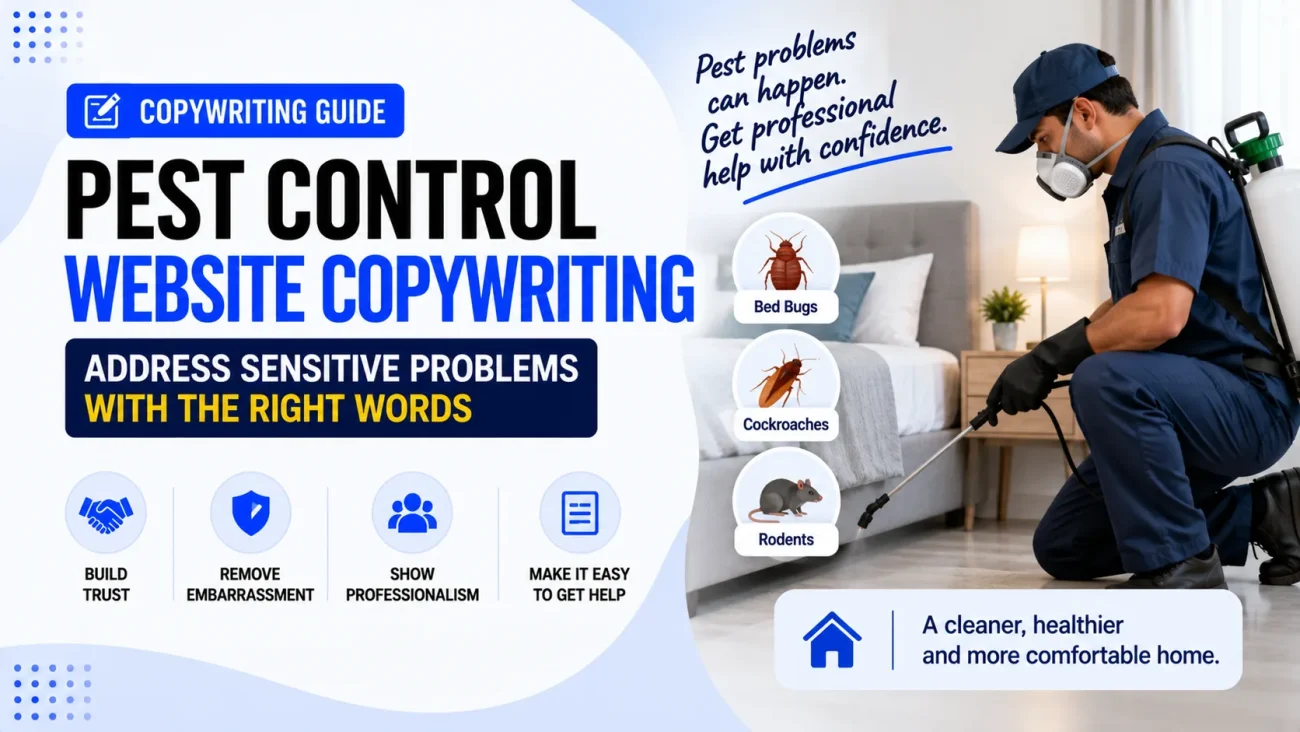
Writing a pest control website is different from writing for many other home services. Someone looking for a plumber may simply want a leaking tap fixed, and someone looking for an electrician may need a switch or wiring problem checked. But when someone searches for bed bug treatment, cockroach control or another pest problem, there can be another feeling behind the search: embarrassment.
The person may be worried that someone will think their home is dirty. They may not want their neighbours to know. They may feel uncomfortable telling a landlord, family member or even a friend. This is why pest control website copywriting needs to do more than explain a service. The words on the page should make the customer feel that asking for help is normal and that the business will treat the situation with respect.
This is especially important for sensitive pest problems such as bed bugs and cockroaches. The Centers for Disease Control and Prevention explains that bed bugs can be found in many different places and that cleanliness does not determine whether they are present. Bed bugs can also spread by travelling in luggage, clothing, bedding and furniture.
So the copywriter has an important job. We need to move the reader from “I hope nobody knows about this” to “I can quietly get help from someone who understands the problem.”
That change in feeling can make the service page much more useful.
Why Pest Control Copywriting Needs A Different Tone
Pest control is still a practical service, but the customer’s emotional state can be very different depending on the pest.
Someone searching for termite treatment may be worried about property damage. Someone looking for mosquito control may be thinking about comfort or prevention. Someone searching for bed bug treatment may be worried about sleeping, spreading the problem and what other people will think.
That means the same tone should not necessarily be used for every pest control page.
A general pest control page can be direct and practical. A bed bug page may need more reassurance. A cockroach page may need to focus on hygiene and control without making the customer feel dirty. A rodent page may need to focus more on safety, property protection and quick action.
Good pest control website copywriting starts by understanding the customer’s problem before trying to sell the service.
The Psychology Of The Embarrassed Buyer
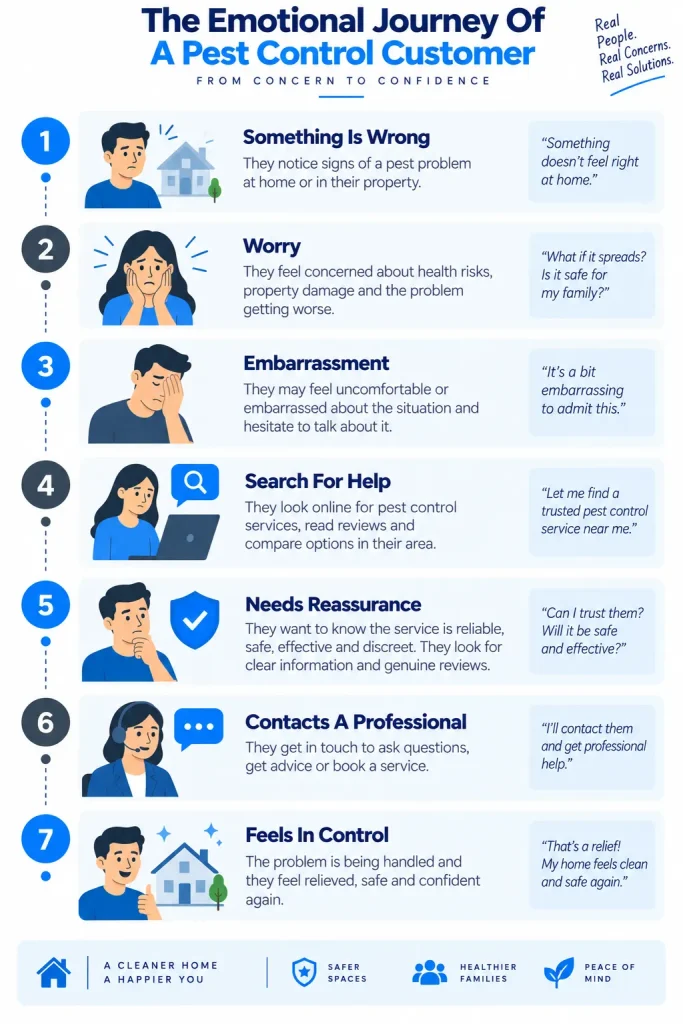
A customer with a pest problem may go through several thoughts before contacting a company.
First comes uncertainty:
“Is this really a bed bug?”
Then worry:
“Could there be more?”
Then embarrassment:
“What will people think if they find out?”
Then avoidance:
“Maybe I can deal with it myself.”
Finally, when the problem continues, the person starts looking seriously for professional help.
This is why the copy should not make the customer feel worse at the moment when they are finally ready to ask for help.
For bed bugs in particular, this matters because the problem is not a simple reflection of how clean a home is. The CDC says bed bugs can be found in many environments and that cleanliness does not determine whether they are present.
A good page therefore does not need to say:
“Is your dirty home full of bed bugs?”
It can say:
“Think you may have bed bugs? We can inspect the problem and explain the treatment options without judgement.”
The second version gives the customer somewhere to go.
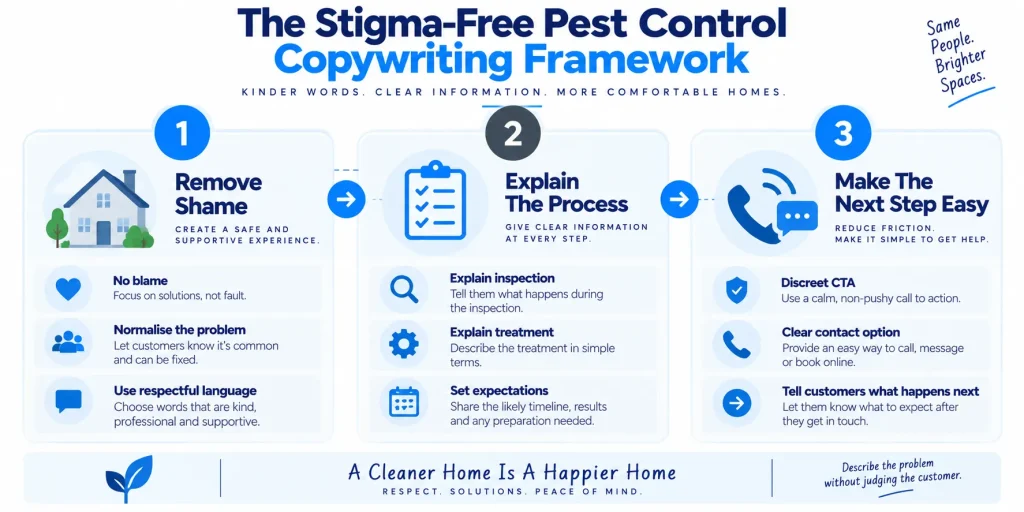
The Stigma-Free Language Framework
There are three simple ideas that can improve writing for sensitive niches such as pest control.
1. Remove Shame From The Problem
The first step is to stop connecting pests with personal failure.
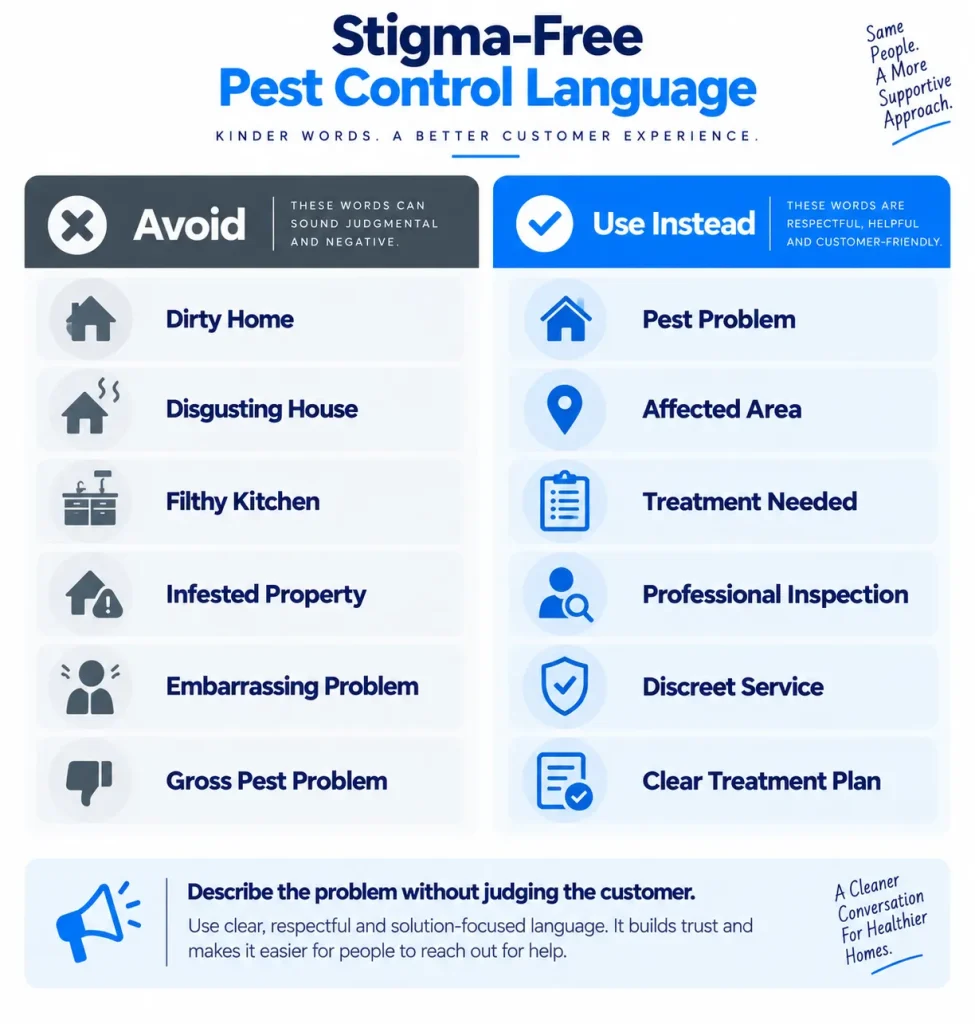
Avoid phrases such as:
“Even the cleanest homes can have pest problems.”
This is better than directly blaming the customer, but it can still sound defensive if repeated too often.
A more natural approach is:
“Pests can enter homes through many different routes, so finding them does not always tell us how they got there. Our team can inspect the affected area and explain the next step.”
This moves the discussion away from blame and towards the solution.
For bed bugs, this is especially important because they can enter homes through luggage, clothing, bedding, furniture and other items, and the CDC specifically notes that cleanliness does not determine whether a place has bed bugs.
2. Talk About Privacy When It Matters
Some customers are not only worried about the pest. They are worried about being seen getting treatment.
If a pest control company genuinely offers discreet service, the website should say so clearly.
Possible wording includes:
- Discreet appointments available
- Confidential booking
- Unmarked vehicles, if genuinely available
- Private treatment discussions
- Flexible appointment times, if genuinely offered
But this is an important copywriting rule: never promise a privacy feature that the company does not actually provide.
If the company uses branded vehicles for every visit, do not write “unmarked vehicles” because it sounds good. The copy must match the actual service.
The same applies to “confidential treatment”, “same-day service”, “guaranteed results” and similar claims.
3. Focus On The Next Step
When people are worried, they do not always need a long explanation of how terrible the infestation could become.
They need to know what they can do next.
Instead of:
“Bed bugs reproduce quickly and can spread throughout your home.”
we can write:
“If you think you have found bed bugs, contact us for an inspection. We can help identify the problem and explain the treatment process before work begins.”
The second version still gives direction without increasing fear.
That is one of the most useful principles in pest control copywriting: the copy should reduce uncertainty wherever possible.
How To Write A Sensitive Pest Control Headline
The headline is one of the most important parts of the page because the customer may be nervous even before reading the first paragraph.
A headline such as:
Bed Bug Infestation? Get Rid Of Them Fast!
may create urgency, but it can also make the situation feel more frightening.
A calmer headline could be:
Bed Bug Treatment With Clear, Discreet Support
or:
Professional Bed Bug Treatment Without The Judgement
The right headline depends on what the company genuinely offers.
For general pest control, a more direct headline may work:
Professional Pest Control For Homes And Businesses
The important point is that the headline should identify the problem and the solution without making the reader feel attacked.
Our earlier article, “How To Write A Headline For A Local Service Website” explains how the headline should quickly explain the service and give the reader a clear reason to continue.
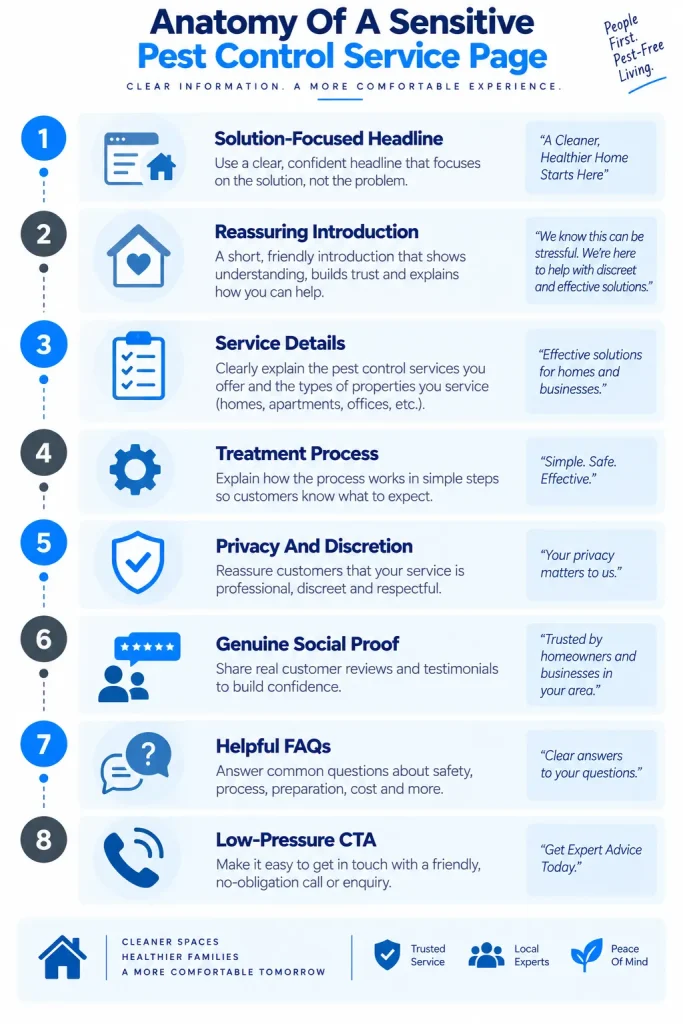
The Anatomy Of A Good Pest Control Service Page
A good pest control service page template should make the customer’s decision easier.
It does not need to be complicated. A simple structure can work very well.
1. Clear Headline
Tell the visitor what service is available and, where relevant, what makes the service suitable for their situation.
2. Reassuring Introduction
Acknowledge the problem without making the customer feel embarrassed.
3. What The Service Covers
Explain the pests or situations the company handles.
4. How The Process Works
Explain inspection, treatment, preparation and follow-up in simple language.
5. Why Choose The Company
Give real reasons such as experience, qualifications, service area, treatment approach or communication.
6. Social Proof
Use genuine reviews and case examples while respecting customer privacy.
7. FAQs
Answer questions customers may be too uncomfortable to ask directly.
8. Low-Pressure CTA
Tell the reader how to contact the company without making the page sound aggressive.
This structure works because it follows the customer’s questions instead of simply following a list of SEO keywords.
Explain The Treatment Process Clearly
Pest control customers often do not know what will happen after they make the call.
That uncertainty can stop them from contacting a company.
For example, a bed bug page could explain:
What Happens After You Contact Us?
First, we ask about the signs you have noticed and the affected area. Depending on the situation, we may arrange an inspection so the problem can be assessed properly.
If treatment is recommended, we explain what needs to be prepared before the visit and what the treatment involves. The exact process can vary depending on the property, pest and treatment method.
After treatment, we explain any follow-up steps that are needed and what the customer should watch for.
This type of information builds trust because the customer can see what happens next.
The EPA also recommends working with experienced pest management professionals for bed bug problems and notes that very few infestations are controlled with only one treatment, so copywriters should avoid promising that every problem will disappear after one visit unless the business can genuinely support that claim.
That is an important example of why good exterminator website content should be accurate as well as persuasive.
Bed Bug Marketing Strategy: Sell Privacy And Clarity, Not Fear
A good bed bug marketing strategy should recognise that the customer may already be worried.
There is no need to make the fear larger.
Instead, focus on three things:
Privacy: Tell customers how discreet the service really is.
Clarity: Explain what the inspection and treatment process involves.
Confidence: Show that the company understands bed bug treatment and can guide the customer through it.
For example:
Think You May Have Bed Bugs?
You do not need to feel embarrassed about asking for help. Bed bugs can affect many types of homes and can be brought in through luggage, clothing, furniture and other items. Our team can inspect the affected area, explain the treatment options and help you understand what needs to happen next.
This approach is supported by pest management industry guidance, which has specifically recommended removing the stigma from bed bug marketing and explaining that an infestation is not a measure of cleanliness or social status.
How To Sell Roach Control Services Without Shaming The Customer
Cockroaches create a slightly different writing problem.
People may immediately connect them with poor hygiene, which means aggressive copy can quickly sound insulting.
Avoid:
“Are disgusting cockroaches taking over your dirty kitchen?”
Instead:
“Seeing cockroaches in the kitchen or other parts of the home can be worrying. Our team can inspect the affected areas, identify possible entry points and recommend a suitable control plan.”
This still makes the problem clear.
It simply does not attack the person experiencing it.
If the company provides a recurring pest control plan, this is also the right place to explain how ongoing visits work and what customers can expect.
That is much more useful than repeatedly telling the reader how disgusting cockroaches are.
Before And After: Pest Control Website Copywriting
The easiest way to understand this approach is to compare weak copy with better copy.
Example 1: Bed Bugs
Before
Are Bed Bugs Taking Over Your Dirty Home?
Bed bugs are a serious problem and can quickly spread everywhere. If you do not act now, your whole house could become infested. Do not let these disgusting insects take over your home. Call us immediately for fast treatment.
After
Think You May Have Bed Bugs? We Can Help.
Finding bed bugs can be stressful, especially when you are not sure how they got there or what to do next. You do not need to feel embarrassed about asking for help, because bed bugs can affect many different types of homes and are not a simple measure of cleanliness. Our team can inspect the affected area, explain the treatment process and help you understand the next steps without judgement.
The second version still creates a reason to act, but it does not make the customer feel worse.
Example 2: Cockroach Control
Before
Get Rid Of These Disgusting Cockroaches Now!
If cockroaches are running around your dirty kitchen, you need professional treatment immediately. These pests can make your home look terrible and may continue multiplying if you ignore them.
After
Cockroach Control For Homes And Businesses
Cockroaches can appear in kitchens, bathrooms, storage areas and other parts of a property, and finding them does not always tell us exactly where they entered. Our team can inspect the affected areas, identify possible problem points and recommend a suitable treatment plan based on the property and level of activity.
Again, the second version is not soft or vague. It clearly sells the service while keeping the customer’s dignity intact.
Use Social Proof Without Exposing Customers
Reviews are important for pest control companies, but sensitive services create a special problem.
A customer may be happy with the service but may not want a public review saying:
“Thank you for removing bed bugs from our bedroom.”
That is understandable.
The business should never pressure customers to reveal sensitive details simply to make the review more useful for marketing.
Instead, a review can naturally say:
“Very professional service. The technician explained everything clearly and arrived on time.”
Or:
“The team was polite, explained the process and followed up after the treatment.”
These reviews still communicate important things about the business.
When replying to reviews, the company should also avoid repeating sensitive pest details unless the customer has already chosen to make them public.
This is another useful part of writing for sensitive niches: privacy should continue after the customer has converted.
Make The CTA Feel Safe
The final step is the call to action.
A CTA such as:
CALL NOW BEFORE IT GETS WORSE!
may be appropriate for some emergency services, but it can feel too aggressive for a customer who is already nervous.
Consider:
- Get A Discreet Quote
- Request An Inspection
- Speak With A Pest Control Professional
- Ask About Treatment
- Book An Inspection
- Send Us Your Pest Problem
If the company genuinely offers text or WhatsApp enquiries, those can also be useful for people who are uncomfortable making a phone call.
Our earlier article, “15 Call to Action Button Examples for Local Business Websites” explains how sensitive service pages can use clear but lower-pressure CTAs.
The CTA should not hide what happens next. If clicking the button opens a quote form, say so. If it starts a WhatsApp conversation, say that clearly.
A customer who understands the next step is more likely to take it.
FAQs Can Answer The Questions People Feel Awkward Asking
A good FAQ section can be especially useful for pest control.
For example:
Question: Can bed bugs happen in a clean home?
Answer: Yes. Cleanliness does not determine whether bed bugs are present. They can be introduced through luggage, clothing, bedding, furniture and other items.
Question: Do I need to leave my home during treatment?
Answer: This depends on the treatment method and the instructions provided by the pest control professional. The company should explain any preparation or safety requirements before treatment.
Question: Will one treatment solve the problem?
Answer: It depends on the pest, property and treatment method. For bed bugs in particular, the EPA notes that very few infestations are controlled with only one treatment, so the website should explain the company’s actual follow-up process rather than promise a guaranteed one-visit solution.
Question: Can you provide discreet service?
Answer: Only include this if the company genuinely provides discreet service. Explain what “discreet” means, such as unmarked vehicles or private scheduling, rather than using the word without explanation.
These questions are useful because they remove uncertainty without making the customer feel foolish for asking.
What Pest Control Pages Should Not Do
There are a few common mistakes that can make a pest control page weaker.
Do Not Use Fear For Every Sentence
The customer already knows there is a problem. Repeating words such as “danger”, “horror”, “disgusting” and “infestation” will not automatically make the page more persuasive.
Do Not Blame The Customer
Avoid connecting pests with laziness, dirtiness or poor housekeeping.
Do Not Make Treatment Promises You Cannot Prove
Avoid claims such as “100% pest-free forever” unless the company has a genuine, clearly defined guarantee that supports the claim.
Do Not Use Graphic Images Everywhere
A few relevant visuals can explain a service, but a page filled with close-up pest photographs may increase discomfort without helping the customer understand the service.
Do Not Hide The Important Information
Customers need to know what the company treats, where it operates, what the process involves and how to contact the business.
Good pest control website copywriting should make the decision easier, not make the problem feel more frightening.
A Simple Pest Control Copywriting Template
For future pest control projects, this basic template can be adapted to different services.
H1: [Pest] Control For [Homes / Businesses]
Introduction:
Acknowledge the problem and explain that professional help is available without judgement.
What We Can Help With
Explain the pest and the service in simple language.
How Our Treatment Works
Explain inspection, treatment, preparation and follow-up.
Why Customers Choose Us
Use real proof and service strengths.
Discreet Service
Include this section only when the company genuinely offers privacy-focused service.
What Customers Should Expect
Explain what happens before, during and after treatment.
FAQs
Answer the questions customers may be hesitant to ask.
Get Help
Use a clear, calm CTA.
This structure can be adapted for bed bugs, cockroaches, termites, rodents, ants and other pest services without making every page sound exactly the same.
Empathy Does Not Mean Weak Sales Copy
There is sometimes a misunderstanding that empathetic writing makes a service page less persuasive.
It does not.
Empathy simply means understanding the situation from the customer’s side.
A pest control company can still clearly communicate:
- What it treats
- Where it operates
- What experience it has
- How the process works
- What customers need to prepare
- What follow-up may involve
- How much information is needed to request a quote
The difference is in how the information is presented.
A professional pest control business does not need to scare people into becoming customers. It needs to show that it understands the problem and can help them deal with it properly.
This also fits Google’s broader people-first guidance. Search content should be created to help people rather than mainly to manipulate search rankings, and Google’s spam policies specifically warn against creating large amounts of low-value content simply to capture search queries.
That makes empathy useful not only for conversion but also for creating better, more useful service content.
Final Thoughts
Pest control is a practical service, but the person looking for it may be dealing with much more than a practical problem.
They may be worried about their home, their family, their sleep, their property or what other people will think. Bed bugs in particular can carry a strong stigma, even though they can affect many types of homes and cleanliness does not determine whether they are present.
That is why pest control website copywriting should not begin with the question, “How can we make this sound more urgent?”
A better question is:
“What does this person need to feel comfortable asking for help?”
Sometimes the answer is privacy. Sometimes it is a simple explanation of the treatment process. Sometimes it is reassurance that they are not being judged. Sometimes it is simply a contact option that feels easier than making a phone call.
The best copy combines all of these things with clear information about the actual service.
When writing for sensitive pest problems, we do not need to hide the problem or pretend that it is not unpleasant. We simply need to describe it without making the customer feel like the problem says something bad about them.
That is the difference between fear-based pest marketing and stigma-free marketing language. The customer already has a problem. Our copy should help them feel that getting professional help is a normal next step.