
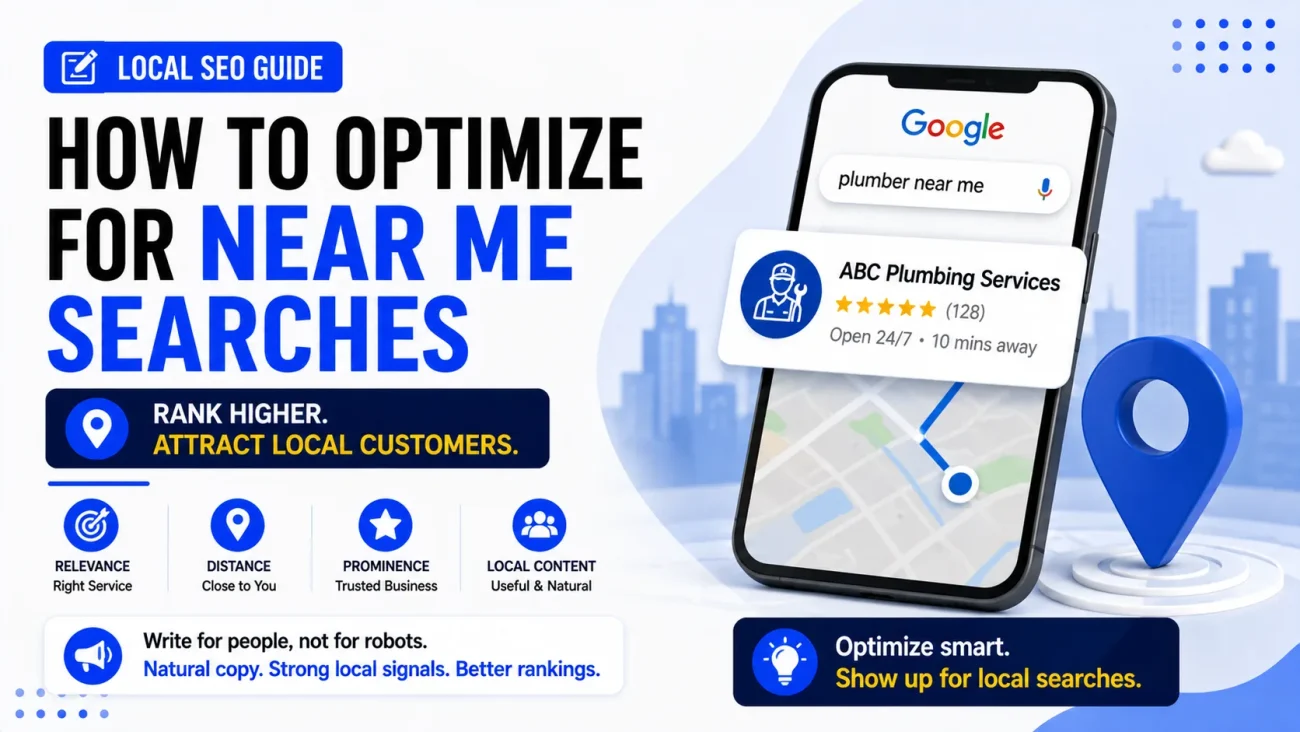
When someone searches for a business “near me,” they usually do not want to read a long article before making a decision. They may need a plumber, electrician, dentist, AC repair service, restaurant or another local business, and they are using Google to find an option that is relevant and close to where they are. This makes local search different from many other types of searches because location can be an important part of the decision.
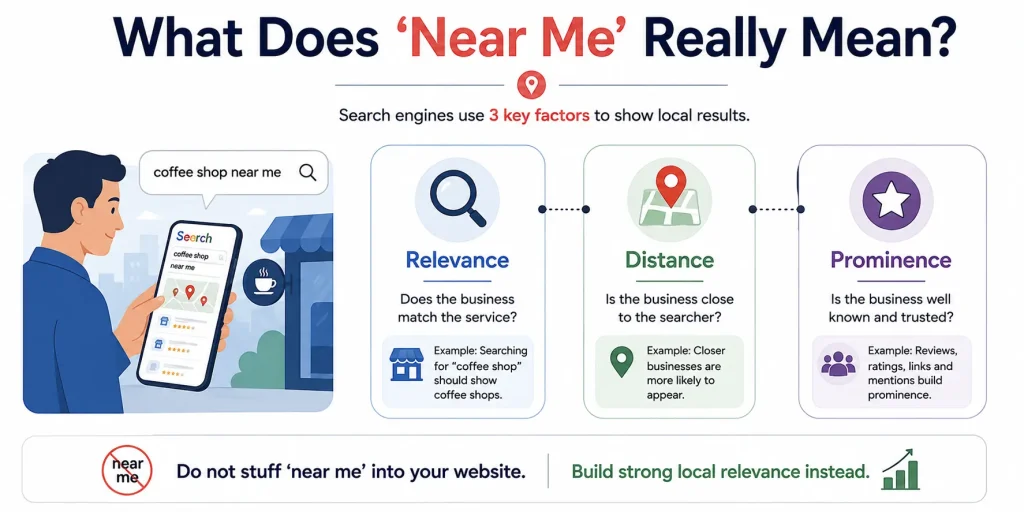
However, writing “near me” again and again across a website is not the answer. In fact, copy such as “best plumber near me,” “plumber near me service,” and “plumber near me in your area” can quickly make a page sound unnatural. Google explains that local results are mainly based on relevance, distance and prominence, so the better approach is to make the business and its local service information clear rather than trying to repeat the words “near me.”
This article explains how to optimize for near me searches through natural website copy, useful local information, service pages and location-focused content, while keeping the writing helpful for real people.
What Does a “Near Me” Search Actually Mean?
A “near me” search is usually a local-intent search where the person wants a product or service close to their current location. Someone may search for “emergency electrician near me” because they need an electrician nearby, while another person may search for “wedding planner near me” because they want to find a planner who works in their area.
The important part is that the words “near me” are only one way people express local intent. Google can use information about the searcher’s location when producing local results, and Google says that distance is one of the main factors used to determine local rankings.
This is why how to optimize for near me searches should not be treated as a simple keyword-placement exercise. The real goal is to make it easy for Google and the customer to understand three things: what the business offers, where it operates and whether it is a useful local option.
Do You Need to Put “Near Me” on Your Website?
This is one of the first questions businesses ask when learning how to optimize for near me searches, and the answer is that there is no need to force the exact phrase into every page.
Google’s own local ranking guidance says local results are mainly based on relevance, distance and prominence, with relevance referring to how well a Business Profile matches what someone is searching for. Google also recommends providing complete and accurate business information so that it can better understand the business.
That means a page for a plumber in Pune can naturally say, “We provide emergency plumbing services across Pune and nearby areas,” rather than repeatedly writing “plumber near me.” The first sentence gives both Google and the customer useful information without making the copy sound like it was written only for a search engine.
The phrase “near me” can sometimes appear naturally in an FAQ or customer-focused sentence, but it should not become the main writing strategy.
Start With Your Main Service and Location
The simplest way to improve local website copy is to clearly explain what the business does and where it serves customers.
For example, compare these two homepage headlines:
“Your Comfort Is Our Priority”
and:
“AC Repair and Service in Ahmedabad”
The second headline gives much more useful information to someone who has arrived on the website from a local search. It tells the visitor what the business does and where it works, while the rest of the page can explain the service in more detail.
This is one of the most useful local keyword optimization examples because the business does not need to use “near me” at all. It simply makes its service and location clear.
Our earlier article, How to Write a Headline for a Local Service Website explains how a local business can make its homepage headline clear about the service and location.
Mention Locations Naturally
When writing local copy, it is useful to mention the places the business genuinely serves, but the location names should appear where they help the reader.
For example:
“Our electricians provide residential electrical repairs across South Delhi, including Saket, Vasant Kunj and Greater Kailash.”
This sounds natural because the locations are part of a real service statement.
A weaker version would be:
“Electrician South Delhi, electrician Saket, electrician Vasant Kunj, electrician Greater Kailash, electrician near me.”
The second version looks like a list of keywords rather than useful website copy.
When thinking about how to optimize for near me searches, focus on writing location information that answers a real customer question instead of trying to include every possible local keyword.
Make Your Service Area Clear
A local customer should not have to guess whether the business serves their area.
This is particularly important for service businesses that travel to customers, because the business may not have a shop or office that people can visit. A plumber, electrician, cleaner, wedding planner or AC repair company may serve several towns or neighbourhoods from one main base.
The website can explain this in a simple service-area section:
“We provide AC repair and maintenance across Noida, including Sector 18, Sector 62, Sector 75 and nearby areas.”
The important part is that these locations should be genuine service areas. Creating pages for places where the business does not actually work can make the website less useful and may create problems with trust.
Create Useful Local Landing Pages
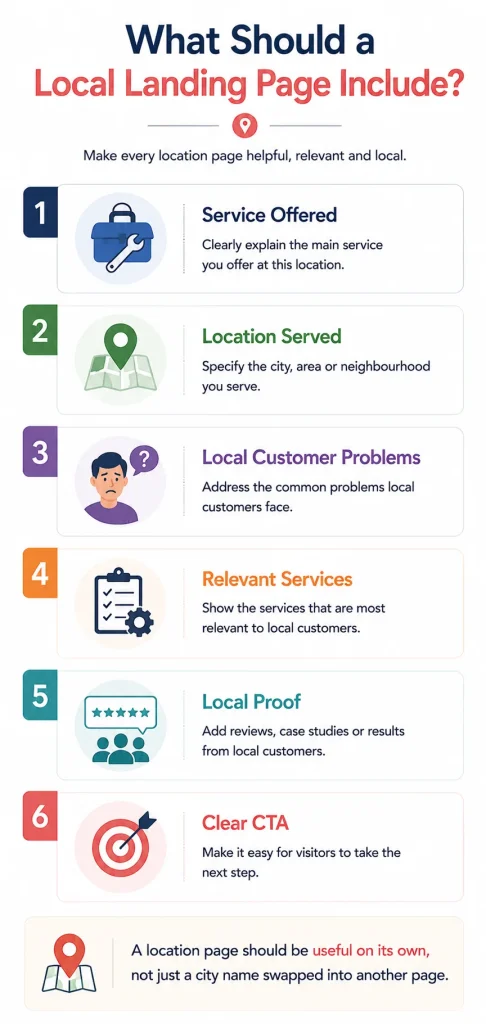
Location pages can be useful when there is enough real information to make each page different and helpful.
For example, an AC company serving Noida and Ghaziabad could have separate pages if it genuinely provides services in both areas. Each page should explain the relevant services, service area, common customer needs and other information that is actually useful for someone in that location.
A page that simply replaces “Noida” with “Ghaziabad” throughout the same paragraph is not a useful local landing page. The visitor should have a reason to be on that particular page.
This is an important part of writing copy for local landing pages, because the location should change the usefulness of the page, not just the keyword.
Do Not Create a Page for Every Nearby Area
More location pages do not automatically mean better local SEO.
If a business serves five real areas, five useful pages may be enough. Creating 50 pages for every small neighbourhood, road or nearby town can lead to pages with very little original information.
For example, a cleaning company serving one city might not need separate pages for every neighbourhood if there is nothing meaningful to say about each area. A stronger approach may be one well-written city page that clearly explains the service area.
This is where how to optimize for near me searches connects with good website planning. The goal is not to create as many pages as possible. The goal is to create pages that help people find and understand a real local service.
Our earlier article, How Many City Pages Do You Actually Need? explains how to decide whether a business needs multiple city or location pages.
Write About Local Customer Problems
One of the easiest ways to make local copy sound less robotic is to talk about the situations customers in that area actually face.
For example, an AC repair company can say:
“During the summer months, an AC problem can become difficult to manage, especially when the unit stops cooling properly during the hottest part of the day.”
This is more natural than:
“Best AC repair near me for all AC problems.”
The first example gives the reader a situation they can recognise, while the second mainly tries to include a search phrase.
This approach also makes hyperlocal content marketing more useful because the content is connected to the real needs of people in the area rather than simply repeating place names.
Use Local Details That Actually Help
Local content does not always have to be about keywords.
A service business can mention practical details such as the areas it covers, the types of properties it works with, local appointment information, parking or access information where relevant, or the types of customers it normally serves.
For example, a wedding planner serving Jaipur could explain whether it works with hotel weddings, large family celebrations, destination weddings and specific types of venues if those are genuine parts of the business.
A dentist could explain the types of appointments offered and the neighbourhoods or areas commonly served.
These details help the customer decide whether the business is relevant, which is more useful than adding “near me” to every heading.
Connect Service Pages With Location Pages
A strong local website usually needs both service information and location information.
For example, a plumber may have:
- Emergency Plumbing
- Drain Cleaning
- Water Heater Repair
and a separate location structure such as:
- Plumbing Services in Noida
- Plumbing Services in Ghaziabad
The website can connect these pages naturally. A location page can link to the relevant service pages, while a service page can explain the main areas served.
This gives visitors more ways to reach the information they need and creates a clearer website structure.
Our earlier article, The Hub and Spoke Method for Service Area Pages explains how service pages and location pages can be connected into a useful website structure.
Keep Your Google Business Profile Accurate
Website copy is only one part of local visibility.
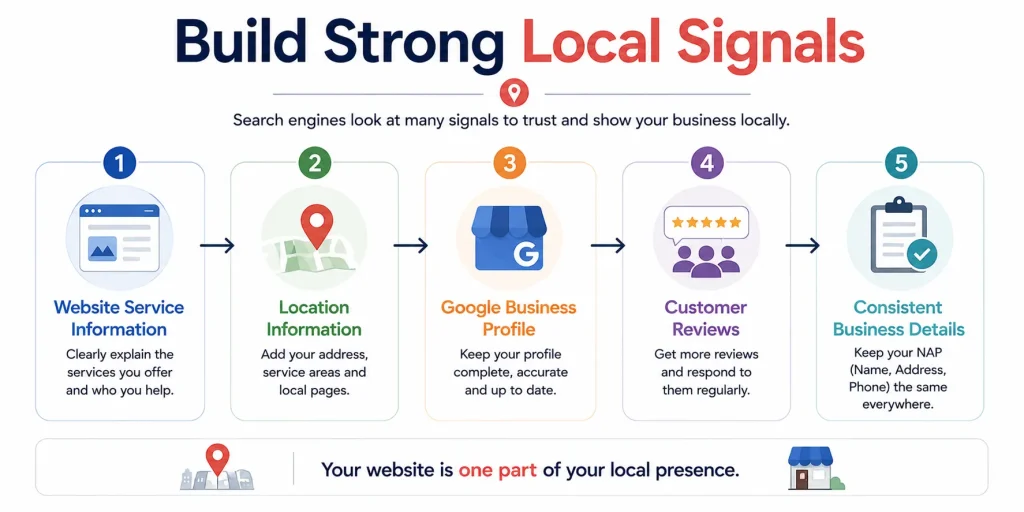
Google explains that businesses can improve their local presence by keeping their Business Profile information complete and accurate, including important details such as business information and hours. Google also explains that local results are based mainly on relevance, distance and prominence.
This means a website saying one thing while the Business Profile says something different can create an unnecessary problem.
For example, if the website says the business is open until 9 PM but the Business Profile says 6 PM, customers may not know which information to trust. The same applies to business names, services, addresses and service areas.
When considering how to optimize for near me searches, make sure the website is part of a consistent local presence rather than treating the website as a separate SEO project.
Use Reviews as Real Local Proof
Reviews can add useful local context when they are genuine and specific.
For example, a review saying:
“We needed an electrician for a wiring problem at our home in Noida, and the team explained the issue clearly before starting the work.”
tells a future customer more than:
“Excellent service. Highly recommended.”
If you have genuine customer reviews that mention the service and area naturally, they can help visitors understand the type of work the business does and the customers it serves.
Do not rewrite reviews to insert keywords. Keep genuine customer language wherever possible.
Google also notes that reviews and other information from across the web can contribute to the prominence side of local ranking.
Add Local Proof to Location Pages
A location page becomes stronger when it has something that connects the business to that area.
This could be a genuine customer review, a real project completed there, a relevant photograph, a description of the types of customers served or another useful local detail.
For example:
“We recently completed an electrical upgrade for a three-bedroom home in Sector 50, Noida, including lighting changes and additional power points.”
This is much more useful than:
“We are the best electrician in Sector 50.”
The first statement provides information that a potential customer can understand. The second is only a claim.
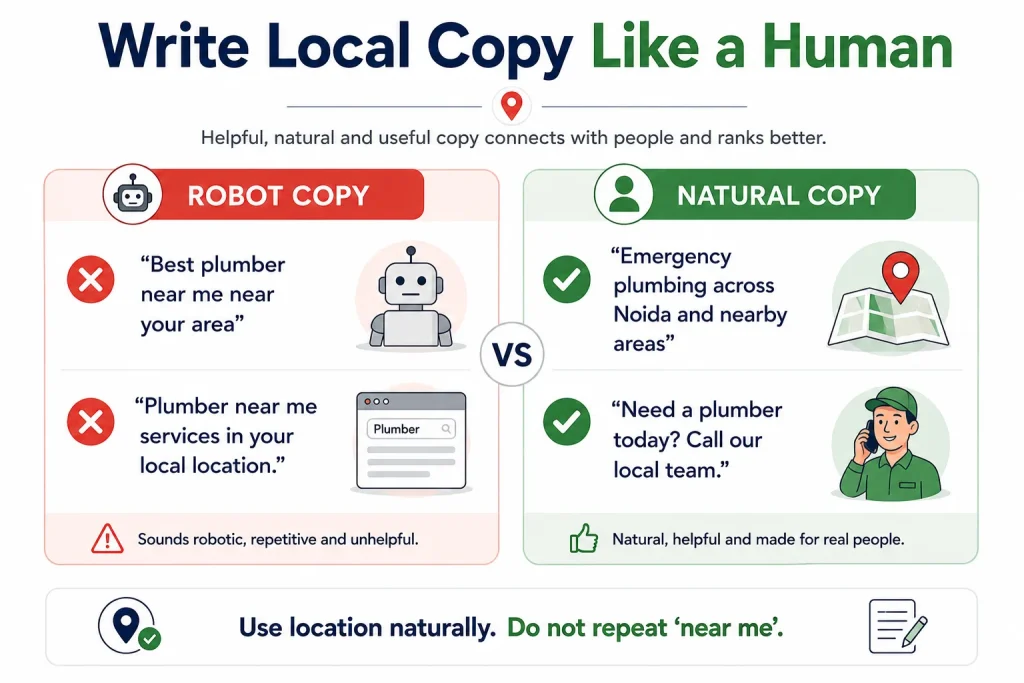
Make “Near Me” Copy Sound Like Normal Language
If you want to know how to write content for near me searches, one of the best tests is to read the copy aloud.
Imagine saying the sentence to a customer.
Would you actually say:
“If you are searching for the best plumber near me in your local area, our plumber near me services are available near you.”
Probably not.
A normal conversation would sound more like:
“Need a plumber in your area? We provide emergency plumbing, drain repairs and water heater services across Noida and nearby areas.”
The second version is clear, local and useful without sounding like a search engine is being addressed.
Use Natural Local Keywords
A useful local keyword strategy usually includes the service, location and customer intent in natural combinations.
For a plumber, examples might include:
- plumber in Noida
- emergency plumber Noida
- drain cleaning Noida
- plumbing services in Noida
For a wedding planner:
- wedding planner in Jaipur
- Jaipur wedding planner
- destination wedding planner Jaipur
These phrases are useful because they describe what the business does and where it operates.
The important thing is not to use every variation on every page. Choose the phrases that match the page and write around the topic naturally.
Do Not Turn Every Heading Into a Keyword
A website can quickly become uncomfortable to read if every heading contains a location and service keyword.
For example:
- Best Plumber Near Me
- Best Plumber Near Me Services
- Best Plumber Near Me in Noida
- Plumber Near Me Noida Services
These headings do not add much information. Instead, use headings that help the reader:
- Emergency Plumbing Services in Noida
- When Should You Call an Emergency Plumber?
- Areas Our Plumbing Team Serves
- What Happens When You Call Us?
This is a better example of proximity search engine optimization because the copy supports local relevance without sacrificing readability.
Use FAQs to Answer Real Local Questions
FAQs can be useful on local service pages when they answer questions customers actually have.
For example:
Do you provide emergency plumbing in Noida?
Yes, we provide emergency plumbing services across our listed Noida service areas, subject to availability.
Which areas do you serve?
We currently serve Noida and the nearby areas listed on our service-area page.
How quickly can someone visit?
Response times depend on the location, time of day and current availability, so we confirm the expected arrival time when you contact us.
The important thing is to give honest answers rather than creating FAQs only because they contain keywords.
Make the Contact Information Easy to Find
If someone is searching for a local business, contact information should not be hidden at the bottom of several pages.
The website should make it easy to find the phone number, enquiry form, booking option or other appropriate contact method.
Google’s own guidance also highlights the importance of useful business information such as location and hours in helping customers find and understand local businesses.
This is especially important for businesses where the customer may need help quickly, such as electricians, plumbers, locksmiths or AC repair companies.
Do “Near Me” Searches Always Bring the Closest Business?
Not necessarily.
Google explains that local results are mainly based on relevance, distance and prominence, and these factors work together. A business that is slightly farther away can still appear when Google considers it a better match for what the person is looking for.
This is another reason why how to optimize for near me searches should not be reduced to distance alone.
A business cannot rewrite its website to physically move closer to every searcher. What it can do is clearly explain its services, keep local business information accurate, build trust and create useful website pages.
Avoid These Common “Near Me” Copy Mistakes
The first mistake is repeating “near me” throughout the page. The second is creating dozens of almost identical location pages where only the city name changes. The third is listing locations that the business does not genuinely serve.
Another problem is writing local copy that says very little about the actual service. A page can mention a city ten times and still fail to answer the customer’s basic questions about pricing, service scope, process, availability or contact.
Finally, do not make claims about being the “best,” “number one” or “most trusted” local business unless there is a real basis for the claim. Clear information is usually more useful than empty praise.
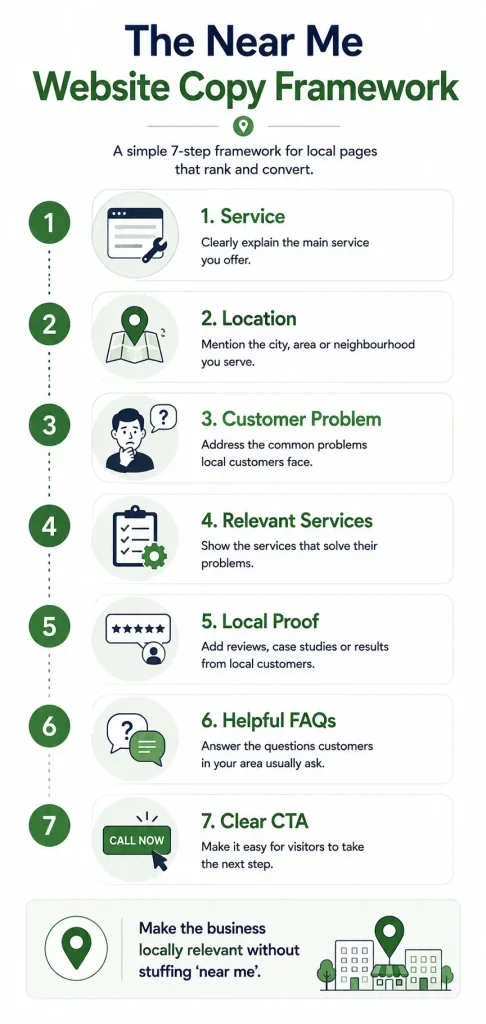
A Simple Framework for Near Me Website Copy
If you are planning a new local page, you can use a simple structure instead of trying to work “near me” into every paragraph.
Start by explaining what the business does and where it serves customers. Then explain the main customer problem, the relevant services, how the process works and why customers can trust the business.
After that, add genuine local proof, useful FAQs and a clear next step.
A Practical Example
Imagine a business called ABC Electrical that serves Noida.
A weak homepage might say:
“ABC Electrical is the best electrician near me providing electrician near me services for all customers near me in Noida.”
There is a location in the sentence, but the copy sounds unnatural and tells the customer very little.
A better version could say:
“Residential Electrical Services Across Noida”
“From faulty switches and lighting problems to new electrical points and wiring work, our team helps homeowners with everyday electrical needs across Noida and nearby areas. Contact us to explain the problem and check availability.”
This version gives the customer useful information without trying to manipulate the search phrase.
That is the central lesson behind how to optimize for near me searches: make the business easier to understand locally instead of making the copy look more “SEO.”
How to Review Your Existing Local Pages
If your website already has location pages, do not immediately create more. First review the pages you have.
Ask whether each page has a clear service, genuine location information, useful customer-focused content, relevant internal links, proof and a clear next step. Then check whether the information is accurate and whether the page offers something useful that another location page does not.
If two pages are almost identical except for the city name, they probably need more work before you create another ten pages.
A good local website should gradually become a useful collection of service and location information rather than a large group of pages created only to target different keyword variations.
Final Website Copy Checklist for Near Me Searches
Before publishing a local page, review it once from the customer’s point of view.
- Is the main service clear?
- Is the location clear?
- Does the business genuinely serve that area?
- Does the page explain a real customer problem?
- Are relevant services explained?
- Is there genuine local proof?
- Are contact details easy to find?
- Are internal links useful?
- Is the location keyword used naturally?
- Does the page avoid repeated “near me” phrases?
If the answer is yes, the page is in a much better position to support local search visibility while still being useful to real people.
Conclusion
Learning how to optimize for near me searches does not mean filling a website with the words “near me.” A strong local website gives Google and customers something much more useful: clear information about the business, its services, the places it genuinely serves and the reasons a customer can trust it.
Google’s own guidance makes it clear that local results depend mainly on relevance, distance and prominence. Distance is not something a business can change through copywriting, so the website should focus on the parts it can control, such as clear service information, accurate local details and useful content.
The best local copy therefore sounds like normal business writing. It can mention cities, neighbourhoods and service areas, but those details should appear because they help the customer understand the service, not because we are trying to repeat a keyword.
If someone searches for an electrician near them, they want to know whether the electrician can help, whether they serve their area, what kind of work they handle and how to contact them. If the website answers those questions clearly, it is doing something much more valuable than simply repeating “near me.”
That is the approach to remember: write for the local customer first, make the location clear, support the business with accurate local information and let the search engine understand the context naturally.