
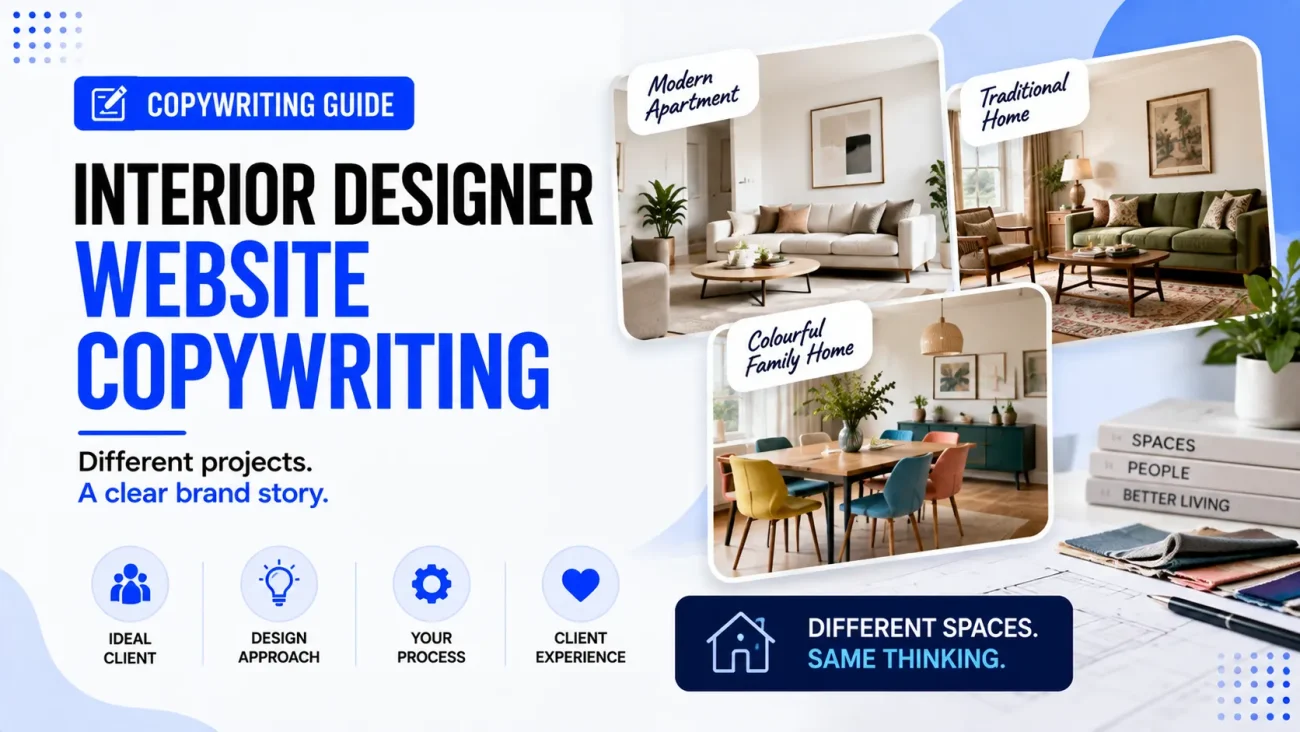
An interior designer can have a portfolio where no two projects look exactly the same. One home may be warm and traditional, another may be modern and minimal, while a third project may mix old architectural details with new furniture and materials. This is a strength of interior design, but it can create a problem when writing website copy because the designer may wonder what the website should actually say when every project is different.
The answer is not to force every project into one visual style. Instead, the website needs to show what stays consistent behind the different projects. The type of client the designer works best with, the way they approach a project, the problems they solve, the experience they provide and the thinking behind their design decisions can become the common thread. This is where good Interior Design Website Copywriting becomes important because the words can connect a varied portfolio into one clear business story.
The Problem With Saying “Every Project Is Different”
Many interior designers are proud of creating custom spaces, and rightly so, because clients usually do not want a home that looks exactly like someone else’s home. But when this idea becomes the main message on the website, it can create a problem because “every project is different” does not tell a potential client much about the designer.
A visitor may still be wondering who the designer normally works with, what type of projects they accept, what the process looks like, what problems they can solve and what it feels like to work with them. The portfolio may look beautiful, but the visitor may not understand what makes the designer different from another studio with equally attractive photographs.
The website therefore needs to communicate something more specific than visual style. The images can show the variety of the work, while the copy should explain the thinking that connects the work.
This is the central idea behind Interior Design Website Copywriting: the projects can change, but the designer’s point of view does not have to change.
Find the Common Thread Behind the Projects
If an interior designer wants to write better website copy, the first step is to look at the last five or ten projects and ignore the photographs for a moment.
Instead, look at the clients, the problems, the decisions and the process. Ask what these projects have in common even when the finished rooms look different. Perhaps the clients are usually busy professionals who want a home that feels calm and organised. Perhaps they own older homes and want to preserve original details while improving how the space works. Maybe they want a designer who can manage the entire project because they do not have the time to coordinate contractors, furniture and finishes.
The visual style may change, but the client problem can remain similar.
For example, a designer may have completed a colourful family home, a quiet apartment and a traditional house renovation. At first, these projects seem unrelated, but perhaps every client wanted a home that felt personal rather than copied from a showroom. That idea can become part of the website’s positioning.
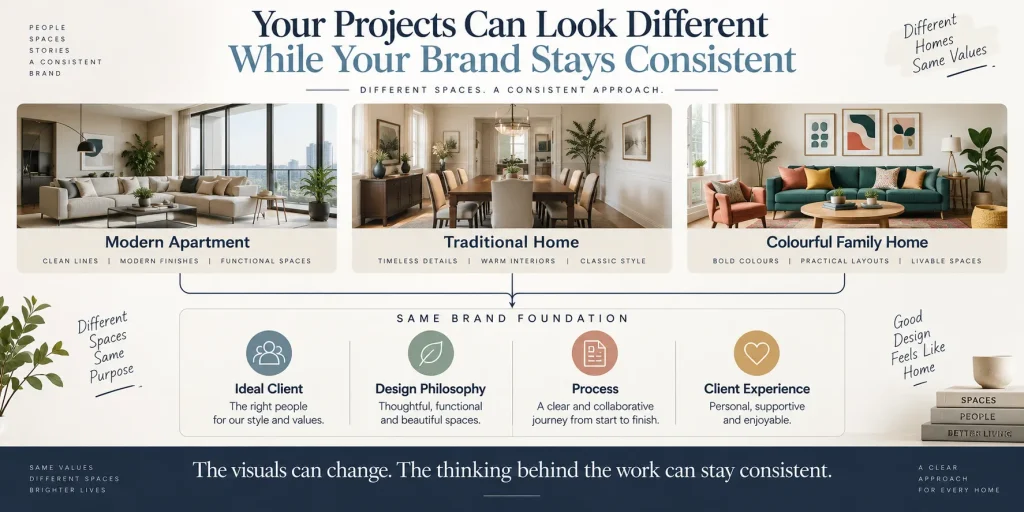
Start With the Ideal Client
One of the easiest ways to create a clear message is to look at who the designer wants to attract, rather than trying to describe every possible design style.
A designer may work on modern, traditional and transitional homes, but the ideal clients could all have something in common. They may be busy professionals who want help managing a renovation, families who need better use of their space, homeowners restoring older properties, or people who want a high-quality finished home without making every design decision themselves.
This does not mean refusing every other client. It simply gives the website a clearer person to speak to.
For example, instead of:
“We create beautiful interiors in many different styles for all types of clients.”
The website could say:
“We work with busy homeowners who want a considered home but do not want to manage every design decision, supplier and detail themselves.”
The second version gives the visitor a better idea of whether the designer may be a good fit.
This is one of the most important parts of Interior Design Website Copywriting, because a clear audience makes the rest of the website easier to write.
Define the Design Philosophy
After identifying the ideal client, the next question is: What does the designer believe about good design?
This does not have to be a complicated brand statement. It could be something as simple as “A beautiful home should also be easy to live in,” or “Good design should respect the original character of a home.”
A design philosophy gives different projects something in common even when the materials, colours and layouts change. One project may use bold colours while another uses soft neutrals, but both can still follow the same belief about how people should experience their homes.
The philosophy should also connect with the client’s needs rather than sounding like a sentence created only for branding purposes.
For example:
“We believe a well-designed home should look considered without feeling difficult to live in.”
This gives the visitor a small but useful idea about how the designer thinks.
Show the Process That Stays the Same
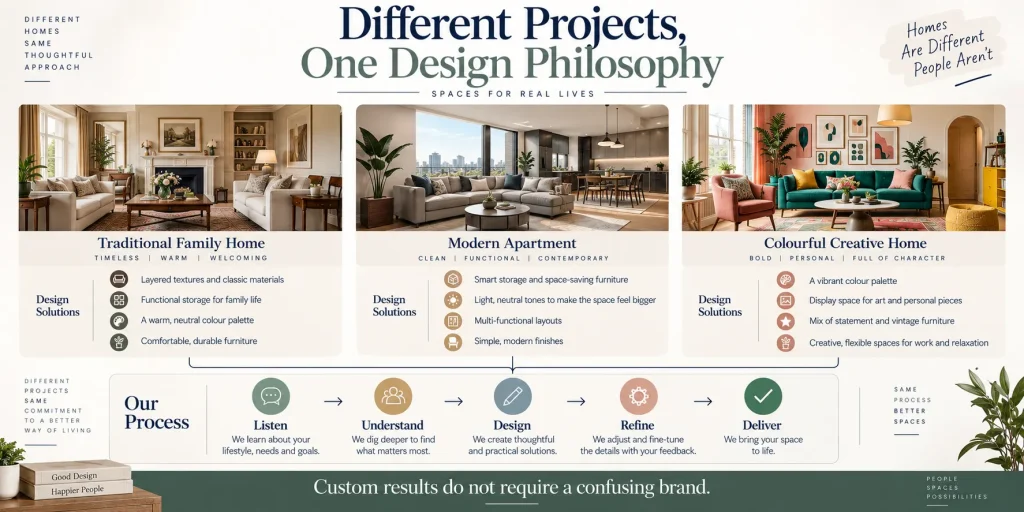
The creative result may be different for every client, but the process can still be clear and repeatable.
A potential client wants to know what happens after making an enquiry. They may wonder whether there is an initial consultation, how the designer understands their needs, when concepts are developed, how selections are made and how the project moves toward completion.
A simple process could look like:
1. Discover — Understand the home, lifestyle, goals and challenges.
2. Develop — Build the design direction, layout, materials and key decisions.
3. Refine — Review the details, selections and practical requirements.
4. Deliver — Coordinate the final stages and bring the design together.
The exact process will be different for each studio, but explaining a consistent process gives the client something predictable to hold on to, even when the creative result is completely custom.
Your Homepage Should Sell the Transformation
The homepage should not try to list every style the designer can create.
A headline such as “Modern, Traditional, Minimal, Eclectic and Everything In Between” may show variety, but it does not explain why someone should hire the studio.
A stronger homepage focuses on the change the designer creates for the client. For example:
“Thoughtful Interiors Designed Around the Way You Live.”
The supporting copy can then explain who the studio works with, what type of projects it handles and how the process works.
Interior-design website guidance commonly recommends a clear value proposition, strong project imagery, a brief service explanation and clear paths to the portfolio and contact page rather than overwhelming visitors with too much information.
This is where Interior Design Website Copywriting should work alongside the visuals instead of competing with them.
Our earlier article, “How to Write a Headline for a Local Service Website” explains how an interior designer can create a homepage headline that clearly communicates the client, service and benefit.
Your About Page Should Explain How You Think
An About page for an interior designer does not need to begin with a long childhood story about rearranging furniture.
Personal stories can be useful, but they should support the business message rather than become the whole message. The visitor is usually more interested in understanding the designer’s approach, experience, services and reason for working in this field.
Instead of saying:
“I have loved interiors since I was a child and always enjoyed moving furniture around my bedroom.”
The designer could write:
“My approach to interior design starts with understanding how a client actually lives. From the way a family uses the kitchen to the way a couple wants their evenings to feel, these details guide the layout, materials and final design.”
The second version tells the visitor something about how the designer works.
A strong About page can include the designer’s background and credentials, but the information should connect back to why the experience matters to the client.
Do Not Let the Portfolio Become Just a Photo Gallery
For an interior designer, the portfolio may be the most important part of the website, but simply uploading beautiful photographs does not show the full value of the work.
A gallery can show what the designer created, but it may not show what the designer had to solve.
This is why project pages can work better as short case studies. Current interior-design website guidance and examples commonly recommend project pages that provide context around the work, rather than presenting only a collection of images.
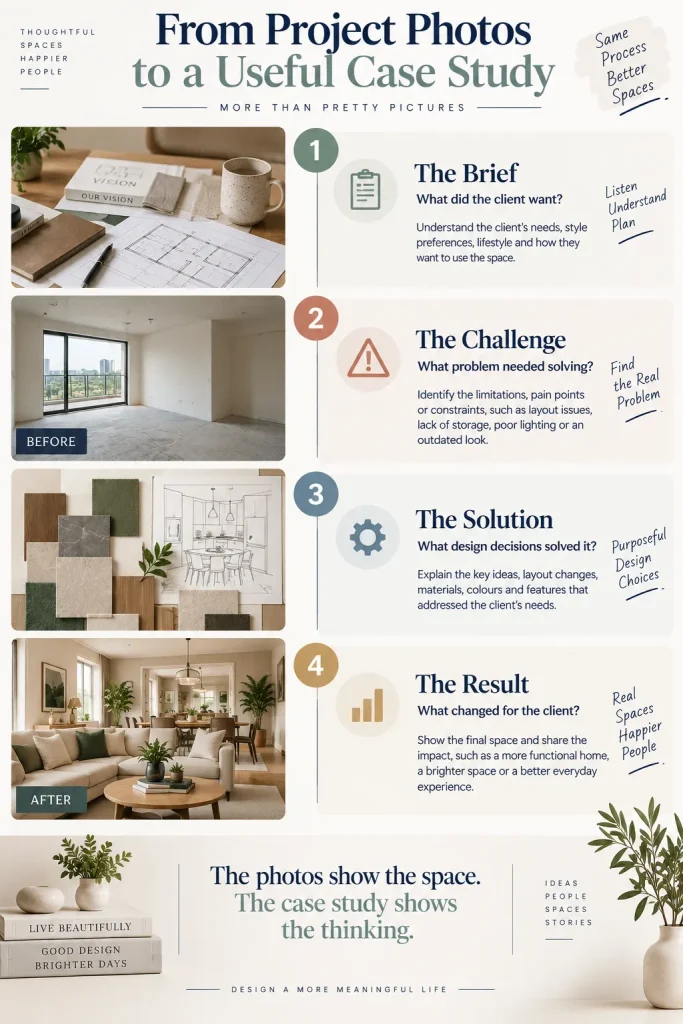
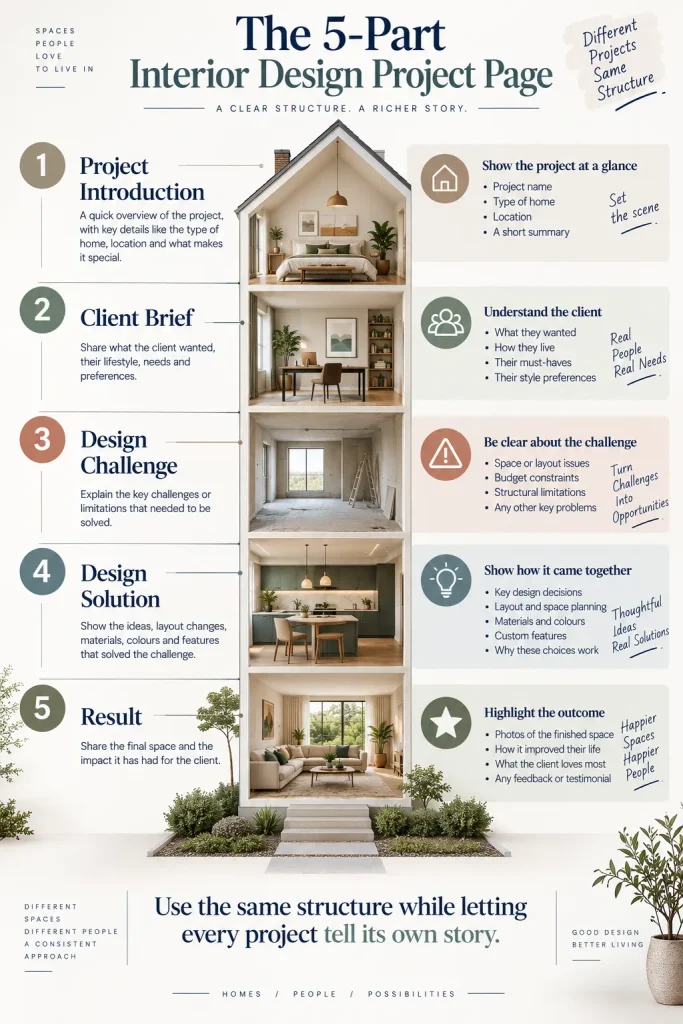
A good project story can explain:
- The Brief: What did the client want?
- The Challenge: What made the project difficult?
- The Approach: What decisions did the designer make?
- The Result: How did the finished space improve the client’s experience?
The photographs then provide the visual proof.
This makes how to write an interior design portfolio less about describing every cushion, material and colour, and more about explaining the thinking behind the finished space.
Start Every Project With the Client’s Brief
A project page should give the reader a reason to care about the project before showing a long collection of photographs.
For example:
The Brief: The clients had recently moved into a three-bedroom home and wanted to make the space feel calmer and more connected, while keeping enough storage for a growing family.
This immediately gives the visitor some context.
The reader can now look at the finished photographs and understand that the design is not only about appearance. It was created to solve a particular problem for particular people.
This is especially useful when every project looks different because the brief becomes part of the story that connects the work.
Explain the Challenge Behind the Design
The challenge is often where the designer’s skill becomes visible.
Maybe the room was too dark, the floor plan did not work for the family, the client wanted to preserve original features, the storage was limited, or the house needed to feel connected without making every room look the same.
Instead of writing:
“We used warm oak, natural stone and soft fabrics to create a timeless interior.”
The designer could write:
“The main challenge was creating enough storage for a busy family without making the ground floor feel crowded, so we introduced built-in storage that followed the existing architecture rather than adding separate furniture pieces.”
The second example explains the decision, which gives the reader a better understanding of the designer’s problem-solving ability.
Explain the Solution Without Overloading the Reader
Once the problem is clear, the solution can be explained in a few focused paragraphs.
There is no need to describe every design decision. The photographs already show many of the visual details, so the copy should explain the choices that are not immediately obvious.
For example, the copy can explain why a particular layout was selected, how storage was integrated, why certain materials were chosen or how the designer balanced the client’s practical needs with the desired feeling of the space.
This is an important rule for Writing About Custom Design Projects: the words should add information that the photograph cannot provide.
Write About the Result, Not Only the Room
The result should explain more than how the room looks.
A client is not buying a photograph. They are paying for a better experience in their home, a solution to a design problem or help managing a project that they may not have the time or knowledge to handle themselves.
For example:
“The finished kitchen now gives the family a clear place to cook, eat and spend time together, while the hidden storage keeps everyday items out of sight.”
This tells the reader what changed.
The designer can still mention the materials and visual choices, but the copy should connect those choices to the result.
Avoid the Aesthetic Trap
Interior designers naturally want to talk about beautiful materials, finishes, furniture and colours because these are important parts of the work. However, if every project description becomes a list of visual details, the website can start to sound like a catalogue.
Instead of:
“The room features linen curtains, oak flooring, a marble coffee table and a neutral boucle sofa.”
We could write:
“The material palette was kept warm and simple so the room would feel calm during busy family evenings, while natural textures added interest without making the space feel formal.”
The second version still communicates the design direction, but it also explains the reason behind it.
This is where Bespoke Interior Design Copy should focus on the experience and thinking behind custom work rather than simply naming the things that appear in the photographs.
Let the Images Do Their Job
Interior design is a visual business, so the website does not need to describe everything that the camera already shows.
If the photograph clearly shows a large stone island, the copy does not need three sentences explaining that there is a large stone island. Instead, the copy can explain why the island was important, how it changed the kitchen or how it solved a particular problem.
This creates a better relationship between words and images.
Current examples of interior-design portfolio sites also show the value of giving projects room to breathe visually while using written context to explain the work and the studio’s point of view.
The best Interior Design Website Copywriting therefore does not compete with the portfolio. It gives the portfolio more meaning.
Make Your Services Feel Clear Even When Projects Are Custom
Custom work does not mean the business has to present itself as completely unpredictable.
A designer can offer different services such as:
- Full-Service Interior Design
- Room Design
- Renovation Design
- Virtual Interior Design
- Design Consultation
The exact services will depend on the business, but each service should explain who it is for, what is included and what the client can expect.
This gives the website a stable structure even when the finished projects are different.
For example:
“Our full-service design option is for homeowners who want support from the early planning stage through selections, detailing and project completion.”
This tells the visitor what they are actually buying.
Explain What Working With You Feels Like
Interior design is not only about the finished room. It is also about the experience of working with the designer.
A client may be worried about making expensive mistakes, choosing between too many options, managing contractors or keeping a renovation moving. Good website copy can acknowledge these concerns without making dramatic promises.
For example:
“Our role is to bring structure to the decisions, explain the options clearly and keep the design moving from the first ideas through to the finished space.”
This type of Website Messaging For Interior Designers can make the business feel more approachable because it explains the role of the designer in the client’s life.
Build a Clear Interior Design Brand Voice
The brand voice should match both the designer and the clients they want to attract.
A luxury studio may use calm and refined language, while a family-focused designer may prefer a warmer and more conversational style. A young studio working with first-time homeowners may want to sound more relaxed and helpful.
The important thing is consistency.
If the homepage sounds formal, the About page sounds casual, and the project pages read like technical reports, the website can feel like several different businesses.
A simple brand voice can be built around three or four qualities, such as:
- Calm and considered
- Warm and approachable
- Clear and practical
- Confident but not overly formal
The exact words are less important than using the same feeling across the website.
Use Project Categories Without Limiting the Brand
If a designer has a varied portfolio, categories can help visitors find projects that are relevant to them.
For example, projects could be grouped by:
- Residential
- Renovation
- Whole Home
- Kitchen
- Commercial
The categories should match the actual work and should help visitors navigate the portfolio.
The goal is not to create a category for every style. A designer does not necessarily need separate sections for “Modern,” “Minimal,” “Traditional,” “Contemporary” and “Eclectic” if those styles overlap across the work.
A project-based structure can often make more sense because potential clients usually arrive with a project need rather than a desire to hire someone who only uses one visual style.
Use Testimonials to Support the Story
A good testimonial can add another layer to a project because it shows how the client experienced the process.
A statement such as:
“We finally feel like the house works for our family, and we no longer spend weekends trying to decide what needs to be changed.”
can be more useful than a generic:
“Amazing designer. Highly recommended.”
If the client gives permission, a testimonial can be placed alongside the relevant project so that the reader sees the design result and hears from the person who lived through the process.
This creates stronger Interior Design Website Copywriting because the website is no longer relying only on the designer’s own claims.
Connect the Portfolio to the Services
A project page should not become a dead end.
After reading about a completed renovation, a visitor should have an easy way to understand which service may be relevant to their own project.
For example, a project can end with:
“Planning a similar whole-home renovation? Explore our Full-Service Interior Design service to see how we support clients from early planning through completion.”
This creates a natural connection between the portfolio and the service page without turning every project into a sales pitch.
Our earlier article, “The 30-Point Website Copy Checklist“ explains how interior designers can review whether each portfolio page has a clear purpose, useful information and next step.
What If Your Projects Are Completely Different?
This is where the original problem becomes easier to solve.
Imagine an interior designer has three projects:
Project 1: A colourful apartment for a young couple.
Project 2: A traditional family home renovation.
Project 3: A quiet modern house for a retired couple.
The visual styles are clearly different, but the designer may have used the same process in all three. They may have started by understanding how the clients wanted to live, solved difficult space-planning problems, developed a practical design direction and managed the details carefully.
That is the story the website can tell.
The portfolio does not need to prove that the designer creates only one style. It needs to prove that the designer knows how to understand different clients and solve different design problems.
A Simple Portfolio Writing Template
Once the designer finds the common thread, writing future project pages becomes much easier because every project can follow a similar structure.
Start with a short project introduction that explains the type of property and the client’s main goal. Then explain the brief, the main challenge, the design response and the result.
For example:
Project Introduction
“A three-bedroom family home redesigned to create better flow between the kitchen, dining and living areas.”
The Brief
“The clients wanted a home that felt more connected and practical for everyday family life.”
The Challenge
“The existing layout separated the main living spaces and offered very little useful storage.”
The Solution
“We opened the main circulation route, introduced built-in storage and used a warm, simple material palette to connect the spaces.”
The Result
“The finished home feels more open and easier to use, while each room still has its own purpose.”
This structure can be reused without making every project sound identical because the actual story changes from project to project.
Create a Repeatable Client Journey
The project pages can be custom, but the client journey on the website should feel predictable.
A simple structure could be:
- Discover: The client learns about the studio and views relevant projects.
- Enquire: They contact the studio and share basic information about their project.
- Consult: The designer learns more about the home, goals, timeline and budget.
- Design: The studio develops the design and guides the client through the process.
This does not mean every project will follow exactly the same timeline. It simply helps a potential client understand what happens next.
That clarity can reduce uncertainty, especially for someone who has never hired an interior designer before.
Do Not Try to Describe Every Possible Client
Another common problem is trying to make the website appeal to everyone.
An interior designer may write:
“We work with homeowners, families, couples, property developers, businesses, restaurants, hotels and anyone looking for beautiful interiors.”
This sounds inclusive but does not create a strong picture of the ideal client.
It is usually better to explain the main type of client and project the studio wants to attract. If the business genuinely serves several groups, those can still be mentioned, but the website should have a clear centre rather than trying to speak equally to everyone.
This makes the Interior Design Brand Voice and overall message easier to recognise.
A Practical Audit for Existing Projects
If the website already has a portfolio, the designer does not need to rewrite every project immediately.
Choose five recent projects and create a simple table with these questions:
- Who was the client?
- What did they need?
- What was difficult about the project?
- What did the designer change?
- Why were those decisions made?
- What improved for the client?
After answering these questions, look for repeated ideas.
If several projects involve busy families, that is a useful pattern. If several involve difficult layouts, that is another pattern. If the designer repeatedly focuses on practical luxury, restoration or calm spaces, that may reveal the underlying philosophy.
This is the golden thread that can then guide the homepage, About page, service pages and future project stories.
Final Checklist for Interior Design Website Copy
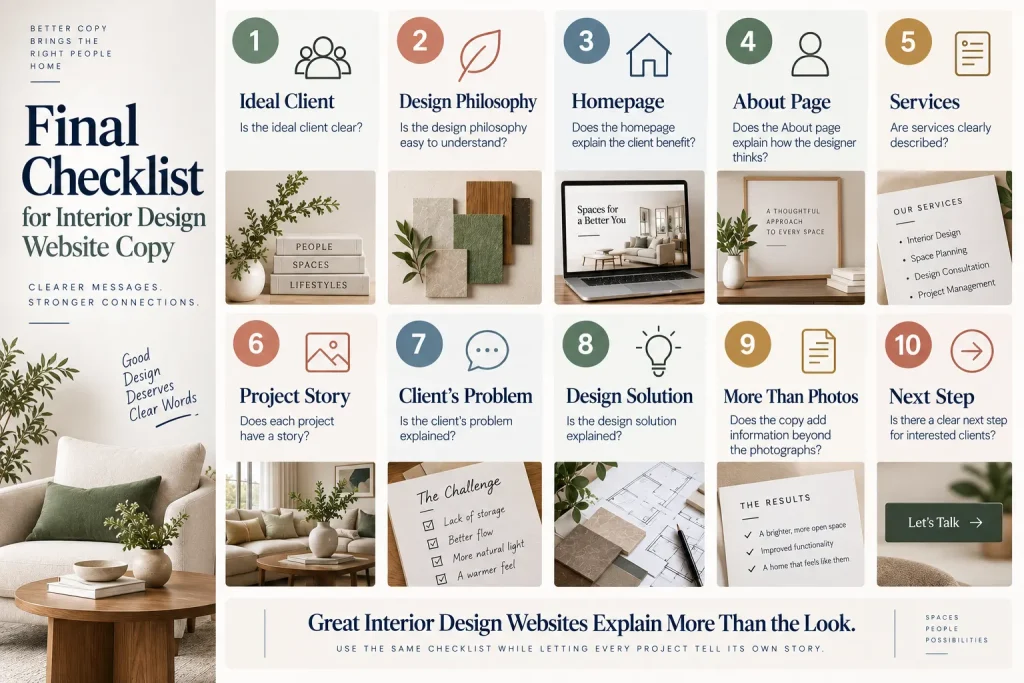
Before publishing or rewriting an interior design website, check whether the copy explains more than the visual style of the projects.
The homepage should make it clear who the designer works with, what they do and what makes their approach useful. The About page should explain the designer’s thinking and experience, while the services page should make the business model understandable.
Each portfolio project should explain the client’s need, the challenge, the design response and the result rather than relying only on photographs. The website should also make the next step clear so that someone who likes the work knows how to start a conversation.
A quick review can include:
- Is the ideal client clear?
- Is the design philosophy easy to understand?
- Does the homepage explain the client benefit?
- Does the About page explain how the designer thinks?
- Are services clearly described?
- Does each project have a story?
- Is the client’s problem explained?
- Is the design solution explained?
- Does the copy add information beyond the photographs?
- Is there a clear next step?
Conclusion
Interior designers do not need every project to look the same in order for their website to have a clear message. In fact, a varied portfolio can become a strong part of the brand when the website explains what connects the projects beneath the surface.
The common thread may be the type of client, the problems the designer enjoys solving, a particular design philosophy, a repeatable process or the experience the studio wants clients to have. Once that thread is clear, the website can show different visual styles without making the business feel unclear.
Good Interior Design Website Copywriting therefore does not try to describe every project using the same words. Instead, it creates a consistent structure around different stories. The homepage explains the overall value, the About page explains the thinking, the services page explains how clients can work with the studio, and the portfolio shows how that thinking has been applied to real projects.
The photographs will always be an important part of an interior design website because clients want to see the finished work. But the copy has another job: it should explain what the photograph cannot show.
It should tell the visitor what the client needed, what was difficult, why certain decisions were made and what changed when the project was finished. When the website can communicate those things clearly, a varied portfolio stops looking like a collection of unrelated rooms and starts looking like evidence of one designer’s way of thinking.