
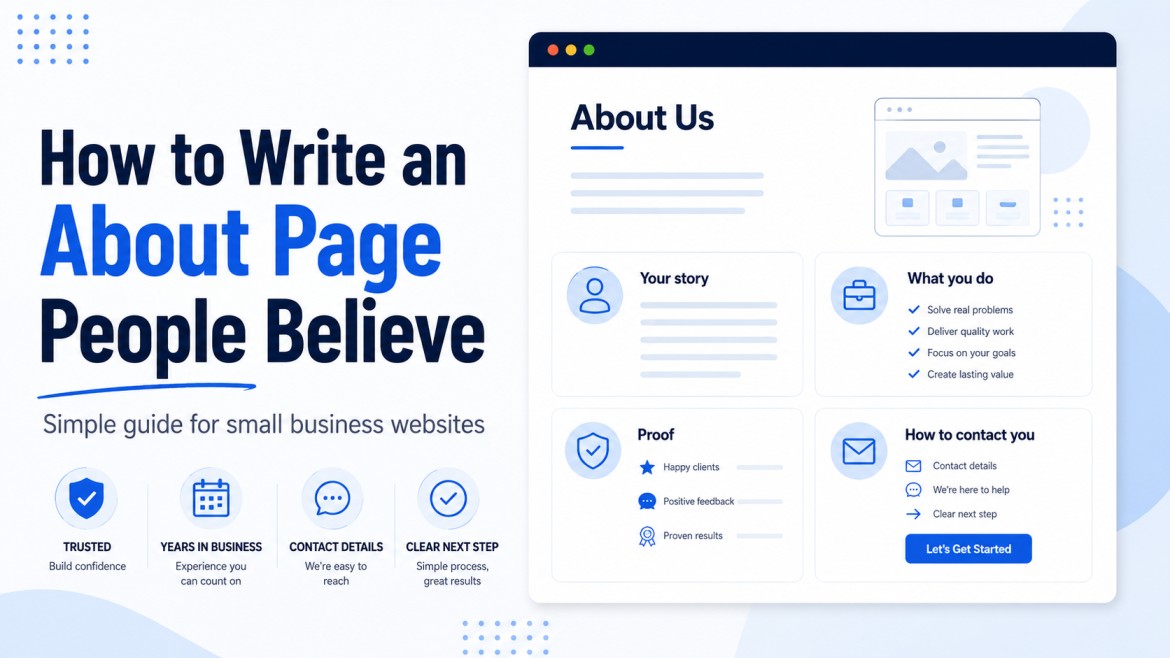
Most people who open your About page are not curious about you. They are checking whether you are real. They have already seen your prices, or your photos, or the review that made them stop scrolling, and now they want one last look at the human being behind it before they pick up the phone. That is why learning how to write an About Us page matters more than most small business owners expect, because this is often the last page somebody reads before they decide to call you or close the tab.
The problem is that almost every About page is written for the wrong reader. It is written as if a stranger has arrived wanting to hear the company’s story from the beginning, when in truth the visitor is standing in their kitchen with a leaking pipe, or sitting in their car outside your salon, giving you about forty seconds to prove you exist.
What people are actually looking for when they open your About page
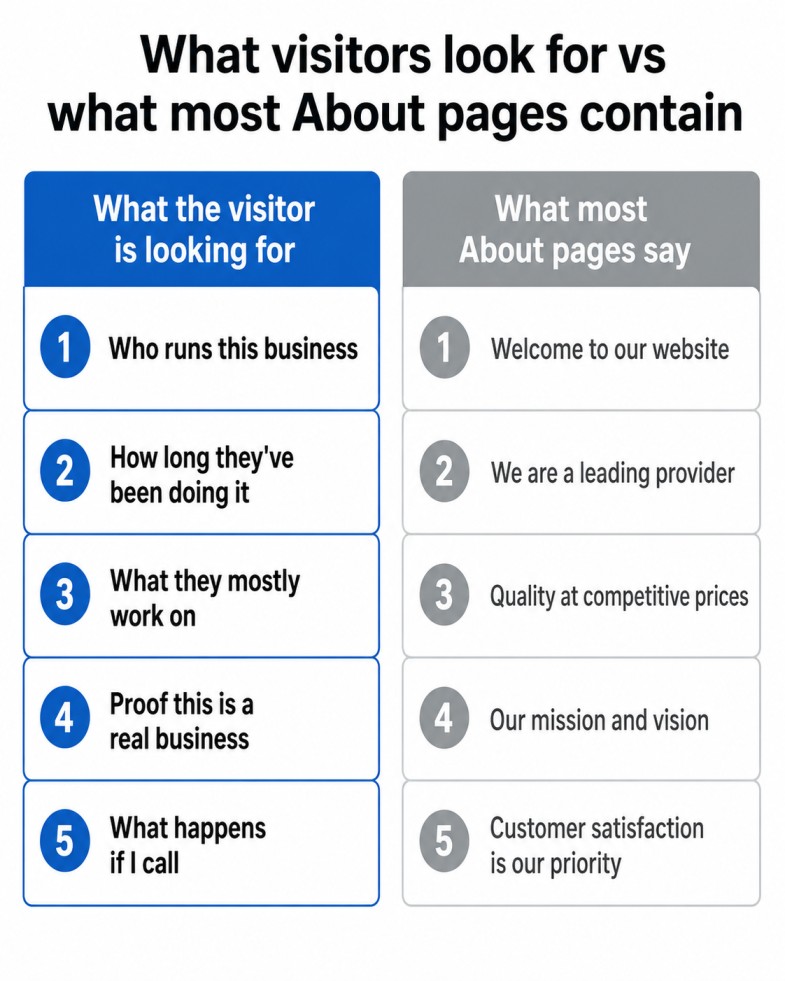
If you could watch somebody read your About page, you would notice that they are not reading it in order. They are scanning it for a handful of specific things, and once they find them, or fail to find them, they leave. Those things are usually the same across every trade and every country.
They want to know who is behind the business, whether that is one person or forty. They want some sign that the business has been around long enough to still be around next month. They want to know what you actually do most days, because a plumber who mostly does bathroom fittings is not the plumber they need for a blocked drain. And more than anything, they are looking for something that cannot be faked, because they have already read three other websites that morning and all three said exactly the same thing.
Why most About pages end up saying nothing
This is worth understanding, because once you see why it happens you stop doing it.
When somebody sits down to write about their own business, they usually feel that they should sound professional, and their idea of professional comes from the large company websites they have seen. So they write in the voice of a large company. They swap “I” for “we”, they swap “fixing” for “providing solutions”, and they add a mission statement because every big website seems to have one. The result reads like a company far larger than theirs, which is exactly the opposite of what their customer wants, because the customer chose a small local business on purpose.
The second reason is that most people write their About page last, usually at eleven at night, after the rest of the site is finished and they are tired of the whole project. So they write four paragraphs that sound roughly like the ones on the competitor’s site, tick it off the list, and never look at it again.
The About page almost everybody writes
Here is a version of the About page you will find on thousands of small business websites. It is a composite, built from patterns that appear again and again across real sites, not the wording of any one business.
About Us
Welcome to Sharma Electricals. Established in 2010, we are one of the leading electrical service providers in the city. Our mission is to deliver quality workmanship and 100% customer satisfaction at competitive prices.
With a team of highly skilled and experienced professionals, we strive to exceed our customers’ expectations in every project we undertake. We believe in building long-term relationships with our clients through honesty, integrity and dedication.
Customer satisfaction is our topmost priority. Contact us today for all your electrical needs.
Read it once and you will probably think it is fine. Read it a second time and try to answer these questions from it: who runs this business, how many people work there, what kind of jobs do they mostly do, and what will happen if you call them. You cannot answer a single one, and neither can the person deciding whether to call.
The real problem, though, is not that the paragraph is empty. It is that the competitor down the road has written the same paragraph, so the visitor is now choosing between two businesses that have told them nothing, and when people cannot tell two options apart, they usually go with whichever one is cheaper.
The same page, rewritten
Here is the rewrite. Nothing in it is invented to sound impressive, and every line in it is the kind of thing the owner would say out loud on the phone.
About us
I’m Rakesh Sharma. I have been doing electrical work in Ghaziabad since 2010, and for the first six years I did it on my own, with my tools in a box on the back of a motorbike. There are four of us now.
Most of our work is what you would expect. Tripping MCBs, wiring that was done badly by somebody else and has started causing problems, fans and lights, and full rewiring in the older houses around Kavi Nagar and Raj Nagar, where the wiring often has not been touched since the building went up.
We are a small team on purpose, and that cuts both ways. It means I know about every job that goes out, and if something goes wrong two weeks later you are talking to me and not to a call centre. It also means we cannot always come the same day, and when we cannot, we tell you that on the phone instead of promising a time we are going to miss.
A visit and inspection anywhere in Ghaziabad is ₹300, and that comes off the bill if you go ahead with the work. Anything larger gets a written quote before we start, and the figure on that quote is the figure on the bill.
My licence number is EL/2010/44821 and our GST number is 09AABCS1429P1Z8. If you would like to speak to somebody we have worked for before, ask me and I will give you two numbers.
To get us out, call 98xxxxxxxx or send a WhatsApp message with a photo of the problem, which honestly saves everybody a lot of time.
That version is not clever, and it does not try to be. It simply answers the questions the visitor already had.
Why the rewrite works
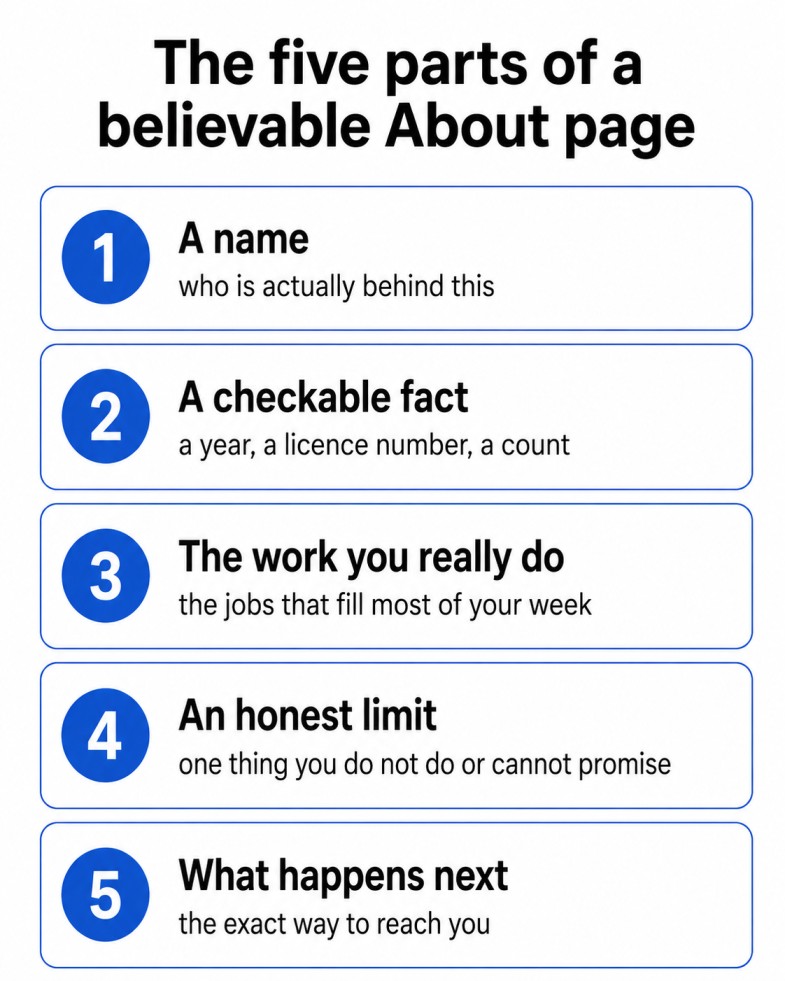
There are only three things happening here, and all three are easy to copy.
A name replaces “we”. The moment a real person appears, the page stops sounding like a brochure and starts sounding like a conversation, and the reader relaxes because they now know who they will be dealing with. This is the single change that does the most work, and it costs nothing.
Specific facts replace general claims. Anybody can write “years of experience”, but only the real business can write “since 2010, and for the first six years on my own, with my tools on the back of a motorbike”. The second version cannot be copied by a competitor without lying, and readers can feel that difference even when they could not explain it.
One honest limit makes everything else believable. This is the part most people are afraid of, and it is the part that works hardest. When the page admits that same-day service is not always possible, the reader’s guard comes down, because a business that is willing to tell you one inconvenient thing is probably telling the truth about the rest. A page full of nothing but promises has the opposite effect, and readers discount every line of it.
How to write the first sentence
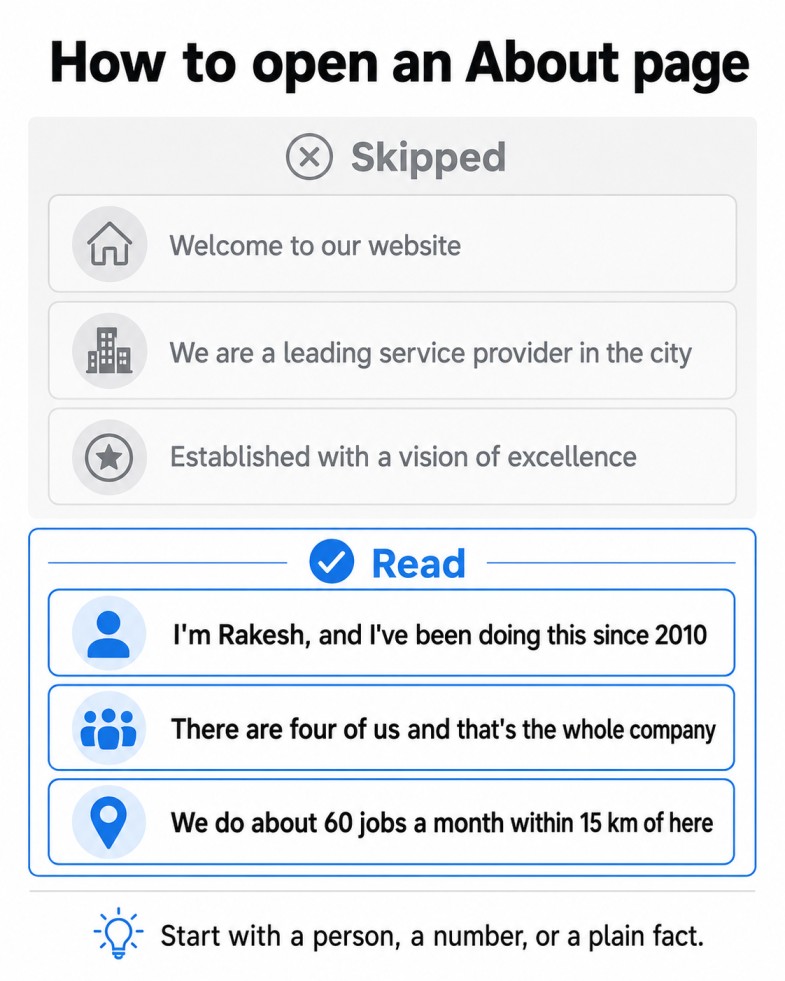
The opening line decides whether the rest gets read, and most opening lines are wasted on a greeting. “Welcome to our website” tells the reader nothing they did not already know, since they can see perfectly well where they are.
Start instead with a person, a number, or a plain statement of what you do. Here are opening lines you can copy and change to fit your own business:
- I’m [Name], and I have been [doing the work] in [city] since [year].
- There are [number] of us, and between us we have been doing this for [number] years.
- [Business name] is me and my [brother / wife / partner], and that is the whole company.
- We do about [number] [jobs] a month, almost all of them within [distance] of [area].
- I started this after [reason], and [number] years later we are still doing it.
- My father started this in [year] and I took it over in [year].
Every one of those is specific enough that a competitor cannot copy it, which is exactly the point.
The phrases to take out
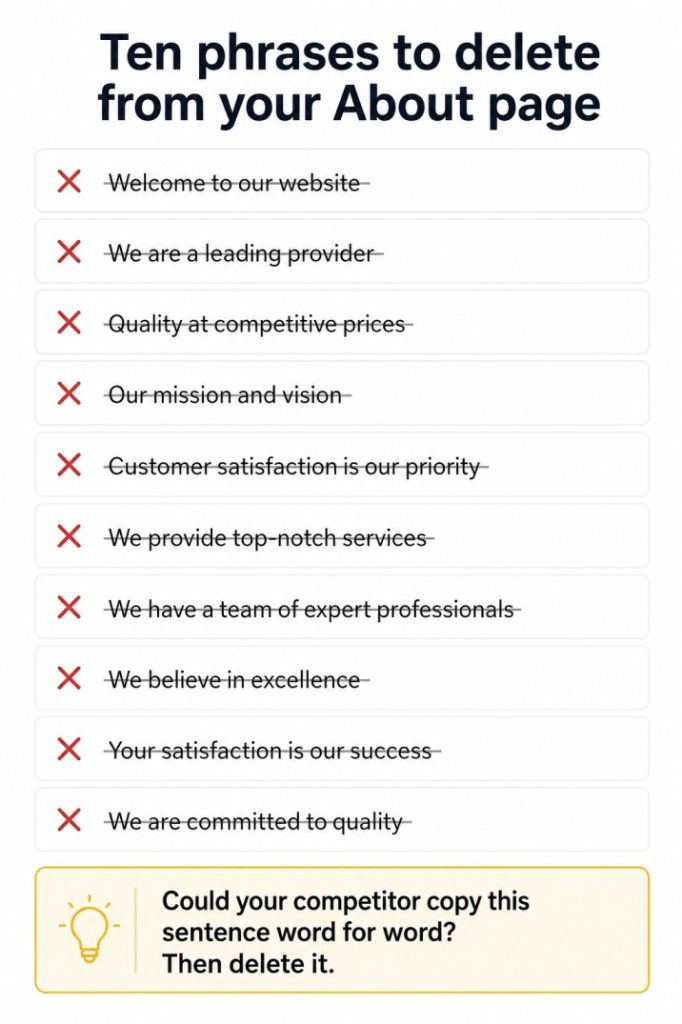
Some words have been used so often on small business websites that they now do the opposite of what they were meant to do. When a reader sees them, they do not think the business is professional, they think the page was written by somebody who had nothing to say, and they start skimming.
Search your draft for these and remove every one you find:
- Welcome to our website
- We are one of the leading / premier / trusted providers
- Quality workmanship at competitive prices
- 100% customer satisfaction
- We strive to exceed expectations
- Our mission is to deliver excellence
- A team of highly skilled professionals
- Your one-stop solution for all your needs
- With years of experience in the industry
- We believe in honesty, integrity and dedication
The test for each one is simple. If your nearest competitor could put the same sentence on their site without changing a word, then the sentence is not describing your business, and it can go. What you write in its place does not need to be impressive, it only needs to be true and specific.
Photos, and the proof that does the real work
A photograph of a real person doing real work will do more for your About page than another paragraph will, and this is true even when the photograph is not very good. A slightly blurred picture of you standing next to your van, taken on a phone, is more convincing than a stock image of a smiling model in a hard hat, because the reader has seen that stock image on four other websites this year.
Beyond the photo, add whatever proof you have that a competitor cannot invent on a Tuesday afternoon. A licence or registration number, a GST number if you are in India, the year the business was registered, the name of a supplier or brand you are authorised to work with, or a photograph of the team with the number of people written underneath. None of this needs a paragraph of explanation. It only needs to be visible, because the reader is not going to check it, they simply need to see that it is there and could be checked.
How long the page should be
Somewhere between three hundred and six hundred words is right for almost every local business, which usually works out at four or five short paragraphs. Below that you have not said enough to be believed, and above that you are writing a history that nobody asked for.
If you find yourself with more to say, the answer is usually that some of it belongs on a different page. Details about your process belong on the service page, details about the areas you cover belong on your location pages, and details about pricing belong wherever the reader is closest to buying.
Two more small things worth doing. Put a way to contact you at the bottom of the About page, because a reader who has just been convinced should not have to go looking for your phone number. And link from the About page to one or two of your main service pages, since somebody who has read this far is interested and will often click.
A template you can fill in today
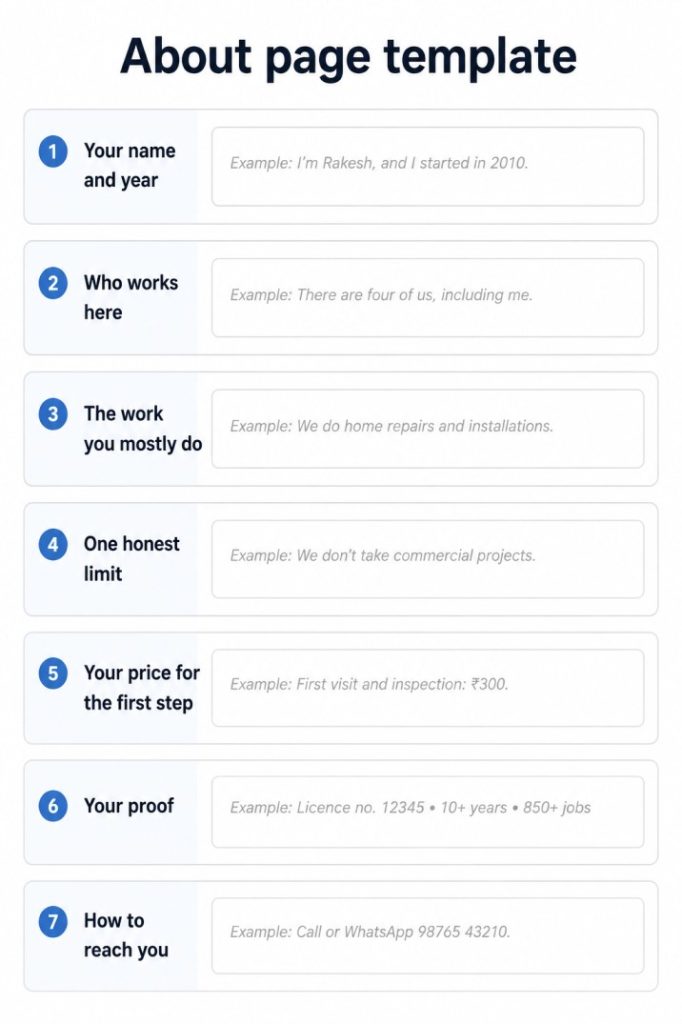
Copy this, replace everything in brackets, and delete anything that does not apply to you. It will not sound like anybody else’s, because the details you put into it are yours.
About [business name]
I’m [your name]. I have been [doing the work] in [city] since [year], and [one sentence about how it started or what it was like at the beginning].
[Say who works there now. “There are four of us.” “It’s me and my brother.” “I still do most of the jobs myself.”]
Most of our work is [the two or three jobs that fill most of your week], usually in [the specific areas you cover most often]. [Add one sentence about something you see a lot in those areas, if there is one.]
[State one honest limit. “We do not take on jobs under ₹500 because the travel costs more than the work.” “We are usually booked two days ahead, and we say so on the phone rather than promising today.”]
[State your price for the first step. “A visit and quote is ₹X.” “Quotes are free and take about twenty minutes.” Then say what happens to that figure: does it come off the bill, is it fixed, is it written down before work starts?]
[Add your proof. Licence number, GST number, registration year, the year you started, or an offer to give the numbers of past customers.]
To [start the job / book a visit / get a quote], call [number] or [WhatsApp / email / form].
Before you publish, check these
Read your finished page once and ask yourself these questions. If the answer to any of them is no, that part still needs work.
- Does a real person’s name appear in the first two sentences?
- Is there at least one number, date or registration detail that somebody could check?
- Have you said what you actually do most days, rather than everything you are capable of?
- Have you admitted one limit?
- Is there a single sentence in there that your competitor could copy word for word?
- Does the page end by telling the reader exactly what to do next?
- Would you be comfortable reading the whole page out loud to a customer on the phone?
That last question is the most useful one. If a sentence would sound strange said out loud to somebody standing in front of you, it will read strangely on the page, and it can either be rewritten in the words you would actually use or removed.
Frequently asked questions
Should I write my About page in first person or third person? First person, in almost every case. “I have been doing this since 2010” is easier to believe than “Mr Sharma has been serving customers since 2010”, because the second version sounds like it was written by somebody else about you, which raises the question of who. Third person only makes sense when the business is genuinely large enough that no single owner is the face of it.
What do I write if my business is new and I have no years of experience? Write about the experience you had before starting the business, because that is usually the real answer. “I worked for a firm in Noida for nine years before starting on my own last March” tells the reader everything they needed, and it is more convincing than a vague claim would have been. New businesses often try to hide their newness, and readers notice the gap where the year should be.
Do I have to put my photograph on the page? It helps a great deal, but it is not the only option. A photograph of your team, your van, your shop front or your work in progress will do a similar job, and if you would rather not have your face on the internet, your name and a checkable registration number will carry most of the weight on their own.
Does the About page help with Google rankings? Indirectly, yes. It rarely ranks for anything by itself, but it is one of the pages Google and its raters look at when judging whether a website belongs to a real business, and a page with a named person, a location and real contact details does that job far better than a page of generic claims.
What to do next
Open your own About page now, read the first sentence, and see whether it names a person or greets a visitor. If it greets a visitor, that one line is the fastest improvement available to you today, and the template above will take you the rest of the way in about twenty minutes.
Once that page is done, the next thing worth fixing is the wording on your buttons, because an About page that convinces somebody is wasted if the button underneath it says “Submit”.